
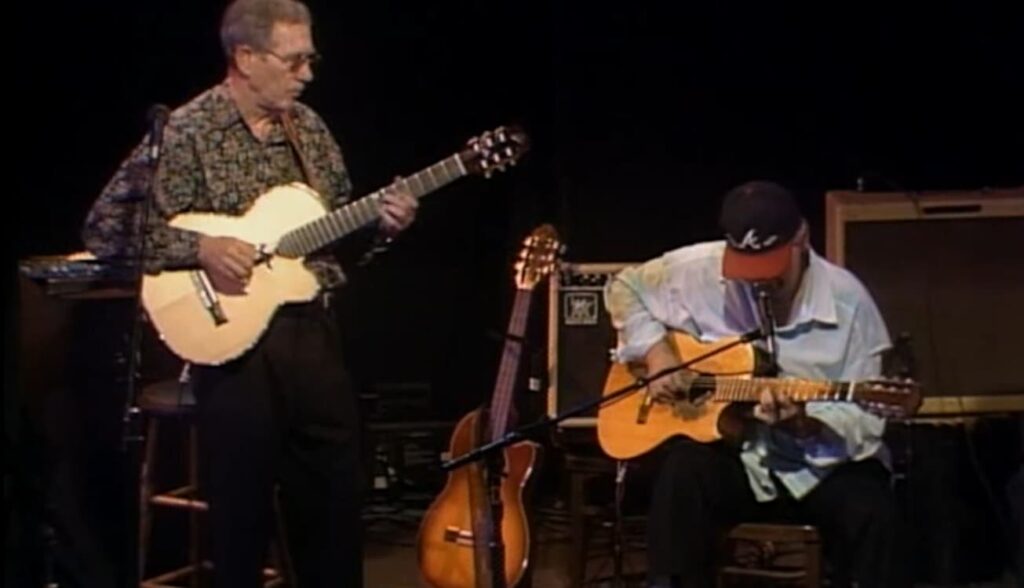
A Playful Duel of Strings, Where Virtuosity Smiles and Mastery Feels Effortless
When Jerry Reed and Chet Atkins brought “The Claw” to life together, they were not simply performing an instrumental—they were sharing a language only a few could truly speak. Originally written and recorded by Jerry Reed in 1967 for his album “The Unbelievable Guitar and Voice of Jerry Reed,” the piece quickly became one of his signature works, even earning a Grammy Award for Best Country Instrumental Performance. Though it did not chart on the Billboard Hot 100—as was often the case with instrumentals of such technical nature—its reputation grew steadily among musicians and listeners who understood what it represented: a bold, intricate, and unmistakably original approach to the guitar.
By the time Reed performed “The Claw” alongside Chet Atkins, the song had already taken on a life of its own. It was no longer just a composition—it was a challenge, a statement, a calling card for a style that defied easy imitation. The title itself referred to Reed’s distinctive right-hand technique, a hybrid picking method that combined thumb, fingers, and a near-percussive attack. In his hands, the guitar did not merely sing—it snapped, pulsed, and danced.
Yet what makes the collaboration between Jerry Reed and Chet Atkins so compelling is not just the technical brilliance on display, but the contrast in their approaches. Reed, with his playful unpredictability, brought a sense of spontaneity to the piece. Atkins, ever the master of control and refinement, responded with precision and clarity. Together, they created something that felt less like a performance and more like a conversation—two voices speaking fluently, occasionally teasing, occasionally challenging, but always listening.
There is a quiet story behind this partnership. Chet Atkins, often referred to as “Mr. Guitar,” had long recognized Reed’s extraordinary talent. In fact, it was Atkins who helped bring Reed into the spotlight, offering support and encouragement at a time when such a unique style might have otherwise remained on the margins. Their relationship was built not on rivalry, but on mutual respect—a shared understanding that the guitar could be both a technical instrument and a deeply expressive one.
In live performances of “The Claw,” that relationship becomes visible. There are moments where the melody seems to shift unexpectedly, where one player introduces a variation and the other responds almost instantly. It is in these exchanges that the true essence of the piece emerges—not as a fixed composition, but as a living, evolving dialogue.
The meaning of “The Claw” lies not in lyrics, but in motion. It is a celebration of skill, certainly, but also of individuality. Each note carries the imprint of the player, the subtle differences in touch, timing, and intention. In this way, the song becomes a reflection of personality as much as technique. It reminds us that mastery is not about perfection, but about finding a voice that cannot be mistaken for anyone else’s.
Listening to Jerry Reed and Chet Atkins together, one cannot help but notice the sense of joy that runs beneath the surface. Despite the complexity of the piece, there is no heaviness in their playing. Instead, there is a lightness, an ease, as though the music exists not to impress, but to delight. It is the sound of two musicians who have spent years refining their craft, now free to simply enjoy it.
Over time, “The Claw” has become something of a rite of passage for guitarists—a piece studied, admired, and often feared for its difficulty. But in the hands of its creator and his closest musical ally, it feels almost effortless. That contrast is perhaps its greatest achievement: the ability to make the extraordinary seem natural.
In the end, the collaboration between Jerry Reed and Chet Atkins on “The Claw” stands as more than a display of technical skill. It is a reminder of what music can be when it is shared—when it becomes a dialogue rather than a monologue, a connection rather than a competition.
And as the final notes fade, there is a lingering sense not of conclusion, but of continuation. The conversation may pause, but it never truly ends. It remains, carried forward by every guitarist who dares to pick up the instrument and attempt to speak in that same intricate, expressive language—one shaped by two masters who understood that sometimes, the most powerful statements are made not with words, but with strings and silence.
 Oldies Songs