
A Tender Confession That Once Defined Youth, Now Echoing as a Memory That Refuses to Fade
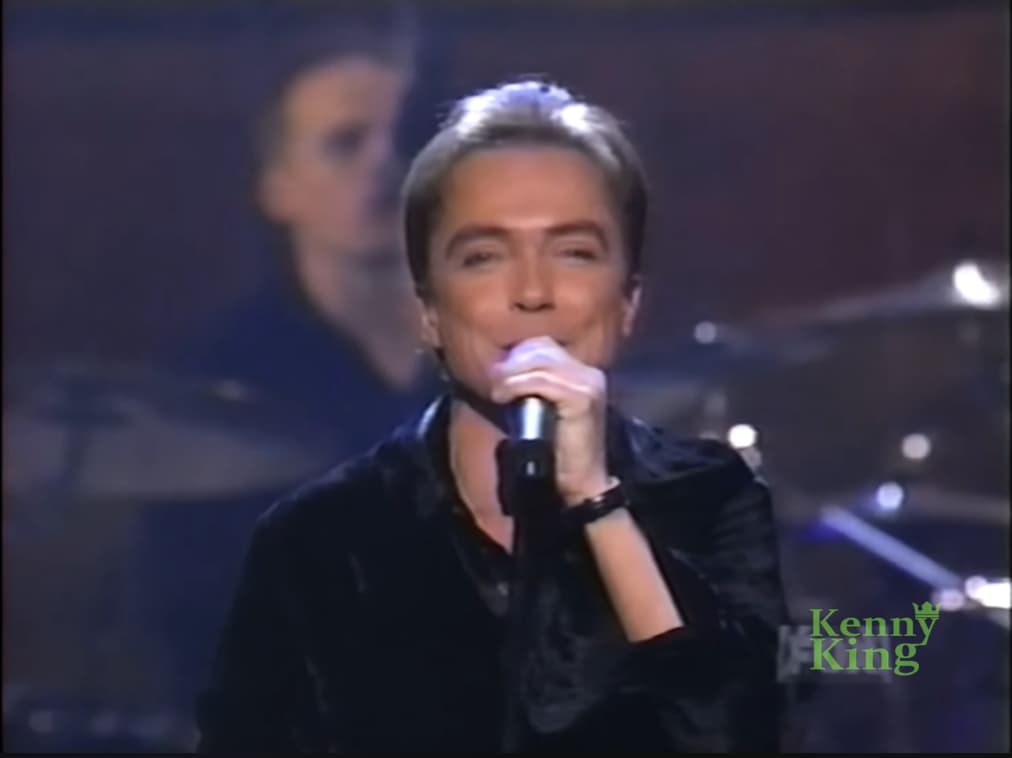
When David Cassidy stood on stage at the Billboard Music Awards in 1997 to perform “I Think I Love You”, the moment carried a weight far beyond the song itself. Originally released in 1970 as the debut single by The Partridge Family, the track had reached No. 1 on the Billboard Hot 100, holding that position for three weeks and selling over a million copies. It became not only a commercial triumph but a defining cultural artifact of its time, launching David Cassidy into a level of fame few artists ever experience. By 1997, however, the performance no longer belonged to the charts—it belonged to memory.
Written by Tony Romeo, “I Think I Love You” was crafted with a simplicity that proved deceptively powerful. Its melody was gentle yet immediate, its lyrics capturing the fragile moment between uncertainty and emotional clarity. At its core, the song is about realization—the quiet, almost hesitant recognition of love before it fully takes shape. That hesitation, expressed in the repeated phrase “I think,” is what gives the song its humanity. It does not declare love with certainty. It approaches it carefully, as though aware of the vulnerability it brings.
In its original 1970 recording, the lead vocal was performed by Shirley Jones, though it was David Cassidy’s presence—both on screen and in the public imagination—that gave the song its enduring identity. At the time, Cassidy’s voice represented something youthful and immediate, a reflection of emotions that felt new, untested, and full of possibility. The production, polished and bright, matched the tone of the era—optimistic, accessible, and undeniably catchy.
But the 1997 performance tells a different story.
Standing years removed from the height of his early fame, David Cassidy approached “I Think I Love You” not as a young man discovering emotion for the first time, but as someone who had lived through its many variations. His voice, naturally altered by time, carried a texture that the original recording did not possess. There was a softness, a kind of reflective distance, as though he were not just singing the song, but remembering it.
The arrangement in this performance remained faithful to the familiar structure, yet the atmosphere had shifted. What was once bright now felt warmer, more grounded. The energy was no longer driven by youthful excitement, but by recognition. Each line seemed to carry with it the weight of years—experiences that had quietly reshaped the meaning of the words.
There is something deeply moving in that transformation.
Because “I Think I Love You”, in this context, becomes more than a song about discovering love. It becomes a reflection on how that feeling changes over time—how certainty replaces hesitation, how innocence gives way to understanding, and how memory itself becomes part of the experience. The phrase “I think” no longer suggests doubt. Instead, it feels like a gentle acknowledgment of how far one has come.
The audience, too, plays a role in this moment. Those who once heard the song in its original form were no longer hearing it for the first time. They were hearing it again, through the lens of their own lives. The connection between performer and listener was no longer built on excitement alone, but on shared history—a recognition that time had passed for both.
For David Cassidy, this performance stands as a quiet testament to endurance. Not in the sense of maintaining fame, but in the ability to return to something once so closely tied to youth and allow it to exist in a new form. He did not attempt to recreate the past exactly as it was. Instead, he allowed the song to evolve, to carry the marks of time without losing its essence.
And that is perhaps why “I Think I Love You” continues to resonate.
Because it captures a moment that never truly disappears—the first recognition of something meaningful, something uncertain, something real. And when revisited years later, it reminds us not only of who we were, but of everything that has shaped who we have become.
In that 1997 performance, the song did not simply return.
It stayed, quietly, where it had always been—waiting to be heard again, with different ears and a deeper understanding.