
A Brotherly Harmony Across Generations — “Tell Me It’s Not True” Reveals the Emotional Bond Between David Cassidy and Shaun Cassidy
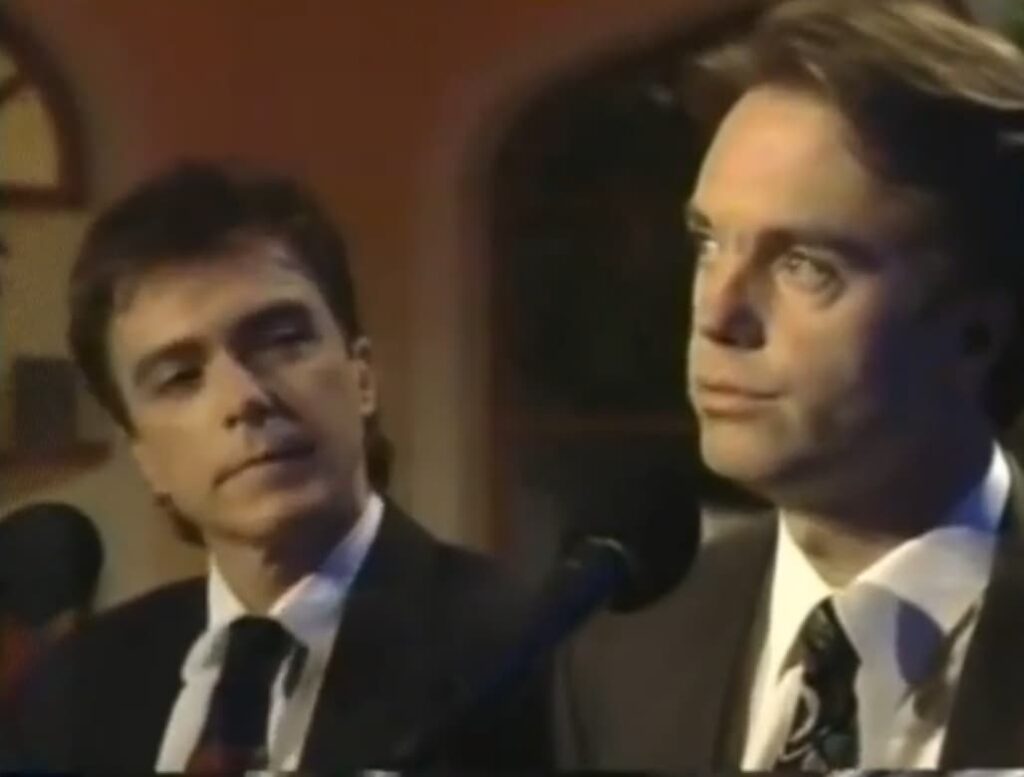
When David Cassidy and Shaun Cassidy appeared together in a 1993 television recording performing “Tell Me It’s Not True,” the moment carried far more meaning than a simple duet. It was a rare and touching musical encounter between two brothers whose careers had once defined different eras of pop stardom. In that performance, audiences witnessed not only a song about heartbreak and disbelief, but also a quiet reflection of time, memory, and family.
The song “Tell Me It’s Not True” has a long and interesting history in popular music. Written by Ken Lewis and Paul Overstreet, the song originally appeared in 1978, when it was recorded by Blood, Sweat & Tears for their album More Than Ever. The track later gained renewed attention when Blood, Sweat & Tears released it as a single in 1979, where it reached No. 2 on the Billboard Adult Contemporary chart and No. 42 on the Billboard Hot 100. Its dramatic melody and emotional lyrics made it a perfect vehicle for powerful vocal interpretations.
By the early 1990s, when David Cassidy and Shaun Cassidy performed the song together on television, the music world had already witnessed the extraordinary rise of both brothers during the 1970s. Their careers followed different paths, yet they were united by a shared musical heritage.
David Cassidy had become a global sensation at the start of the decade through the television series “The Partridge Family.” As the show’s musical centerpiece, Cassidy recorded several chart topping hits. The group’s single “I Think I Love You” reached No. 1 on the Billboard Hot 100 in 1970, while songs like “Doesn’t Somebody Want to Be Wanted” climbed to No. 6 in 1971. Cassidy’s fame quickly grew beyond television, transforming him into one of the most recognizable pop stars of the early seventies.
A few years later, Shaun Cassidy would experience a similar wave of popularity. In 1977, his energetic cover of “Da Doo Ron Ron” reached No. 1 on the Billboard Hot 100, becoming one of the biggest singles of the year. His follow up hit “That’s Rock ‘n’ Roll” climbed to No. 3 on the same chart, confirming his place among the era’s leading young pop performers.
Despite their individual success, the two brothers rarely appeared together in musical performances. That is what made the 1993 television recording of “Tell Me It’s Not True” so memorable. Instead of the youthful pop excitement that had once defined their careers, the performance presented something quieter and more reflective.
The song itself carries a deeply emotional narrative. The lyric describes a moment when someone hears devastating news about a lost love and desperately hopes that it cannot possibly be real. The repeated plea in the title — tell me it’s not true — captures the fragile space between denial and acceptance.
When David Cassidy and Shaun Cassidy sing those words together, the effect becomes even more powerful. Their voices blend in a way that feels both familiar and sincere. There is a warmth in the harmony that suggests shared history, not only in music but in life itself.
Musically, the arrangement in the 1993 performance is restrained and elegant. Soft instrumentation allows the vocal lines to remain the emotional center of the song. Rather than emphasizing dramatic vocal power, the brothers deliver the lyric with quiet sensitivity, allowing each phrase to unfold naturally.
Watching the performance today creates a powerful sense of reflection. The energy of youth that once filled stadiums and television screens had matured into something deeper. Fame, success, and the passing of years had transformed the moment into a thoughtful reunion rather than a pop spectacle.
In many ways, “Tell Me It’s Not True” became more than a cover song in that performance. It served as a reminder of how music connects different chapters of a life.
Through their shared voices, David Cassidy and Shaun Cassidy created a moment that felt both nostalgic and deeply human — a simple song about heartbreak that, for a brief time on a television stage in 1993, became a quiet celebration of family, memory, and enduring harmony.