
A simple morning greeting becomes a lifelong lesson in love, warmth, and the quiet wisdom of everyday devotion
Few songs in country music carry the effortless charm and enduring sincerity of “Kiss An Angel Good Morning”, and in the hands of Charley Pride, it became more than a hit—it became a gentle philosophy for living. Released in 1971 as part of the album “Charley Pride Sings Heart Songs”, the track quickly rose to No. 1 on the Billboard Hot Country Singles chart, while also crossing over to reach No. 21 on the Billboard Hot 100—a rare achievement that reflected its universal appeal beyond genre boundaries.
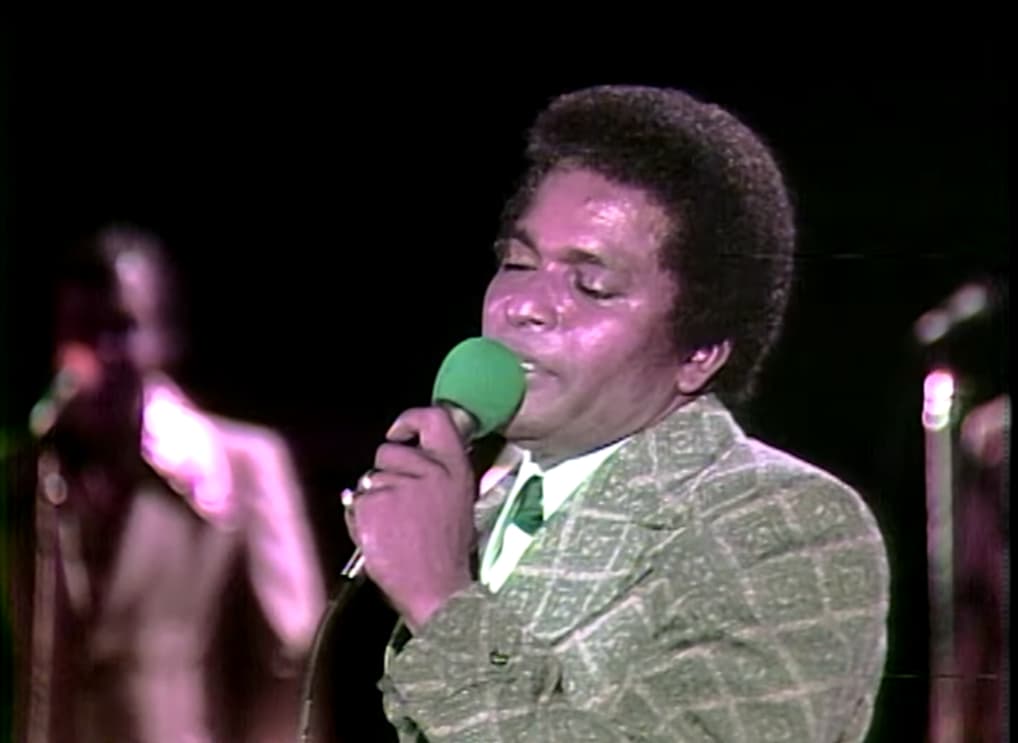
By the time Charley Pride performed it on The Midnight Special, the song had already settled into the hearts of listeners, but something about that televised moment gave it a different kind of permanence. Standing under studio lights, with his calm presence and unmistakable voice, Pride didn’t just sing the song—he seemed to live inside it, as though every word had been quietly proven true over time.
The story behind “Kiss An Angel Good Morning” begins with songwriter Ben Peters, who crafted a lyric that felt disarmingly simple. There are no grand metaphors, no elaborate declarations—just a straightforward piece of advice: treat love with care, show appreciation daily, and never let routine take the place of affection. In another voice, the message might have sounded sentimental, even naïve. But in Charley Pride’s delivery, it becomes something else entirely—measured, sincere, and grounded in lived experience.
Part of what makes this song so enduring is the way it reflects a certain kind of emotional clarity. The narrator isn’t searching for love or recovering from its loss. Instead, he is quietly explaining how to keep it alive. “Kiss an angel good morning and love her like the devil when you get back home”—a line that has echoed across decades—not because it is poetic in the traditional sense, but because it feels true in a way that doesn’t need embellishment.
Watching the performance on The Midnight Special, one notices how unhurried everything feels. The arrangement is light, almost breezy, with gentle guitar lines and a rhythm that moves without urgency. There is space in the music, and within that space, Pride’s voice carries the weight of the song. It is warm without being overly polished, confident without needing to prove anything. There is a quiet assurance there, as though he understands that the message does not need to be pushed—it only needs to be offered.
And perhaps that is where the deeper meaning lies.
At a time when much of popular music leaned toward either heartbreak or escapism, “Kiss An Angel Good Morning” stood apart by focusing on something steady and sustaining. It did not dramatize love; it normalized it. It suggested that happiness is not found in rare, extraordinary moments, but in small, consistent gestures—those that often go unnoticed until they are no longer there.
For Charley Pride, the success of this song marked a defining moment in an already remarkable career. As one of the most successful country artists of his era, he had already built a reputation for blending traditional country sounds with a broader accessibility. But this particular recording seemed to capture something essential about his artistry—a balance between humility and confidence, between storytelling and personal truth.
Over the years, the song has never really faded. It continues to appear in conversations, playlists, and memories, not as a relic of its time, but as something quietly relevant. Its message does not belong to a specific generation or moment. It belongs to anyone who has ever understood that love, at its core, is less about grand declarations and more about what is done, day after day, often without recognition.
In the end, the performance on The Midnight Special serves as a kind of snapshot—not just of a song at the height of its popularity, but of an artist fully at ease with what he is offering. There is no need for spectacle, no attempt to impress. Just a voice, a melody, and a message that lingers long after the final note.
And perhaps that is why it still resonates.
Because long after trends have shifted and sounds have changed, the idea at the center of “Kiss An Angel Good Morning” remains untouched—a quiet reminder that the simplest expressions of love are often the ones that last the longest.