
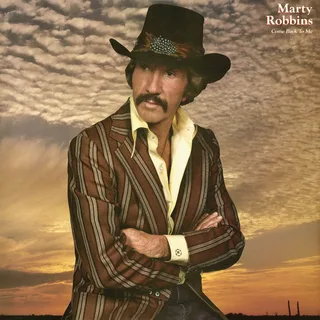
Marty Robbins – “Long Gone Lonesome Blues”: When the “Velvet” Master Met the “Drifting Cowboy” in a Rhythmic High-Noon
In the vibrant, high-fidelity landscape of 1963, a musical event occurred that saw the convergence of two of the greatest eras in country music history. When Marty Robbins recorded his version of Hank Williams’ 1950 classic, “Long Gone Lonesome Blues,” for his iconic album “Portrait of Marty,” he didn’t just cover a standard; he reimagined it through the lens of a new, sophisticated era. For those of us who remember the early sixties—the transition from the raw honky-tonk grit of the post-war years to the polished “Nashville Sound” of Columbia Records—this track was a revelation. It caught the “Gentle Giant” of the Western ballad at a vocal peak where he could pay homage to the “Hillbilly Shakespeare” while asserting his own peerless, crystalline authority.
The “story” behind this recording is a masterclass in vocal athletics and rhythmic “mini-movie” storytelling. While the original Hank Williams version was defined by a skeletal, bluesy sorrow, Marty’s interpretation is infused with a driving, almost cinematic energy. The track is anchored by a propulsive, walking bassline and the signature, weeping steel guitar that mimics the “lonesome whippoorwill” of the lyrics. Marty’s delivery is a study in “high-level” control—he navigates the legendary “blue yodel” transitions with an ease that few pop or country singers of the era could ever hope to match. It was a period where Marty was bridging the gap between his “Gunfighter” persona and his status as a sophisticated vocal stylist, proving that the “Gentle Giant” could be just as ruggedly lonesome as he was impeccably melodic.
For the sophisticated listener who has spent a lifetime observing the “ebbs and flows” of the American musical narrative, hearing Marty sing “Long Gone Lonesome Blues” today is a deeply evocative experience. It brings back memories of wood-paneled consoles, the crackle of a fresh 45rpm record, and the realization that the feeling of being “long gone” is a universal human milestone. The lyrics—”I’m gonna find me a river, one that’s cold and deep”—speak to the “qualified” reader who understands that life is often a series of departures and “quiet desperation.” For those of us in our silver years, the song is a mirror of our own resilience. It reminds us of a time when the “Master Storyteller” could take a simple three-chord blues and turn it into a high-intensity drama of the human spirit.
The meaning of Marty’s take on this Hank Williams classic lies in its “velvet” defiance. Marty Robbins possessed the unique, almost magical gift of being a “vocal chameleon” who could inhabit the past while sounding entirely modern. As we reflect on this 1963 masterpiece today, through the lens of our own decades of experience, we see it as more than just a track on a “Portrait” album; it is a testament to the enduring power of the narrative song to bridge generations. The Master Storyteller may have eventually returned to his “El Paso” trails, but in the soaring, rhythmic yodels of this song, he remains the eternal guardian of our most lonesome reflections. To listen to it now is to sit once more with Marty, acknowledging that while we may be “long gone” from the world of 1963, his voice remains eternally present.
 Music Legend