
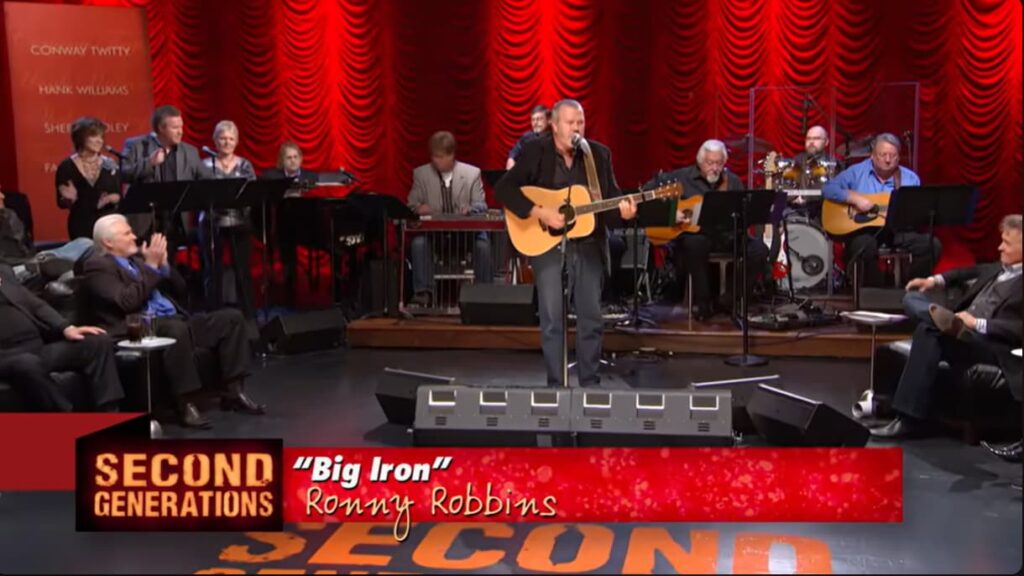
Ronny Robbins – “Big Iron”: A “High-Fidelity” Legacy and the Resonant Echoes of a Father’s Masterpiece
In the timeless, dust-blown landscape of 1959, Marty Robbins released a recording that would define the “Gunfighter Ballad” for generations. But when his son, Ronny Robbins, steps to the microphone to perform “Big Iron,” he isn’t just singing a cover; he is engaging in a profound, rhythmic act of heritage. For those of us who have spent decades following the “Master Storyteller,” hearing Ronny take on the tale of the Arizona Ranger and the outlaw Texas Red is a visceral experience. It catches the “Gentle Giant” legacy at a point where “velvet” DNA meets the rugged, high-noon drama of the original Columbia Records masterpiece.
The “story” behind “Big Iron” is the ultimate “mini-movie” of the Western genre. The narrative—a tense, cinematic countdown to a showdown in the town of Agua Fria—relies on a steady, galloping rhythm that mimics the heartbeat of a man facing his fate. When Ronny performs it, he brings a “high-level” vocal sincerity that honors his father’s crystalline phrasing while asserting his own masculine authority. It is a study in the “Countrypolitan” transition; where Marty’s original was a stark, acoustic-driven warning, Ronny’s tribute versions often lean into the sophisticated, modern production that keeps the legend alive for a new century. He proves that the “Gentle Giant” style isn’t just a sound—it’s a family tradition of storytelling excellence.
For the sophisticated listener who has navigated the “twists and turns” of several decades, hearing Ronny Robbins sing “Big Iron” today is a deeply evocative experience. It brings back memories of wood-paneled dens, the flickering glow of a television Western, and the realization that as we reach our silver years, the “torches” we pass to our children are our most precious legacy. The lyrics—”He was vicious and a killer though a youth of twenty-four”—speak to the “qualified” reader who understands that life is often a series of “high-noon” moments where character is tested. For those of us who have seen the seasons turn, Ronny’s performance is a mirror of our own resilience and the “pride” we take in seeing a great story told well by the next generation.
The meaning of Ronny’s interpretation lies in its unapologetic respect for “The Truth” in a song. Marty Robbins possessed the unique, almost magical gift of being a “vocal chameleon,” and Ronny has inherited that ability to inhabit a character completely. As we reflect on this performance today, through the lens of our own decades of experience, we see it as more than just a tribute; it is a testament to the enduring power of the narrative song to bridge the gap between father and son. The Master Storyteller may have moved on to that eternal “El Paso” trail, but in the rhythmic, soaring notes of Ronny’s voice, the “Big Iron” remains forever on his hip. To listen to it now is to sit once more with the Robbins family, acknowledging that while the “outlaw” may fall, the melody remains eternally clear.
Video