
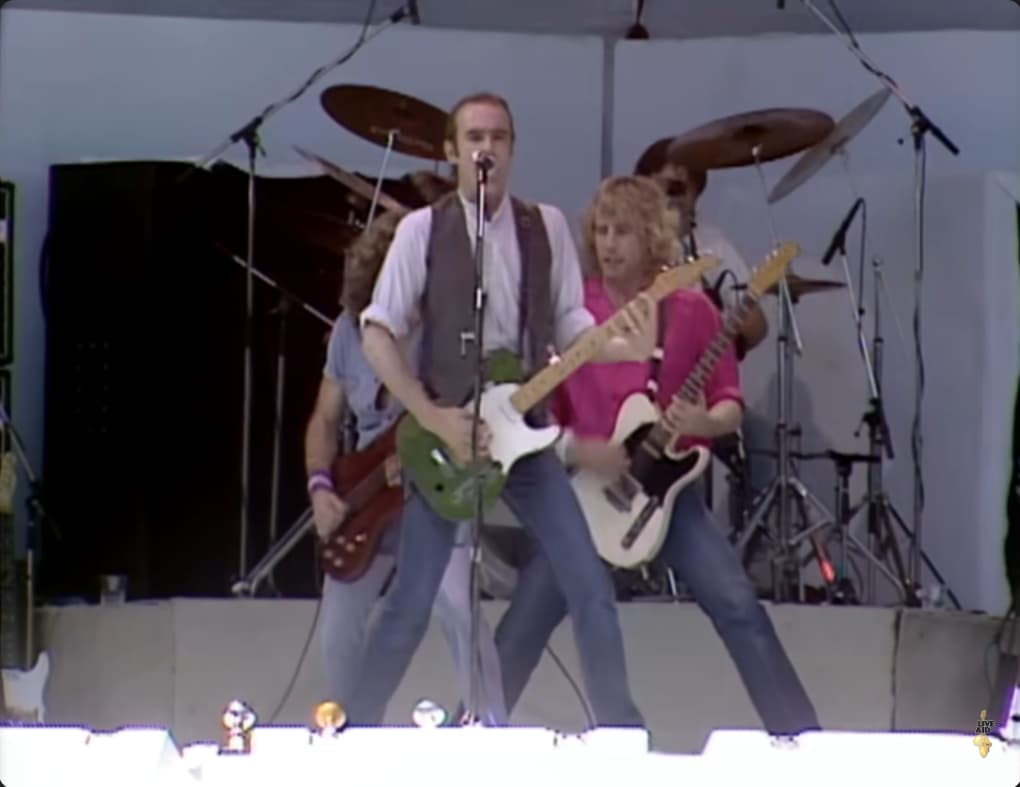
A driving pulse of freedom and urgency, where a simple rock song becomes a timeless call to keep moving, no matter the years behind or ahead.
When Status Quo stepped onto the stage at Live Aid 1985, they brought with them a song that had already long secured its place in British rock history—“Caroline.” Originally released in 1973 as part of the album Hello!, the track surged to No. 5 on the UK Singles Chart, becoming one of the band’s defining recordings. Yet it was on that July day in 1985, before a worldwide audience of millions, that “Caroline” found a renewed sense of purpose, echoing across continents as both a celebration and a statement.
From the very first churning chords, “Caroline” has always carried a sense of motion. Built on the unmistakable boogie rock foundation that Status Quo would come to embody, the song is deceptively simple—repetitive, even—but therein lies its power. It does not aim to surprise; it aims to endure. The rhythm rolls forward like a long road stretching endlessly ahead, and in a live setting like Live Aid, that momentum becomes something almost physical, something that binds performer and audience together in a shared pulse.
The origins of “Caroline” trace back to a time when Status Quo were solidifying their identity. Moving away from their earlier psychedelic experiments, they embraced a stripped-down, guitar-driven sound that prioritized groove over complexity. It was a decision that defined their career. “Caroline” stands as one of the earliest and clearest expressions of that shift—a song that does not ask for attention through intricacy, but commands it through persistence.
By the time of Live Aid, the band had already spent over a decade refining that sound on stages across the world. They understood something fundamental about rock music: that its greatest strength lies not in reinvention, but in connection. And as they launched into “Caroline” that day, there was no need for elaborate staging or dramatic buildup. The song itself was enough. Its familiarity cut through the vastness of the event, offering something immediate and grounding amidst the enormity of the occasion.
What makes the Live Aid performance particularly striking is the contrast it embodies. On one hand, there is the sheer scale of the event—a global audience, a cause of immense importance, a stage shared with some of the biggest names in music history. On the other, there is “Caroline,” a song rooted in simplicity, almost stubborn in its refusal to be anything more than what it is. And yet, in that moment, the two align perfectly. The song’s steady drive becomes a kind of anchor, a reminder that even in the largest of moments, it is the simplest elements that resonate most deeply.
For listeners, “Caroline” often carries with it a sense of continuity. It recalls earlier days—perhaps the first time it was heard on the radio, or the countless times it played in the background of everyday life. At Live Aid, those memories converged with the present, creating a layered experience where past and present existed side by side. The song did not change, but the meaning deepened.
There is also something quietly defiant in the way Status Quo approached that performance. While many artists sought to adapt, to evolve with changing trends, they remained steadfast. “Caroline” was played as it always had been—loud, direct, unpolished in the best possible way. It was a reminder that authenticity does not age, that a song built on honest foundations can carry itself across decades without losing its relevance.
In the end, the Live Aid rendition of “Caroline” stands not as a reinvention, but as a reaffirmation. It confirms what had always been true about the song: that its power lies in its constancy, its refusal to fade or be reshaped by time. As the final chords rang out across the vast crowd, there was a sense not of conclusion, but of continuation—a rhythm that would keep rolling, long after the stage had gone quiet.
And perhaps that is the enduring legacy of “Caroline.” Not just a hit from 1973, not just a performance in 1985, but a living thread that runs through years of music and memory, steady and unbroken, carrying with it the simple, undeniable truth that sometimes, all a song needs to do is keep going.