
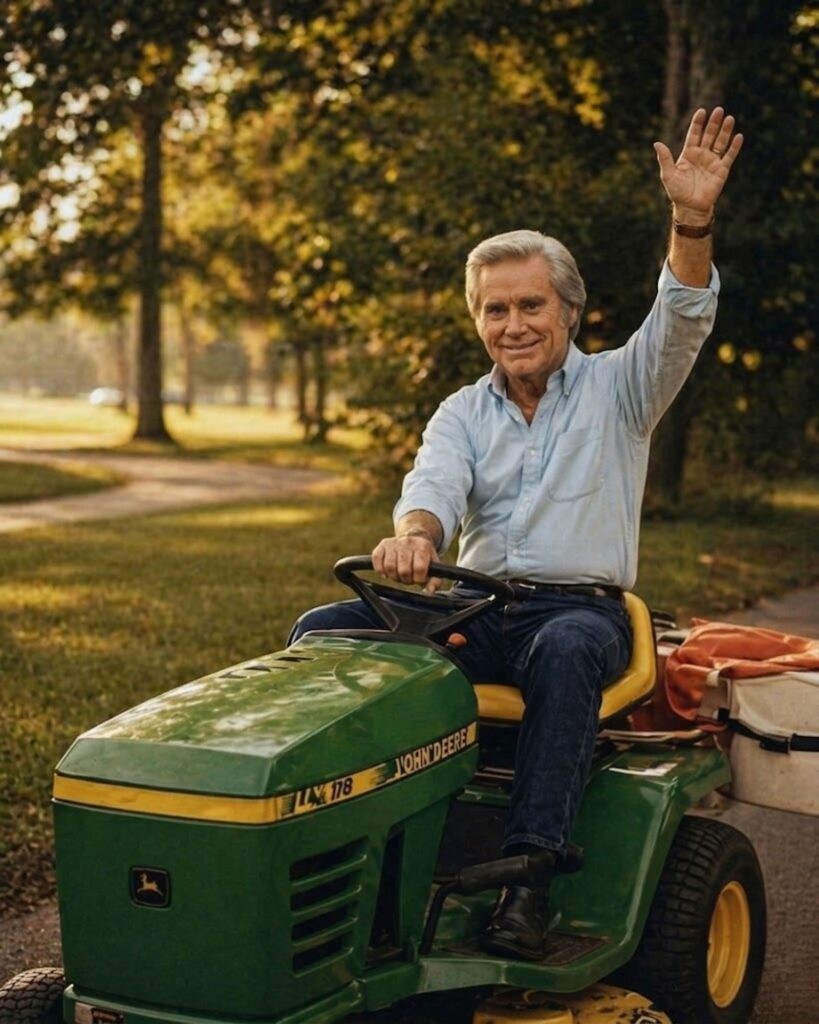
Beneath the laughter, a long road of reckoning—George Jones turned a notorious moment into a lifetime of hard-won redemption
There are stories in country music that seem too strange to be true, and then there is the one about George Jones and the riding lawnmower—a story told so often, with such amusement, that it has almost become folklore. The image is unforgettable: a man, locked out of his own escape, finding another way. His wife had hidden every car key in the house, hoping to stop him. But outside, under a quiet light, sat a John Deere mower. And so, at five miles per hour, he rode it eight miles to a liquor store.
It is the kind of story that invites laughter. And for years, that is exactly what it received. Vince Gill sang about it. Hank Williams Jr. referenced it. In Nashville, it became part of the mythology, even immortalized in a mural. The industry turned it into something colorful, something almost charming. Even George Jones himself leaned into the humor, famously putting “NO SHOW” on his license plates, a quiet nod to the reputation that followed him through the darkest years of his career.
But stories like this have a way of hiding what matters most. Because behind the image of that slow ride through the night was not comedy, but collapse. At the time, George Jones weighed barely 105 pounds. His life had been shaped early by the shadow of alcoholism—his own father had died from it. By then, three marriages had already fallen apart. In one year alone, he missed 54 concerts, leaving behind disappointed audiences and a career that seemed to be slipping beyond repair.
And the lawnmower was not a one-time act of desperation. It happened twice. Two different wives. Two different nights. The repetition alone tells its own story—a cycle not yet broken, a man not yet ready to stop.
For many, that would have been the end of the narrative. A legend undone by his own habits, remembered more for chaos than for music. But that is not where this story ends.
What is often forgotten—what rarely makes it into the retelling—is what came after. George Jones did something far more difficult than riding eight miles in the dark. He stopped. He got sober. And slowly, deliberately, he began to rebuild what had been lost.
There was no grand announcement, no sudden transformation that erased the past. Instead, there was consistency. He returned to the stage. He honored the commitments he once broke. There is a quiet story, less told, that he made a point of playing the shows he had once missed—without charging, as if trying, in some small way, to settle a debt that could never fully be repaid.
By the time he reached his final concert in Knoxville in 2013, the man on stage was no longer the figure of the old stories. He closed the night with “He Stopped Loving Her Today,” the song that had once redefined his career and remains one of the most revered recordings in country music. After the final note, he turned to his wife, Nancy Jones, and said simply, “I gave ’em hell.”
It was not said with arrogance. It sounded more like a conclusion.
Today, that lawnmower sits quietly in a museum, an artifact of a story that refuses to fade. People still take pictures with it. They still smile. The story still circulates, polished over time into something easier to tell.
But what lingers, just beneath that surface, is something else entirely. Because the real story is not about how far he rode, or how unusual the journey looked. It is about why he needed to make it—and what it took for him to finally stop.
And perhaps that is why, even now, the story carries a different weight for those who look a little closer. The laughter remains, but it no longer feels complete. There is something unfinished in it, something that resists being reduced to a punchline.
Because when the engine finally went quiet, what followed was not another story to tell—but a life, slowly put back together, piece by piece. And that part, more than anything, is the one that stays.