
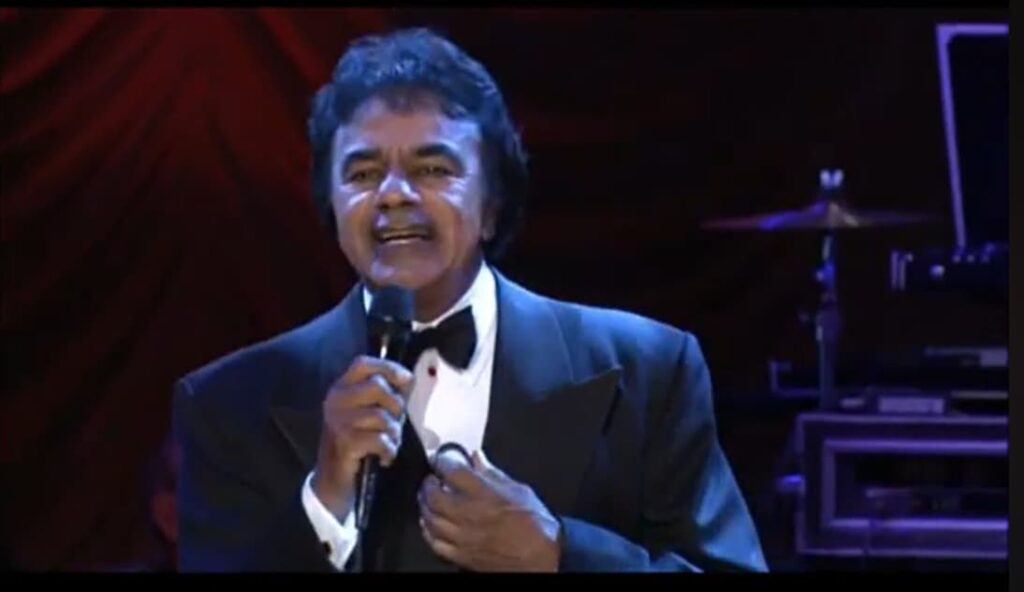
A gentle crossing of borders—Brazilian Songs becomes a quiet celebration of rhythm, memory, and a voice that has learned how to linger rather than impress
When Johnny Mathis reached the milestone of his 50th Anniversary Concert, he did not choose to look back only through his most famous hits. Instead, he opened a different window—one filled with warmth, subtle rhythm, and the soft sway of another musical world. The segment often remembered as “Brazilian Songs” was not tied to a single charting release, nor did it belong to the competitive language of rankings. And yet, it revealed something essential about Johnny Mathis—an artist whose longevity has never depended solely on past success, but on an enduring sensitivity to song itself.
To understand the weight of this moment, it helps to remember where that journey began. In the late 1950s, Mathis rose to prominence with recordings that defined romantic pop for a generation. His album Johnny’s Greatest Hits remained on the Billboard charts for an unprecedented 490 weeks, a record that quietly spoke of consistency rather than sudden impact. Songs like “Chances Are” and “Misty” established him as a voice of refinement—controlled, elegant, and unmistakably intimate.
By the time of the 50th Anniversary Concert, however, the narrative had shifted. The voice was still there, but it carried more than tone—it carried time. And in choosing to perform Brazilian standards, Mathis stepped into a repertoire shaped by composers such as Antônio Carlos Jobim and Vinicius de Moraes, figures who helped define the sound of bossa nova. These were songs built not on vocal power, but on nuance—on phrasing, on space, on the delicate balance between melody and silence.
What makes this performance so compelling is not its ambition, but its restraint. Mathis does not attempt to transform these songs into something grander than they are. He approaches them with care, allowing their natural rhythm to guide his interpretation. There is a noticeable lightness in his delivery, as though he understands that these melodies require room to breathe.
The meaning behind this selection runs deeper than a simple stylistic choice. Brazilian music, particularly bossa nova, carries within it a sense of quiet reflection—a blend of longing and ease that resists clear definition. In the hands of Johnny Mathis, that quality becomes even more pronounced. His voice, long associated with romantic ballads, finds a new dimension here. It softens, settles, and adapts, meeting the music where it lives rather than drawing it toward himself.
There is also an unspoken narrative within this moment. After decades in the industry, after countless recordings and performances, an artist reaches a point where expression becomes less about proving and more about understanding. The “Brazilian Songs” segment feels like an extension of that understanding. It suggests a willingness to listen—to the music, to its origins, to its emotional undercurrents.
The arrangement throughout remains understated. Gentle guitar lines, subtle percussion, and the characteristic sway of bossa nova create an atmosphere that feels both distant and familiar. It is not a dramatic shift from Mathis’s earlier work, but rather a quiet expansion of it. The same attention to detail, the same care in phrasing, is present—only now it moves within a different rhythmic landscape.
Listening to this performance, one becomes aware of how time alters not only the voice, but the intention behind it. The clarity of youth gives way to something more textured, more reflective. Notes are held differently. Phrases are allowed to linger. Silence becomes part of the performance, not merely the space between sounds.
In the end, Johnny Mathis does not present “Brazilian Songs” as a departure from his identity, but as a continuation of it. It is a reminder that an artist’s journey is not confined to a single style or moment. It evolves, often quietly, shaped by curiosity and a deepening sense of connection to the music itself.
And within that evolution, there is something profoundly reassuring. The voice may change, the repertoire may expand, but the essence remains. Not fixed, but steady. Not loud, but lasting.