
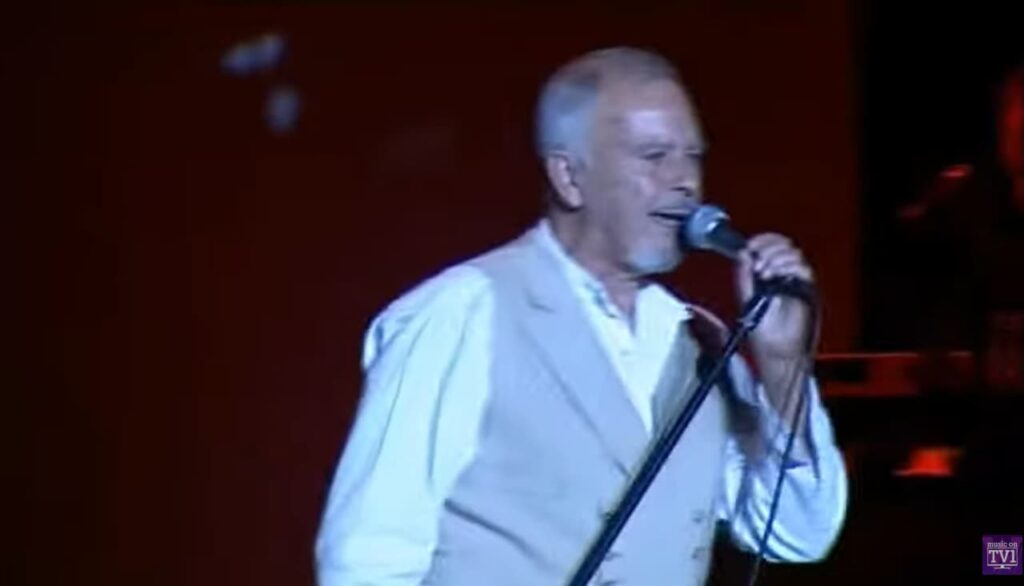
A song about chasing something already gone—“Stardust” becomes, in time, a reflection on youth, illusion, and the quiet cost of remembering
When David Essex returned to the stage with “Stardust – The Secret Tour Live (2009),” he was not simply revisiting one of his most recognizable songs—he was revisiting a version of himself. Originally released in 1974, “Stardust” reached No. 7 on the UK Singles Chart, emerging at a time when Essex stood at the intersection of pop stardom and cinematic storytelling. The song was closely tied to the film Stardust (1974), in which he starred, blurring the line between fiction and reality, between the character he portrayed and the life he was already beginning to live.
By 2009, that line had long since dissolved. What remained was the song itself—unchanged in structure, yet transformed in meaning. In its original form, “Stardust” carried a restless energy, a sense of searching that mirrored the ambitions of youth. It spoke of longing, of something just out of reach, something that shimmered but could never quite be held. At the time, it felt immediate, almost urgent.
But in “The Secret Tour Live,” the urgency softens. The performance does not chase the past—it acknowledges it. Essex approaches the song with a measured calm, allowing its phrases to unfold without strain. His voice, no longer defined by youthful brightness, carries a different kind of strength. There is a weight behind it now, shaped not by loss, but by understanding.
The arrangement in this live setting reflects that shift. Where the original recording leaned into polished production and cinematic sweep, the 2009 performance feels more intimate. The instrumentation is controlled, deliberate, giving space for the vocal to lead. Each note seems placed with care, as though the song is being rebuilt in real time rather than simply performed.
What makes this rendition particularly compelling is the way it reframes the song’s central idea. “Stardust,” once a symbol of aspiration and distance, becomes something more reflective. It no longer represents what lies ahead, but what has already passed. The “stardust” is no longer something to be reached—it is something remembered, something that lingers quietly in the background of experience.
There is also a subtle sense of reconciliation in the performance. The song does not reject its origins, nor does it attempt to recreate them exactly. Instead, it accepts the distance between then and now. This acceptance gives the performance its emotional depth. It is not driven by nostalgia alone, but by a recognition that time changes not only the artist, but the meaning of the work itself.
For David Essex, whose career has moved between music and film, between public image and private reflection, “Stardust” has always held a unique place. It is both a song and a symbol—a reminder of a moment when everything seemed to be in motion, when identity was still being formed. In 2009, that moment is no longer immediate, but it is not forgotten.
Listening to “Stardust – The Secret Tour Live,” there is a sense of stillness that was not present in the original recording. The song breathes differently. It does not push forward; it lingers. And in that lingering, it allows the listener to feel the passage of time—not as something lost, but as something carried.
There are no dramatic reinventions here, no attempts to modernize or reinterpret for the sake of relevance. The performance remains faithful to the song’s core, trusting that its meaning has deepened naturally. This restraint becomes its greatest strength. It allows the emotion to emerge quietly, without being forced.
In the end, “Stardust” in 2009 is no longer about the pursuit of something distant. It is about the recognition of what remains after that pursuit has ended. It is about memory—not as a fixed image, but as something that shifts, softens, and settles over time.
And as the final notes fade, there is a quiet understanding that the song has not changed at all. Only the perspective has. And in that change, David Essex reveals something that was always there, waiting beneath the surface—something less immediate, perhaps, but far more enduring.