
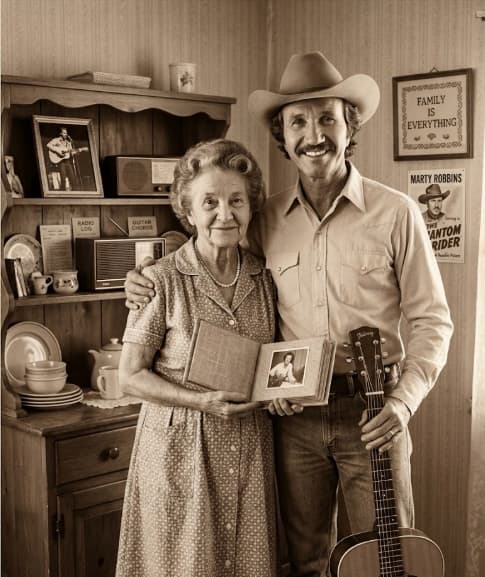
Marty Robbins – “The Power of a Mother’s Love”: How Emma Robinson Cultivated the Heart of a Western Legend
Behind the sweeping vistas of the “El Paso” desert and the roaring engines of the NASCAR circuit, there was a quiet, foundational force that hummed through every note Marty Robbins ever sang. It was the influence of his mother, Emma Robinson. Born into the harsh, arid reality of Glendale, Arizona, Marty—born Martin David Robinson—did not have a childhood of ease. Instead, he had a childhood of profound observation, watching a woman of immense resilience navigate the crushing weight of the Great Depression and the complexities of a difficult family life. If Marty became known as the “Gentle Giant,” it was because Emma taught him the value of gentleness in a world that was often anything but.
The “backstory” of Emma’s influence is a narrative of survival and soul-deep support. While Marty’s father was often absent or struggling with his own demons, it was Emma who kept the “R.F.D.” spirit alive in their home. She was the one who encouraged his early interest in music, recognizing that the boy with the sensitive heart needed a way to translate his surroundings into something beautiful. While his career “ranked” him as a titan with 94 Billboard hits, Marty never lost sight of the fact that his ability to empathize with the characters in his songs—the outlaws, the weary travelers, and the heartbroken—was a gift inherited from a mother who understood the human condition better than anyone.
The Architecture of Empathy: A Mother’s Unseen Hand
For those of us who have lived long enough to see our own parents’ lives in a clearer light, the story of Emma and Marty resonates with a haunting, nostalgic truth. A mother’s love isn’t just about protection; it is about providing the moral and emotional architecture for a child’s future. In Marty’s 1964 song “Mother Knows Best,” which he penned himself for the R.F.D. album on Columbia Records, he wasn’t just writing a standard country tune; he was offering a public confession of her wisdom.
“I’ve found out the hard way, like she said I would… that Mother knows best, she always understood.”
This line captures the bittersweet realization that comes with maturity. Emma didn’t just teach Marty how to sing; she taught him how to listen. She taught him to see the “wrinkles” and the “disappointment” in others, a skill that allowed him to write “My Woman, My Woman, My Wife” with such staggering honesty years later. His “Velvet Voice” wasn’t just a physical attribute; it was an emotional one, polished by the trials he watched his mother endure with quiet dignity.
A Legacy Rooted in the Arizona Soil
As we look back at the grand legacy of Marty Robbins, we must recognize that his “Desert Dust” origins were softened by Emma’s presence. She was the one who ensured that the stories of his grandfather, “Texas” Bob Heckle, were balanced by a sense of domestic peace. For the sophisticated reader, the relationship between Marty and Emma serves as a “souvenir” of an era when family bonds were the primary source of one’s identity.
When Marty stood on the stage of the Grand Ole Opry, he carried the hopes of a boy from Oildale and the values of a woman from Glendale. He proved that a man could be a daring racecar driver and a rugged cowboy, yet still remain a “mother’s son” at heart—unafraid to be vulnerable, unashamed to be kind, and always aware of the “foundation” that allowed him to stand tall.
 Music Legend