
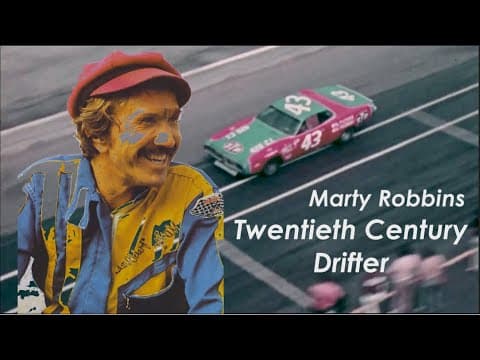
A life lived between speed and song—“The Singing Racer” reveals how Marty Robbins carried the same quiet intensity from the racetrack into every note he sang
In 1973, when Marty Robbins released The Singing Racer, it was not merely another entry in a long and successful discography—it was a deeply personal statement. By then, Robbins was already a towering figure in country music, with a career that had produced enduring classics like “El Paso,” which reached No. 1 on the Billboard Hot 100 in 1960 and earned a Grammy Award. He had also secured multiple No. 1 hits on the Billboard Hot Country Singles chart, establishing himself as both a storyteller and a craftsman of melody. Yet The Singing Racer stood apart, not because of its commercial dominance, but because of what it revealed about the man behind the music.
Unlike many albums shaped by market expectations or shifting trends, The Singing Racer was born from Robbins’ lifelong passion for auto racing. He was not simply an admirer of the sport—he was an active participant, competing in NASCAR events throughout the late 1960s and early 1970s. This dual identity—artist and racer—gave the album its unique character. It was not an attempt to merge two worlds artificially; it was a reflection of a life that had always moved between them.
Commercially, the album did not reach the same heights as some of his earlier releases, and it did not produce major chart-topping singles. However, that absence of chart pressure allowed for something more personal to emerge. The songs on The Singing Racer feel unhurried, grounded, and sincere—less concerned with immediate success and more focused on expression.
What makes this album particularly compelling is the way Robbins translates the language of racing into something broader. On the surface, the themes revolve around speed, competition, and the mechanical rhythm of the track. But beneath that, there is something quieter at work. The songs speak of focus, of solitude, of the thin line between control and risk. These are not themes limited to racing—they mirror the emotional landscape that Robbins had always explored in his music.
Vocally, Marty Robbins approaches these songs with his characteristic clarity. His voice, smooth yet firm, carries a sense of calm even when the subject suggests motion and urgency. This contrast becomes one of the album’s defining qualities. The faster the world around the song seems to move, the steadier his voice becomes. It is as though he is grounding the experience, bringing it back to something human and understandable.
There is also a subtle sense of introspection running through the album. Racing, by its nature, is an outward expression of speed and competition. But Robbins treats it differently. He focuses on the internal experience—the concentration, the awareness, the quiet moments between bursts of action. In doing so, he transforms what could have been a novelty concept into something more enduring.
The production of The Singing Racer reflects this approach. It avoids excess, favoring clean arrangements that allow the narrative to take center stage. The instrumentation supports the vocal without drawing attention away from it, creating a sense of balance that mirrors Robbins’ own dual identity.
Listening to the album now, there is a feeling that extends beyond its original context. It is not simply a record about racing, nor is it just another chapter in a country music career. It is a portrait of a man navigating two passions, finding a way to let them coexist without conflict.
There is something deeply human in that effort—the desire to pursue different parts of oneself without losing balance. In The Singing Racer, Marty Robbins does not choose between music and racing. He allows them to inform each other, to exist side by side.
And perhaps that is what gives the album its quiet resonance. It does not seek to impress or to dominate the charts. Instead, it offers something more lasting—a sense of authenticity, a glimpse into a life lived fully, without compromise.
As the final notes settle, what remains is not the sound of engines or applause, but a feeling of continuity. A reminder that sometimes, the most meaningful journeys are not defined by speed or destination, but by the ability to carry one’s passions forward, steadily, with purpose and quiet conviction.