
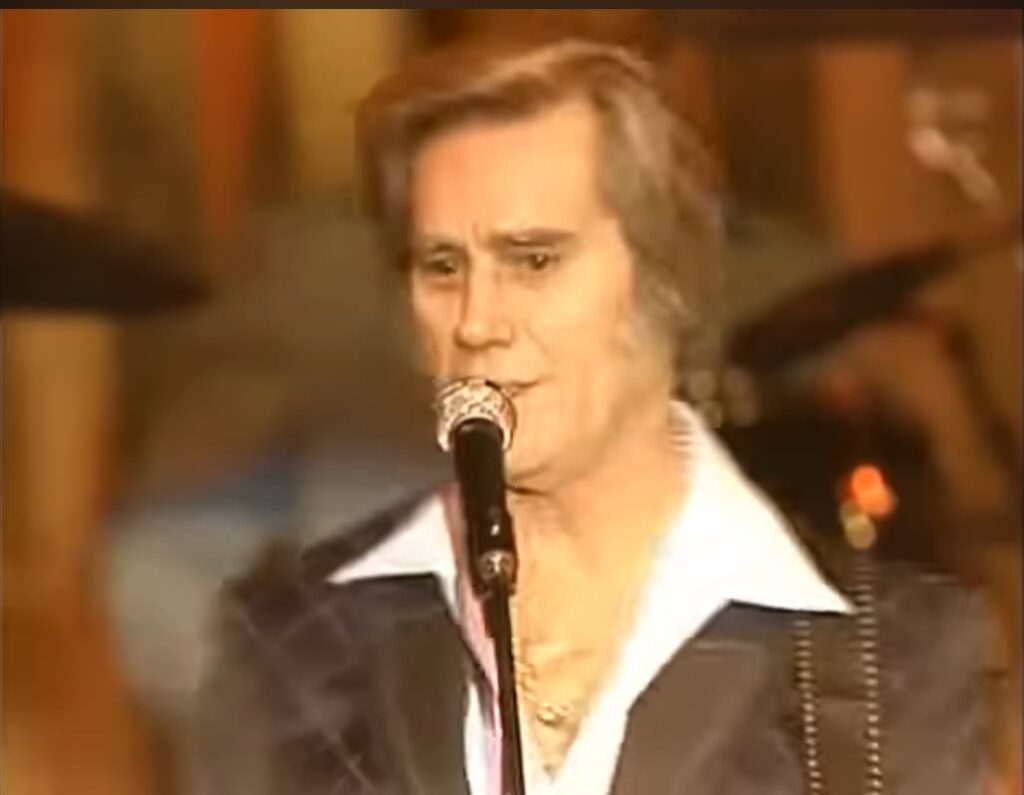
A voice worn by truth—Live in Lafayette, Louisiana (1983) captures George Jones at the fragile edge between survival and surrender
When George Jones stepped onto the stage in Lafayette, Louisiana in 1983, he carried far more than a setlist with him. By then, he was already recognized as one of the greatest voices in country music history, a man whose recordings had repeatedly defined the genre’s emotional depth. Songs like “He Stopped Loving Her Today,” which reached No. 1 on the Billboard Hot Country Singles chart in 1980, had not only revived his commercial success but reaffirmed his artistic authority at a time when many believed his career had begun to slip away.
The Lafayette performance belongs to that uneasy period of recovery. It came after years marked by personal struggle, inconsistency, and a reputation that often overshadowed his musical brilliance. Yet on stage, something remarkable happens—none of that chaos is visible in the way one might expect. Instead, what emerges is a kind of stillness, a quiet focus that seems to exist in direct contrast to everything surrounding it.
There is no elaborate production here, no attempt to dress the moment in spectacle. The setting is grounded, almost understated, allowing the full weight of George Jones’ voice to take center stage. And that voice, even in 1983, remains unmistakable. It is not simply strong or technically precise—it is lived-in. Every phrase carries a history, every note feels shaped by something that cannot be rehearsed.
What defines this performance is not perfection, but presence. Jones does not perform as though he is trying to prove anything. There is no sense of reaching outward for validation. Instead, he turns inward, delivering each song with a kind of restrained honesty that feels almost private, even in front of an audience.
The setlist, drawn from the core of his career, reinforces this feeling. Songs that had once been heard as narratives of heartbreak now take on a different dimension. They are no longer just stories—they feel like acknowledgments. When he sings about loss, regret, or devotion, there is an unmistakable sense that these are not distant emotions. They are immediate, understood, and perhaps still unresolved.
Musically, the band provides steady, unobtrusive support. The arrangements remain faithful to the original recordings, avoiding unnecessary embellishment. This restraint allows the focus to remain where it belongs—on the voice and the story it carries. There is a discipline in this simplicity, a recognition that the strength of the performance lies not in variation, but in clarity.
There is also something quietly revealing in the way Jones moves through the songs. He does not linger too long, nor does he rush. The pacing feels natural, almost conversational, as though each song is part of a larger, unspoken narrative. It is this continuity that gives the performance its depth. It does not feel like a series of separate moments, but a single, unfolding experience.
By 1983, George Jones had already lived through more than most artists would publicly endure. And yet, none of that is addressed directly. It does not need to be. It is present in the subtle shifts of his voice, in the slight roughness that appears at the edges of certain lines, in the calm control that holds everything together.
Listening to Live in Lafayette, Louisiana (1983), there is a sense of witnessing something unguarded. Not in the sense of vulnerability on display, but in the absence of pretense. Jones does not attempt to reshape his image or redefine his legacy in this moment. He simply sings.
And in that act, something becomes clear. The voice that once carried him to the top of the charts, the voice that endured through years of uncertainty, remains intact—not unchanged, but unmistakably his.
As the performance unfolds, there is no dramatic turning point, no single moment that defines it. Instead, its power lies in its consistency. Song after song, note after note, the same quiet truth emerges: that music, at its most honest, does not need to declare itself loudly. It only needs to be felt.
And when the final song fades, what lingers is not applause or spectacle, but a presence—a reminder that George Jones, even in his most uncertain years, could step onto a stage and deliver something that felt entirely real, entirely unfiltered, and entirely unforgettable.