
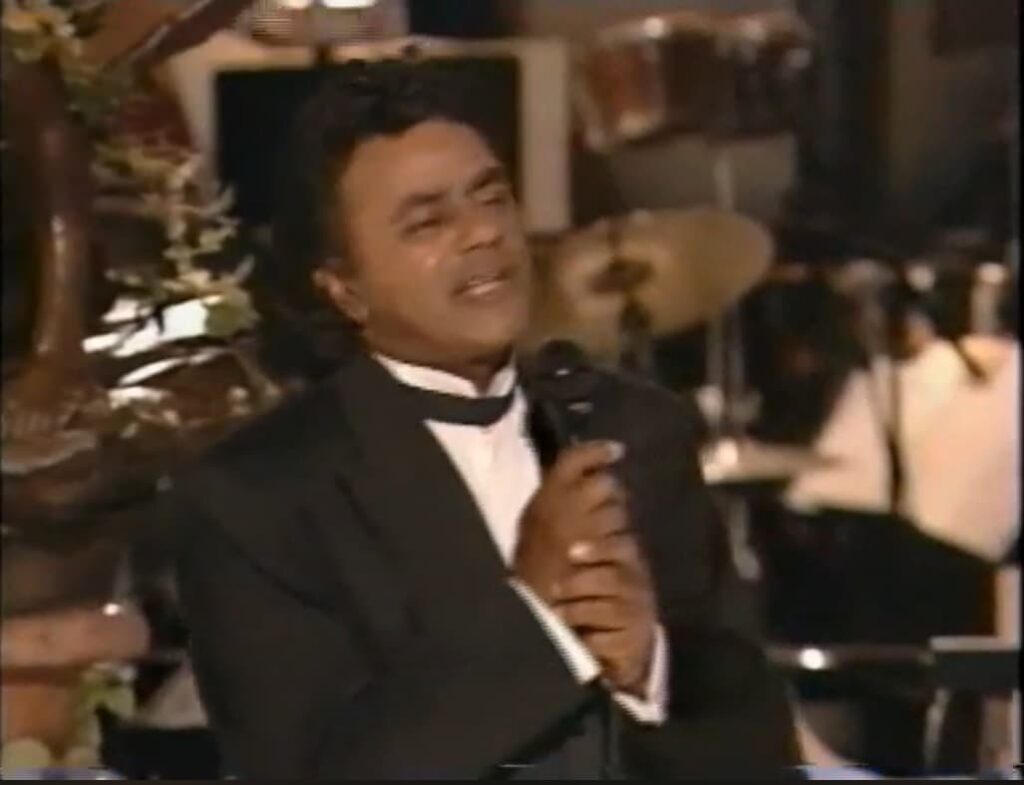
A melody suspended in time—“Moment to Moment” becomes, in performance, a quiet reflection on how love is not held, but lived one fragile instant at a time
When Johnny Mathis performs “Moment to Moment (Live)”, he returns to a composition that has always carried a certain elegance, a kind of emotional restraint that refuses to declare itself too loudly. Written by the legendary duo Henry Mancini and Johnny Mercer, the song originated in 1966 as part of the soundtrack to the film Moment to Moment. While it did not emerge as a major chart-topping single in the way many popular standards of its time did, it found its place within the broader American songbook—a quiet, sophisticated piece that relied more on interpretation than commercial impact.
For Johnny Mathis, whose career has been defined by consistency and emotional clarity, the song offers something uniquely suited to his style. By the time he began performing it live in later years, he had already built a legacy that included dozens of charting albums, with over 70 albums reaching the Billboard charts and classics like “Chances Are” and “Misty” securing his place among the most enduring vocalists in American popular music. His approach to “Moment to Moment” reflects that experience—not as an attempt to reshape the song, but as an understanding of what it already contains.
The live setting reveals something that studio recordings often cannot fully capture. There is a sense of presence in the way Mathis delivers each line, as though the song is being rediscovered rather than repeated. His voice, remarkably preserved over decades, moves through the melody with a softness that feels intentional rather than diminished. Every phrase is measured, every note given space to settle.
What defines this performance is its restraint. The song itself avoids dramatic declarations, focusing instead on the uncertainty that exists within intimacy—the idea that love is not something fixed, but something that unfolds gradually, moment by moment. Mathis does not attempt to heighten this uncertainty. Instead, he leans into it, allowing the subtle shifts in the melody to carry the emotional weight.
There is a kind of quiet discipline in his phrasing. He does not rush toward resolution, nor does he linger excessively. The pacing feels natural, almost conversational, as though the song is being shared rather than performed. This approach creates an intimacy that draws the listener inward, encouraging reflection rather than reaction.
The orchestration, typically understated in live arrangements of this piece, supports rather than competes with the vocal. Gentle strings and soft instrumental accents provide a framework within which the melody can exist freely. There is no attempt to modernize or reinterpret the arrangement in a way that would disrupt its original character. Instead, the performance honors the song’s origins, allowing its timeless quality to remain intact.
What becomes increasingly clear as the performance unfolds is that “Moment to Moment” is less about a specific story and more about a state of mind. It captures the delicate balance between certainty and doubt, between holding on and letting go. These are themes that resonate differently with time. What may have once felt like uncertainty can, in retrospect, feel like awareness—a recognition that some experiences are not meant to be fully understood in the moment they occur.
For Johnny Mathis, whose career spans more than six decades, this perspective feels particularly fitting. His voice carries not only the melody, but the passage of time itself. There is a calmness in his delivery that suggests acceptance rather than resolution. The song does not seek to answer its own questions. It allows them to remain, gently, within the music.
As the final notes fade, there is no dramatic conclusion, no sense of finality. Instead, there is a lingering stillness—a quiet acknowledgment that the meaning of the song exists not in its ending, but in its unfolding.
In that space, Johnny Mathis offers something rare. Not a reinterpretation, not a reinvention, but a continuation. A reminder that some songs do not change because they do not need to. They simply deepen, revealing new layers with time.
And in “Moment to Moment (Live)”, that depth is felt not through grand expression, but through the smallest details—the pauses, the phrasing, the silence between notes. It is there, in those quiet spaces, that the song truly lives.
Video:
