
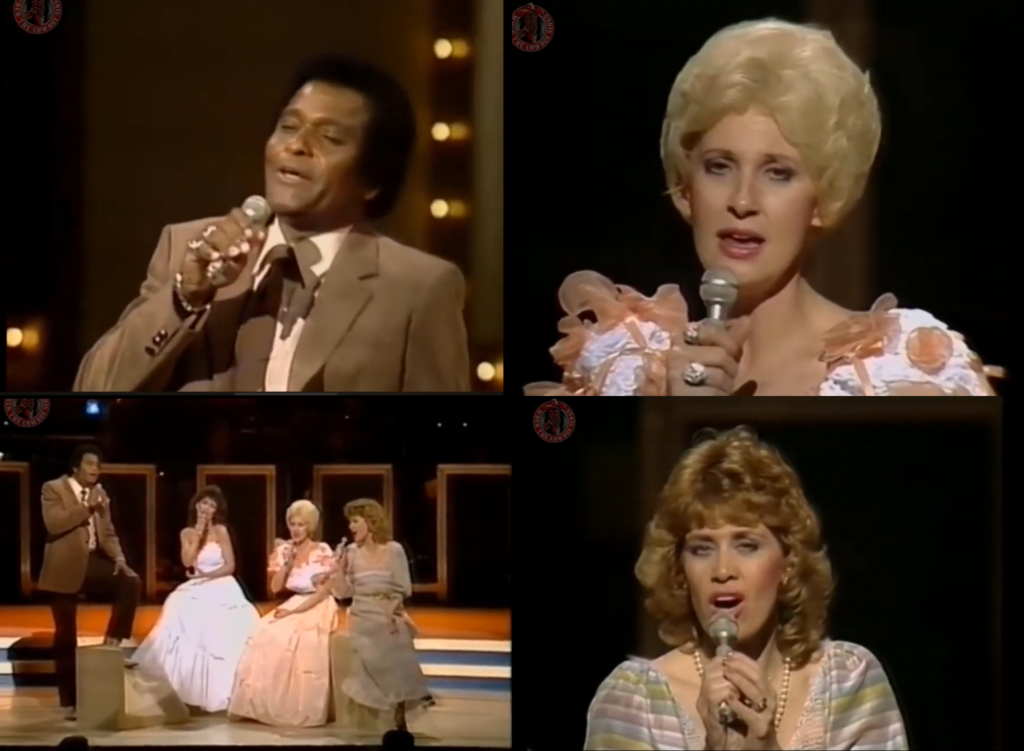
A gathering of voices in reverence—when country music’s finest women and Charley Pride honored the immortal spirit of Hank Williams
In 1983, a remarkable moment unfolded on stage when Charley Pride, Tammy Wynette, Janie Fricke, and Charly McClain came together for a heartfelt medley paying tribute to the legendary Hank Williams. Though not a charting single itself, this performance stands as a cultural echo of an era when country music still wore its heart plainly on its sleeve, rooted deeply in tradition, storytelling, and raw emotional truth.
By 1983, each of these artists had already carved their own place in the genre. Charley Pride, one of the most successful country artists of all time, had amassed dozens of No. 1 hits on the Billboard Hot Country Songs chart throughout the late 1960s and 1970s. Tammy Wynette, forever associated with the classic “Stand by Your Man” (a No. 1 country hit in 1968), had become the voice of resilience and heartbreak. Meanwhile, Janie Fricke was enjoying her own peak, with No. 1 hits like “Don’t Worry ’Bout Me Baby” (1982), and Charly McClain had just reached No. 1 with “Who’s Cheatin’ Who” (1981).
And yet, when they stood together to honor Hank Williams, all individual accolades seemed to fall away. Because in truth, every note they had ever sung, every story they had ever told, could be traced back—at least in spirit—to him.
Hank Williams, who passed away tragically young in 1953, never saw the full reach of his influence. But by the early 1980s, his songs had become the very foundation of country music’s identity. Classics like “Your Cheatin’ Heart,” “I’m So Lonesome I Could Cry,” and “Cold, Cold Heart” were no longer just songs—they were part of the emotional vocabulary of an entire genre.
This medley performance in 1983 carries a quiet reverence that is difficult to replicate in modern tributes. There is no sense of spectacle for its own sake. Instead, there is a deep, almost unspoken understanding among the performers. Each artist approaches the material not as an opportunity to reinterpret, but as a responsibility—to preserve, to honor, and to remember.
Tammy Wynette’s voice, always rich with lived emotion, brings a fragile honesty to the ballads. There is a sense that she does not merely sing the lyrics—she inhabits them. Her phrasing lingers just long enough to let the sorrow settle in.
Janie Fricke, with her smooth, polished tone, offers contrast—her delivery more restrained, yet no less sincere. She bridges the traditional and the contemporary sound of early 1980s country, reminding listeners how the genre was evolving while still holding onto its roots.
Charly McClain, often associated with a more modern country-pop sensibility, steps into the older material with surprising ease. Her voice carries a youthful clarity, but there is respect in every note—a recognition that these songs demand something deeper than technical precision.
And then there is Charley Pride. His presence in the medley feels grounding, almost symbolic. Pride himself had broken barriers in country music, not only through his success but through his quiet dignity in an industry that was not always welcoming. When he sings Hank Williams, there is a sense of continuity—one pioneer honoring another, across time and circumstance.
What makes this tribute particularly moving is not just the music, but the atmosphere it creates. There is a stillness between the lines, a kind of shared memory that seems to hover over the performance. It is the kind of moment where the audience is not simply listening—they are remembering, each in their own way.
Unlike studio recordings that chase perfection, this live medley embraces imperfection in the most human sense. Slight variations in phrasing, subtle differences in tone—these are not flaws, but reminders that this music lives and breathes through those who carry it forward.
And perhaps that is the true legacy of Hank Williams. Not just the songs themselves, but the way they continue to find new voices, new interpretations, new moments of connection.
The 1983 medley does not attempt to modernize or reinvent. It does something far more meaningful—it pauses. It looks back. It acknowledges the path that led to that stage.
And in doing so, it reminds us that country music, at its very core, has always been about something simple and profound: telling the truth, even when it hurts… and singing it anyway.