
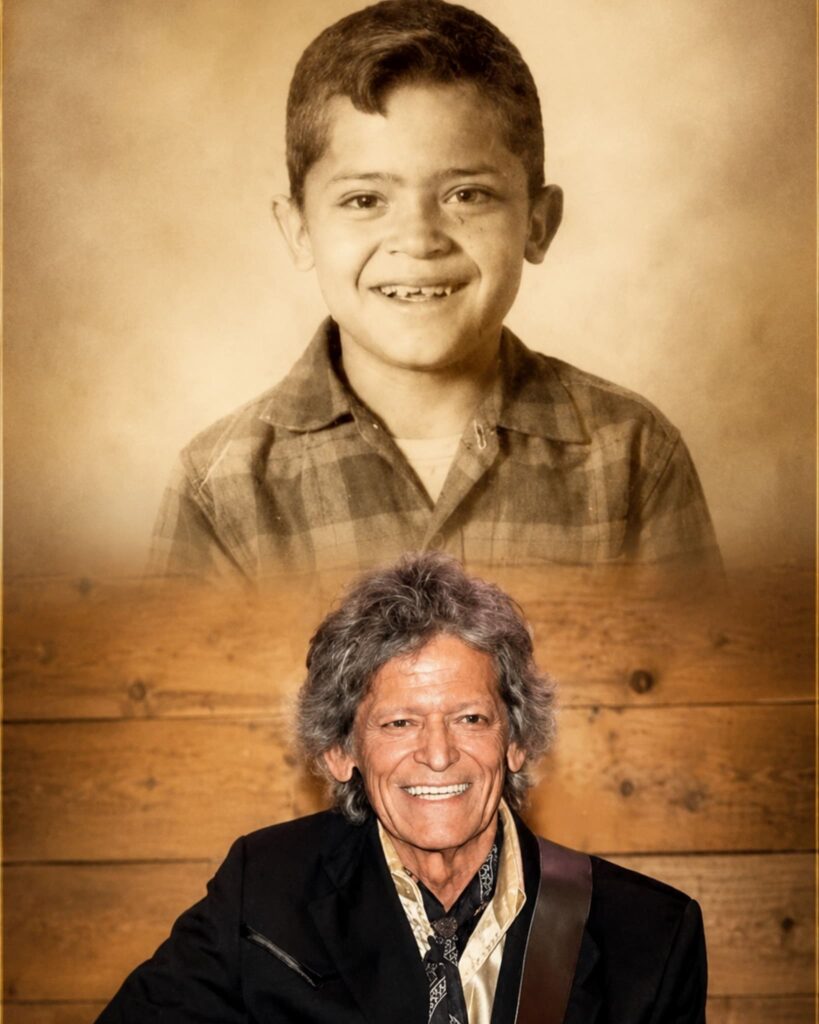
From a jail cell to No.1—how Johnny Rodriguez turned pain into one of country music’s most powerful voices
Long before the spotlight found him, Johnny Rodriguez was just a teenager sitting behind bars in Texas—unknown, unheard, and carrying a weight most people his age could never fully understand. Loss had already shaped his life in ways that left deep silence behind. His father was gone. His older brother was gone. And in that quiet, music became his only refuge—the only way to give voice to something too heavy to hold inside.
He sang not for an audience, but to survive the stillness. And somehow, that raw, unpolished voice carried beyond the walls.
It reached the ears of Joaquin Jackson, a Texas Ranger who happened to hear the young man singing from his cell. There was something unmistakable in it—not just talent, but truth. The kind that can’t be taught, only lived. That moment, quiet as it was, would become the turning point of everything that followed.
Word began to travel. Eventually, it reached Happy Shahan, who offered Johnny a chance to perform at Alamo Village—a far cry from the concrete walls he had known. For the first time, his voice met an audience. And people listened. Not out of curiosity, but because they felt something real in what he carried.
From there, doors began to open—ones that might have seemed impossible just months earlier. Country legends like Tom T. Hall and Bobby Bare recognized what they were hearing and helped guide him toward the next step. It wasn’t overnight fame. It was momentum built on authenticity.
By the age of just 21, Johnny Rodriguez signed with Mercury Records, stepping into a world that had no idea how close it had come to never hearing him at all. Then, in 1973, everything changed.
His single “You Always Come Back to Hurting Me” climbed to No.1 on the country charts, marking the arrival of a voice that felt both fresh and deeply rooted in emotion. It was quickly followed by hits like “Ridin’ My Thumb to Mexico” and “That’s the Way Love Goes”, songs that carried the same honesty that once echoed through a jail corridor.
What made Johnny Rodriguez stand out wasn’t just success—it was the story inside the sound. There was a lived-in quality to his voice, something that couldn’t be replicated. Listeners weren’t just hearing music; they were hearing survival, resilience, and a kind of quiet defiance against the odds.
And perhaps that’s the most powerful part of his journey. Before Nashville embraced him, before the charts confirmed his place in country music history…
Texas had already heard him.
Not in a concert hall. Not on the radio.
But in a place where hope is hardest to hold onto—
and where, somehow, he found a way to sing anyway.