
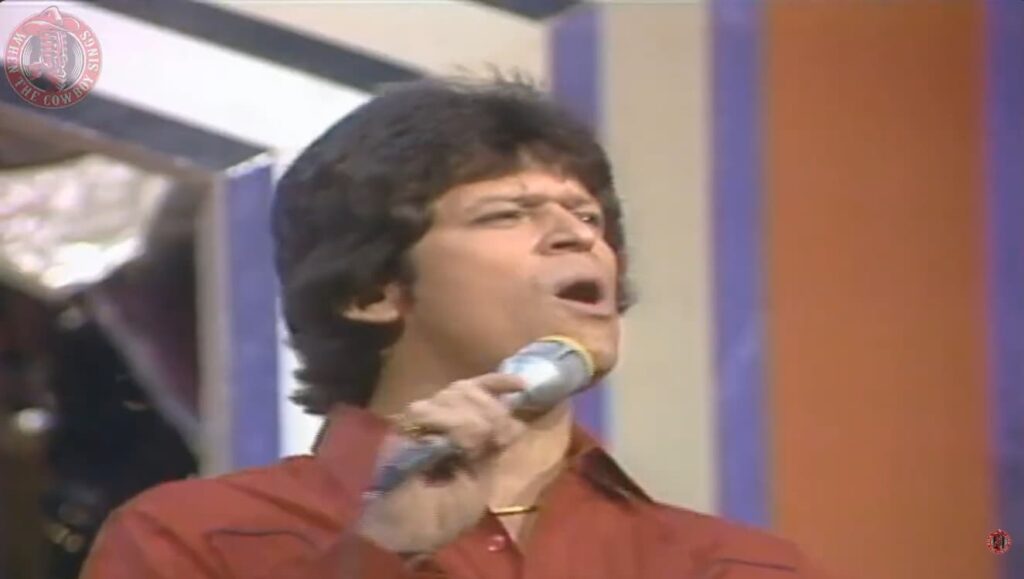
A quiet confession of longing—“I Want You Tonight” captures the fragile space between desire and distance, where love feels closest just before it slips away
When Johnny Rodriguez released “I Want You Tonight” in 1977 as part of the album Rodriguez, the song marked a subtle but meaningful moment in his evolving career. It reached No. 13 on the Billboard Hot Country Singles chart, a respectable showing during a period when country music itself was beginning to shift—leaning toward smoother production and broader crossover appeal. While it did not achieve the chart-topping success of earlier hits like “Ridin’ My Thumb to Mexico” or “That’s the Way Love Goes,” the song holds a quieter significance, revealing an artist moving inward rather than outward.
By the late 1970s, Johnny Rodriguez had already established himself as one of the most distinctive voices in country music. His phrasing, often relaxed yet emotionally precise, carried a kind of natural storytelling that never felt forced. In “I Want You Tonight,” that quality becomes especially apparent. There is no attempt to overwhelm the listener with dramatic gestures. Instead, the song unfolds gently, almost hesitantly, as though aware that the emotions it carries are too delicate for excess.
The story behind the song is not tied to a single widely documented event, but it reflects a recurring theme in Rodriguez’s work—the tension between presence and absence, between wanting and knowing that what is wanted may not remain. The lyrics are direct, even simple on the surface, yet beneath that simplicity lies a deeper uncertainty. The desire expressed is immediate—“tonight”—but the implication is that tomorrow may bring distance once again.
Musically, the arrangement mirrors this emotional balance. The instrumentation is smooth, understated, with soft steel guitar lines and a steady rhythm that never intrudes upon the vocal. It is the kind of production that defined much of late-1970s country, where clarity and warmth took precedence over rawness. Yet within that polished sound, Rodriguez’s voice retains its individuality. There is a slight weariness in his tone, a subtle hint that the longing he expresses is not new, but familiar—perhaps even expected.
What makes “I Want You Tonight” resonate is not its narrative complexity, but its emotional honesty. It does not attempt to resolve the situation it presents. There is no promise of reconciliation, no assurance that the moment will lead to something lasting. Instead, it exists entirely within the present—a fleeting window where feeling takes precedence over outcome.
In this way, the song reflects a broader truth about relationships that is rarely spoken aloud. Not every connection is meant to endure, yet that does not diminish its significance. Sometimes, what matters most is the recognition of the moment itself—the willingness to acknowledge what is felt, even if it cannot be held onto.
Rodriguez’s delivery reinforces this idea through restraint. He does not push the melody beyond its natural limits. He allows space between phrases, giving the listener time to absorb not just the words, but the silence that surrounds them. It is within that silence that the song finds its depth.
Listening now, “I Want You Tonight” carries with it a sense of reflection that may not have been immediately apparent upon its release. It feels less like a plea and more like a memory—something revisited rather than experienced for the first time. The passage of time has softened its edges, revealing layers that might have once gone unnoticed.
In the end, Johnny Rodriguez offers no grand statement, no definitive conclusion. He simply presents a moment, fully aware of its impermanence. And perhaps that is why the song continues to linger. Not because it demands to be remembered, but because it quietly becomes part of the listener’s own memory—one that returns, unexpectedly, long after the music has faded.