
A haunting tale of temptation and illusion, carried through time by a voice that refuses to fade
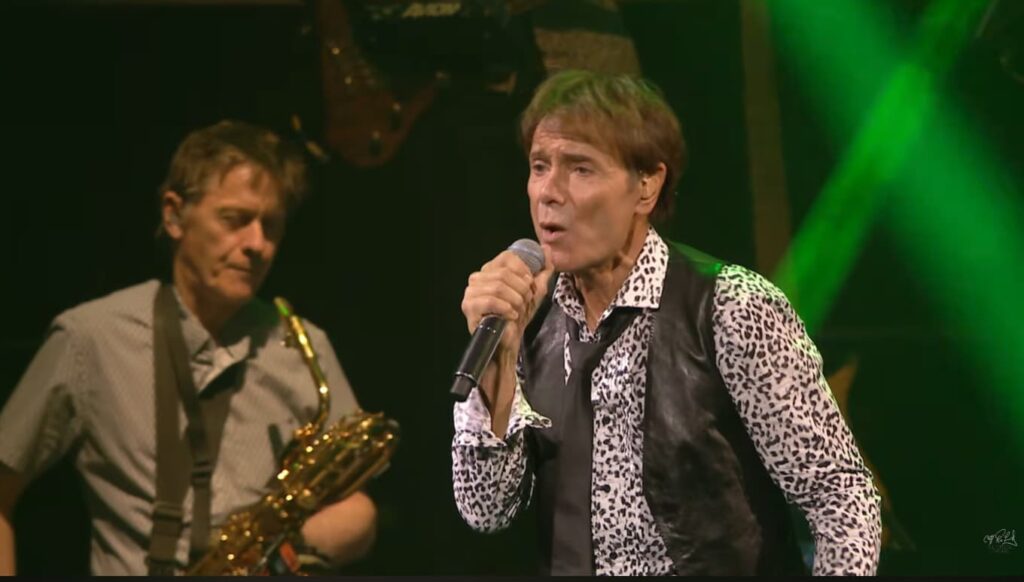
When Cliff Richard took the stage at the Royal Albert Hall on October 14, 2015, celebrating his remarkable 75th Birthday Concert, the performance of “Devil Woman” was not merely a nostalgic revisit—it was a powerful reaffirmation of an artist’s enduring presence. Decades after its original release, the song still pulsed with an eerie energy, proving that some melodies do not age; they evolve, gathering new meaning with every passing year.
Originally released in 1976, “Devil Woman” marked a significant turning point in Cliff Richard’s career. At a time when he was seeking to reestablish himself in an ever-changing musical landscape, the song became a bold departure from his earlier, more wholesome image. Written by Terry Britten and Christine Holmes, the track introduced a darker, more mysterious tone—one that hinted at danger, obsession, and the seductive pull of the unknown. It was a risk, but one that paid off handsomely.
Upon its release, “Devil Woman” achieved considerable chart success. It reached No.9 on the UK Singles Chart and climbed even higher internationally, peaking at No.6 on the Billboard Hot 100 in the United States—a rare and notable achievement for a British artist during that period. The song also appeared on the album “I’m Nearly Famous” (1976), which itself marked a creative resurgence for Cliff Richard, helping to redefine his musical identity for a new generation.
Yet beyond its commercial triumph, the true intrigue of “Devil Woman” lies in its narrative. The song tells the story of a man entangled with a mysterious fortune teller, a figure both alluring and ominous. It draws from themes of superstition, fate, and emotional vulnerability—ideas that resonate deeply, especially when viewed through the lens of experience. The “devil woman” is not merely a character, but a symbol: of temptation, of illusions we willingly embrace, and of the consequences that often follow.
By the time of the 2015 performance, Cliff Richard’s voice had matured, gaining a richness that only time can bestow. There is a subtle shift in interpretation—where once the song may have carried a sense of youthful curiosity, it now feels more reflective, almost cautionary. Each line is delivered with precision, but also with a quiet understanding of the story’s deeper implications. The audience, too, seems to recognize this transformation, responding not just to the music, but to the journey behind it.
The setting of the Royal Albert Hall adds another layer of significance. This historic venue, with its grand architecture and storied past, serves as the perfect backdrop for such a moment. It is a place where music is not simply performed, but remembered. As Cliff Richard stands beneath its iconic dome, there is a sense of continuity—of an artist who has traveled through decades of change, yet remains unmistakably himself.
What makes this performance particularly moving is the balance between vitality and reflection. There is still energy in the delivery, still a spark that recalls the earlier years. But there is also a calmness, a sense of perspective that transforms the song into something more than entertainment. It becomes a conversation between past and present, between who we were and who we have become.
In revisiting “Devil Woman” at this stage in his life, Cliff Richard offers more than a performance—he offers a reminder. That music, at its best, is not fixed in time. It grows with us, revealing new layers, new meanings, new truths. The shadows within the song feel less like something to fear, and more like something to understand.
And so, as the final chords echo through the hall, what lingers is not just the memory of a hit song, but the quiet realization that even the most mysterious stories can, over time, become familiar companions—guiding us gently through the changing landscapes of our own lives.