
A gentle surrender to time and feeling, where life is best understood not by holding on—but by learning to let go
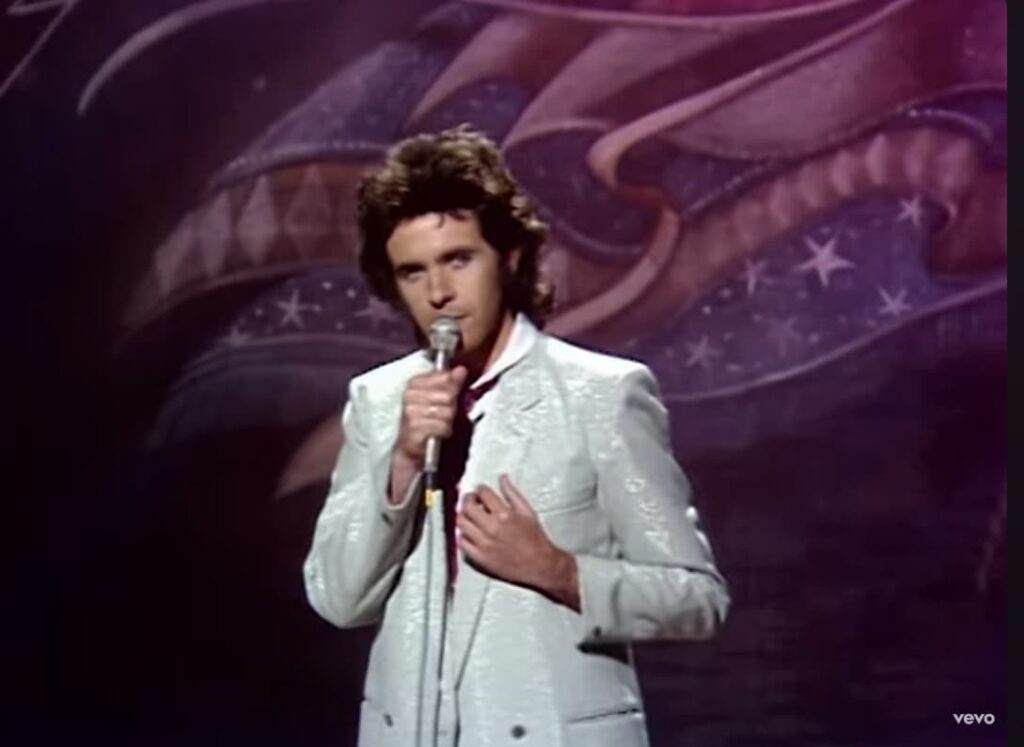
There are moments in an artist’s journey when the need to impress quietly fades, replaced by something more enduring: the desire to express. David Essex’s Let It Flow belongs to that reflective chapter—a song that does not chase the charts, but instead settles into the listener with a calm, almost meditative grace. Unlike his earlier hits such as Rock On (UK No. 1 in 1973, US No. 5) or Hold Me Close (UK No. 1 in 1975), “Let It Flow” did not achieve notable chart success upon release. Yet, in many ways, it reveals a deeper layer of Essex as an artist—one less concerned with acclaim and more attuned to the quiet truths that emerge over time.
By the time this song appeared in his repertoire, David Essex had already lived through the rise and transformation of popular music. The urgency of youth, the energy of fame, the relentless pace of success—all of it had softened into perspective. “Let It Flow” feels like the natural outcome of that evolution. It is not a song that demands attention; it invites reflection. And in doing so, it offers something rare: a sense of peace.
The message at the heart of the song is deceptively simple. To “let it flow” is to accept life as it comes—to resist the instinct to control every outcome, to allow emotions to move freely rather than be held back. It is a philosophy that often arrives only after experience has had its say. In Essex’s delivery, there is no urgency, no insistence. Instead, there is a quiet assurance, as though he is sharing something learned rather than something imagined.
Musically, the song mirrors this sentiment with understated elegance. The arrangement is gentle, built around soft instrumentation that supports rather than leads. There are no dramatic crescendos, no abrupt changes—just a steady, flowing rhythm that carries the listener forward. It is music that breathes, that allows space between notes, and in that space, meaning begins to form.
What makes “Let It Flow” particularly compelling is its emotional restraint. In an era where expression often leans toward the immediate and the intense, this song takes a different path. It speaks in a quieter voice, one that trusts the listener to meet it halfway. There is a sense of acceptance woven through every line—not resignation, but a calm understanding that not everything needs to be resolved.
For those familiar with David Essex’s earlier work, this song offers a striking contrast. Where once there was youthful energy and a drive toward recognition, here there is reflection and a willingness to slow down. It is the sound of an artist who has nothing left to prove, and therefore everything left to say.
Listening to “Let It Flow” today feels like sitting beside a quiet stream, watching the water move without urgency. It does not ask for attention, yet it holds it effortlessly. It brings to mind moments when life seems to pause—when the noise recedes, and something clearer begins to emerge. In those moments, the song finds its true resonance.
There is also a subtle sense of reassurance in its message. Life, with all its unpredictability, does not need to be mastered. It can be experienced, allowed, understood in its own time. This perspective gives the song a kind of timelessness. It does not belong to a specific era, because its message is not bound by one.
In the end, “Let It Flow” may not stand among the most celebrated titles in David Essex’s catalog, but it holds a quiet importance. It represents a turning inward, a moment of clarity that comes not from striving, but from acceptance. And in that acceptance, there is a kind of beauty—soft, enduring, and deeply human. It is a reminder that sometimes, the most meaningful songs are not the ones that rise the highest, but the ones that stay with us the longest… gently, steadily, like a current we learn not to resist.