
A hypnotic pulse of rebellion and introspection—where rhythm becomes identity, and youth echoes through time
There are songs that define a moment, and then there are songs that seem to exist outside of time altogether. Rock On by David Essex belongs firmly to the latter. First released in 1973 as part of the album Rock On, the track achieved remarkable success, reaching No. 3 on the UK Singles Chart and later climbing to No. 5 on the Billboard Hot 100 in the United States in 1974. It was a breakthrough moment that transformed Essex from a rising performer into a distinctive voice of his era.
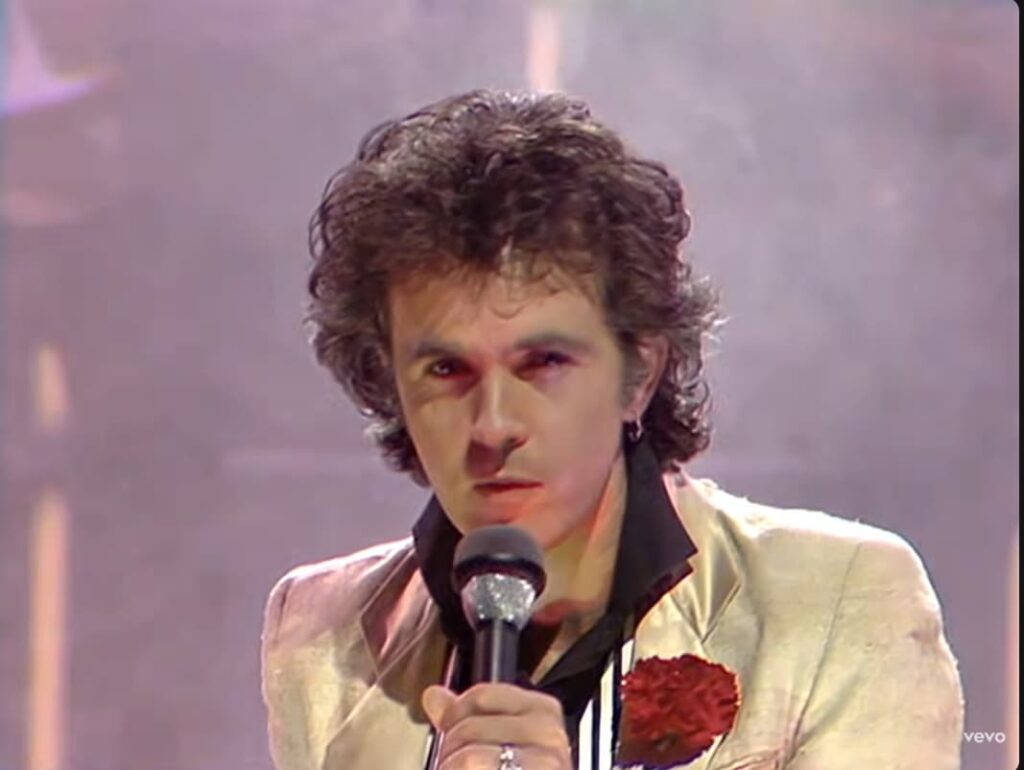
Yet, nearly a decade later, the 1982 live performance from the “David Essex Showcase” offers something altogether different—something quieter, more reflective, yet no less powerful. By this point, the urgency of the early 1970s had softened. The cultural noise had shifted, trends had come and gone, but “Rock On” endured. And in that 1982 rendition, one can hear not just a song being performed, but a relationship between artist and time unfolding in real moment.
The story behind “Rock On” is as unconventional as the song itself. Produced by Jeff Wayne, the track was notable for its sparse arrangement—famously lacking a traditional drum kit, instead relying on a haunting bass line and layered percussion to create its signature rhythm. This minimalist approach gave the song an almost hypnotic quality, allowing Essex’s voice to drift, whisper, and echo in ways that felt both intimate and distant. It was not merely a pop song; it was an atmosphere.
Lyrically, the song paints fragmented images of youth culture—references to icons like James Dean, fleeting impressions of rebellion, and a sense of searching for identity in a world that feels both exciting and uncertain. There is no linear narrative, no clear resolution. Instead, “Rock On” captures a feeling—a mood that resonates precisely because it is incomplete, because it leaves space for the listener to fill in the gaps.
By 1982, when Essex revisited the song on stage, that youthful ambiguity had taken on new meaning. The performance carries a different weight, shaped by years of experience and reflection. The voice is still unmistakable, but there is a subtle shift in tone—a deeper resonance, a quieter confidence. Where the original recording felt exploratory, almost experimental, the live version feels assured, as though the song has found its place in the artist’s life.
Musically, live renditions of “Rock On” often expand upon the original’s minimalism while still respecting its core essence. The rhythm remains steady, almost meditative, but there is a warmth in the live instrumentation that adds a new dimension. It is less distant, more grounded—like a memory revisited with clarity rather than confusion.
What makes this 1982 performance particularly compelling is the sense of continuity it represents. Songs like “Rock On” are often tied to a specific time, a specific audience. But here, it proves its durability. It no longer belongs solely to the era that created it; it belongs to anyone who has ever paused to consider where they stand in the passage of time.
There is also something deeply انسانی—deeply human—about the way Essex approaches the song in this setting. He does not attempt to recreate the past note for note. Instead, he allows the song to evolve, to reflect who he has become. And in doing so, he offers something more meaningful than nostalgia: he offers perspective.
The enduring appeal of “Rock On” lies in its ability to remain open-ended. It does not dictate how it should be felt or understood. It simply exists, inviting reflection. In 1973, it may have sounded like the voice of youth searching for direction. In 1982, it becomes something else—a quiet acknowledgment of the journey itself.
And perhaps that is why the song continues to resonate. Because no matter how much time passes, there is always a part of us that recognizes that rhythm, that voice, that feeling of standing between what was and what is yet to come.
In the end, “Rock On” is not just a song—it is a moment suspended in sound. And in the hands of David Essex, especially in that 1982 live performance, it becomes a reminder that while everything changes, some echoes never truly fade.