
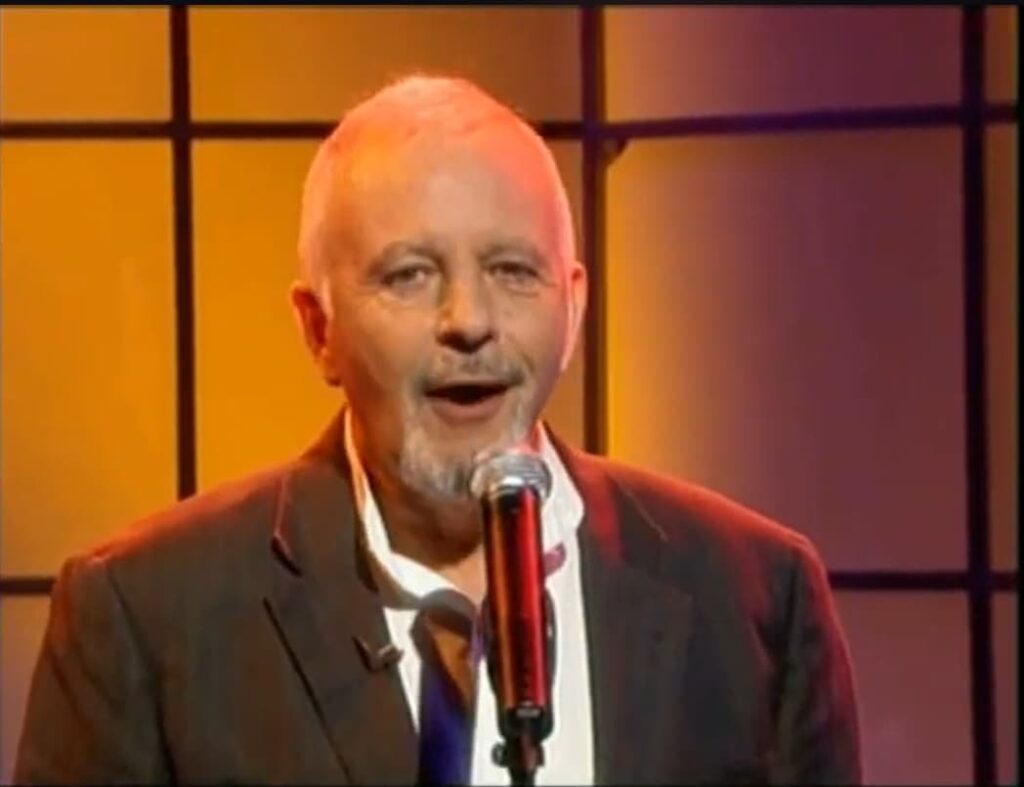
A fleeting return to the spotlight, where time softens the edges of fame and leaves behind only the voice—and the memories it still carries
On September 16, 2008, David Essex took to the stage once more, offering a performance that was less about chart positions and more about continuity—about the enduring thread that connects past triumphs to present reflection. While this particular appearance was not tied to a new charting single, it cannot be understood without looking back at the remarkable success that first defined his career. Songs like Rock On, which reached No. 1 on the UK Singles Chart in 1973 and climbed to No. 5 on the US Billboard Hot 100, and Hold Me Close, another UK No. 1 hit in 1975, had long secured his place in the golden era of British pop.
By the time of this 2008 performance, the world around him had changed in countless ways. Musical styles had evolved, audiences had shifted, and the industry itself had become something almost unrecognizable compared to the one he first entered. Yet when David Essex stood before a live audience, there remained a quiet familiarity—something unmistakably his. It was not just the voice, though that still carried its distinctive texture, but the presence: calm, assured, and touched by the kind of experience that cannot be imitated.
What makes performances like this so compelling is not the pursuit of perfection, but the embrace of time. There is a subtle transformation that occurs in artists who continue to perform across decades. The youthful urgency that once drove their early recordings gives way to something more measured, more reflective. In Essex’s case, this shift feels particularly natural. His songs, often rooted in melody and mood rather than sheer vocal display, lend themselves to reinterpretation as the years pass.
The 2008 setting—intimate, unhurried—allowed for that reinterpretation to unfold. There was no need to recreate the exact energy of the 1970s. Instead, the performance carried a sense of looking back, not with regret, but with a quiet understanding. Each note seemed to acknowledge the distance traveled, both by the artist and by those listening. It is in these moments that music reveals one of its most enduring qualities: its ability to remain the same, even as everything around it changes.
For many, hearing David Essex again in this later chapter evokes more than just recognition. It brings with it a flood of associations—places, times, emotions that have long since passed but are never entirely gone. A familiar melody can do that. It can collapse years into seconds, turning a present moment into something layered and complex. And Essex, with his understated delivery, seems to understand this instinctively. He does not overreach; he allows the music to do its quiet work.
There is also something deeply human in witnessing an artist continue to engage with their own legacy. It is not always easy to revisit songs that once defined a particular moment in life. Yet Essex approaches it with a sense of ease, as though those songs are not relics, but companions—still relevant, still alive in their own way. This perspective gives the performance a warmth that cannot be manufactured.
Musically, the arrangements in such live appearances often lean toward simplicity. Stripped of heavy production, the songs return to their core elements—melody, lyric, and voice. In doing so, they reveal a different kind of strength. What once might have been driven by rhythm and energy now rests on nuance and phrasing. It is a shift that invites closer listening, rewarding those who pay attention to the subtle details.
In the end, the significance of David Essex’s performance on that September evening lies not in novelty, but in continuity. It is a reminder that music does not belong solely to the moment in which it was created. It evolves, not by changing its form, but by deepening its meaning over time. And when an artist returns to it—years later, with a lifetime behind them—it becomes something richer, more textured, and perhaps more honest.There is a quiet beauty in that kind of return. No grand statements, no dramatic reinventions—just a voice, a song, and the passage of time gently woven between them.
Video:
