
A Whisper Turned Revolution—“Rock On” and the Quiet Power of Reinvention in a Changing Musical Era
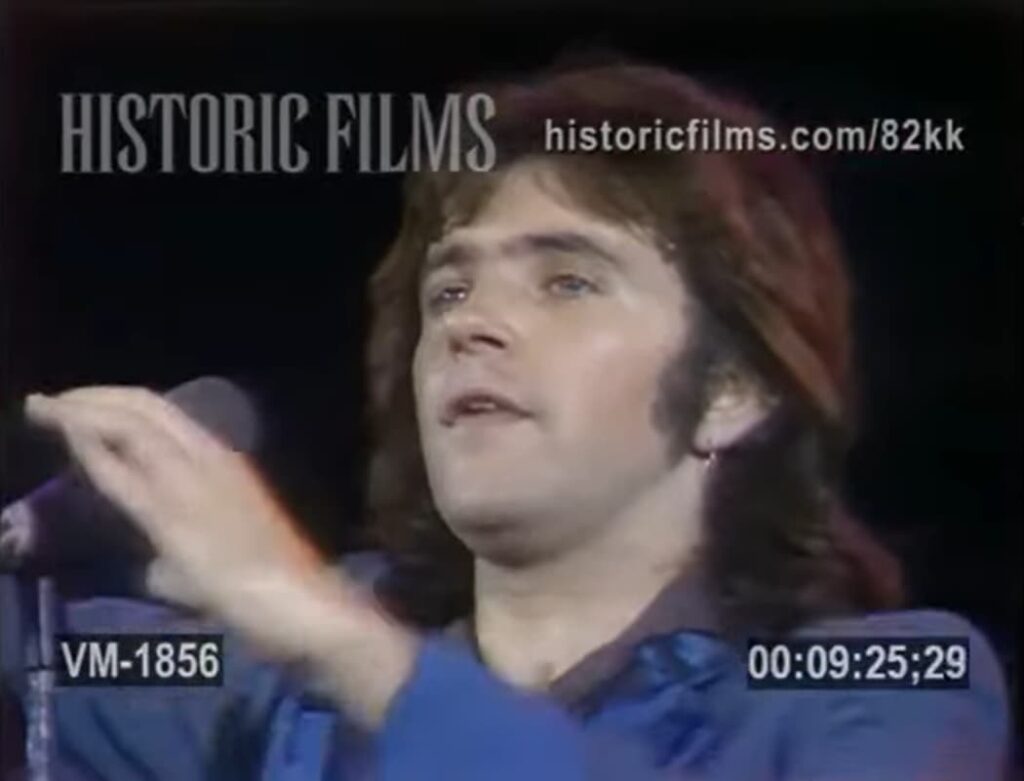
When David Essex stepped onto the stage of “Don Kirshner’s Rock Concert” in 1976 to perform “Rock On,” he was no longer simply the rising British star who had first introduced the song to the world three years earlier—he had become something far more intriguing: an artist who understood how to evolve without losing the essence of what made him unforgettable.
Originally released in 1973 as the lead single from his debut album “Rock On,” the song quickly distinguished itself from everything else on the airwaves. It climbed to No. 3 on the UK Singles Chart and crossed the Atlantic to reach No. 5 on the Billboard Hot 100 in 1974, an impressive feat for a track so unconventional in both structure and sound. At a time when glam rock was often defined by bold theatrics and glittering excess, “Rock On” chose a different path—minimalist, hypnotic, and almost unsettling in its restraint.
That restraint became its signature.
Built around a sparse rhythm, an eerie echo, and Essex’s distinctive half-whispered vocal delivery, the song created an atmosphere that felt both intimate and distant, as if it were being transmitted from another space entirely. It was not a song that demanded attention through volume or speed. Instead, it drew listeners in quietly, almost mysteriously, holding them there with a tension that never fully resolved.
By the time of the 1976 performance on “Don Kirshner’s Rock Concert,” that tension had matured.
Television, in that era, played a crucial role in shaping how music was experienced. Shows like Kirshner’s provided a platform where artists could present themselves without the layers of studio production—where the song had to stand on its own, carried by presence and authenticity. For David Essex, this setting was particularly revealing. Without the controlled environment of the recording studio, the subtle complexities of “Rock On” became even more apparent.
There is something striking about watching him perform the song live.
Rather than amplifying its energy, he leans into its stillness. His voice, calm yet charged with quiet intensity, seems to hover just above the instrumentation. Every word feels deliberate, every pause meaningful. It is a performance that resists the urge to impress, choosing instead to immerse.
And perhaps that is why “Rock On” has endured.
Because beneath its unusual arrangement lies a deeper narrative—one that reflects the uncertainties of its time. The early 1970s were marked by cultural shifts, by a sense that the old certainties were fading and something new, though not yet fully understood, was emerging. In that context, the song’s detached tone and fragmented imagery begin to make sense. It is not merely about music or identity; it is about disconnection, about searching for meaning in a world that feels increasingly abstract.
The line between performer and observer blurs.
In his delivery, David Essex does not position himself as a storyteller in the traditional sense. He becomes part of the atmosphere, another element within the soundscape. This approach, subtle as it may seem, was quietly revolutionary. It challenged the expectation that a singer must always project outward, choosing instead to draw inward—to create a space where the listener must meet the song halfway.
The 1976 television performance captures this philosophy beautifully.
There is no excess, no distraction—only the song, unfolding in its own time. And in that simplicity, one begins to notice details that might otherwise go unheard: the texture of the rhythm, the echo trailing behind each phrase, the way silence is used as deliberately as sound.
Looking back, it becomes clear that “Rock On” was never meant to fit neatly into its era. It stood slightly apart, both of its time and ahead of it. Its influence can be traced in later artists who embraced minimalism and atmosphere, who understood that sometimes the most powerful statement is the one delivered softly.
In the end, what David Essex achieved with this performance—and with the song itself—was not just success, but distinction.
A reminder that music does not always need to shout to be heard.
Sometimes, it only needs to whisper… and trust that someone, somewhere, is listening closely enough to understand.