
A Role Refused, A Destiny Preserved — When Stepping Aside Became the Most Honest Choice of All
There are moments in music and film history that seem almost invisible at the time, yet carry a quiet, lasting significance. One such moment came when David Essex, already a prominent figure in 1970s pop culture, revealed decades later that Olivia Newton-John had once wanted him to take on the role of Danny in the iconic film Grease. In hindsight, his decision to step away—and his belief that John Travolta was the right choice—feels less like a missed opportunity and more like an act of artistic clarity.
By the time this possibility arose in the mid-1970s, David Essex was not an unknown figure seeking a breakthrough. Quite the opposite. He had already enjoyed tremendous success with songs like “Rock On”, which reached No. 5 on the UK Singles Chart in 1973 and later climbed to No. 1 on the Billboard Hot 100 in 1974 in the United States. His follow-up hit, “Gonna Make You a Star,” solidified his presence by reaching No. 1 in the UK. These were not fleeting successes—they were defining moments that placed him firmly among the era’s most recognizable voices.
Yet what made Essex distinctive was not just chart performance, but tone and temperament. His music carried a certain introspection, a thoughtful distance from the louder, more flamboyant currents of glam rock that surrounded him. Even at the height of his popularity, there was a sense that he stood slightly apart, observing rather than chasing the spotlight.
It is within this context that the story of “Grease” becomes particularly intriguing. The film, released in 1978, would go on to become a cultural phenomenon, with its soundtrack dominating charts worldwide and songs like “You’re the One That I Want” reaching No. 1 on the Billboard Hot 100. The role of Danny Zuko required not only vocal ability, but a certain charisma—an effortless blend of rebellion and charm that could carry both the music and the narrative.
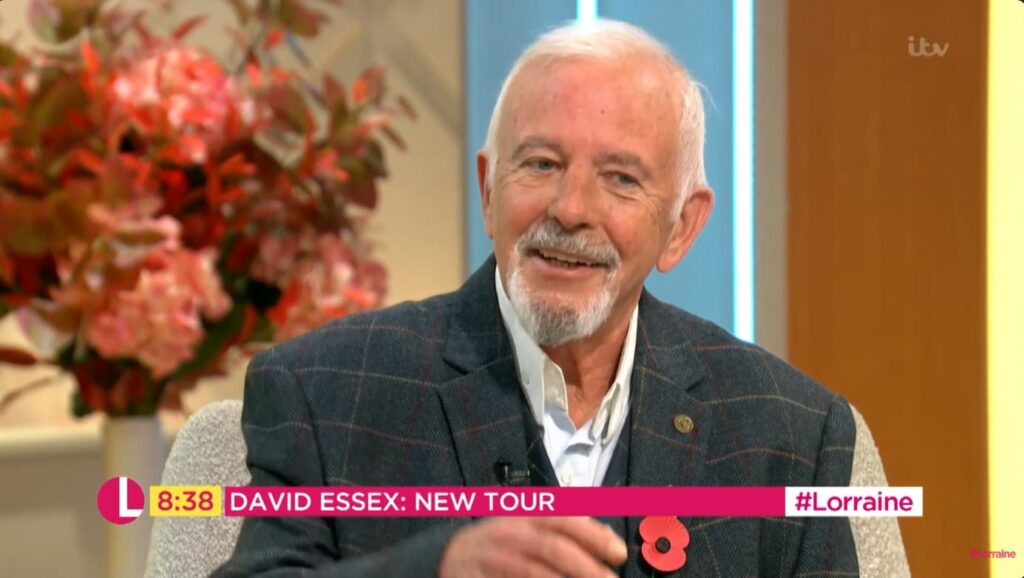
In a 2019 interview on the program Lorraine, David Essex reflected on this moment with remarkable humility. Rather than expressing regret, he spoke with a quiet conviction that John Travolta was, in fact, the perfect fit. It is a rare thing for an artist to recognize not only their own strengths, but also the precise point at which another’s presence is more fitting. That acknowledgment reveals much about Essex—not just as a performer, but as a craftsman who understood the nuances of artistic identity.
While the role of Danny slipped away, Essex’s own musical journey continued with a different kind of depth. His work in the years that followed retained its reflective quality, never fully surrendering to commercial trends. Decades later, when he announced his return to touring alongside the release of the album “Unplayed Hits”, it felt less like a comeback and more like a continuation—an artist revisiting the quieter corners of his catalog, the songs that had not been shaped by radio demands or public expectation.
The title itself, “Unplayed Hits,”, carries a certain poignancy. It suggests that success is not always measured by chart positions or airplay, but by the personal significance a song holds. In many ways, this philosophy mirrors the earlier decision regarding “Grease”. Not every opportunity must be taken. Not every spotlight must be embraced. Sometimes, the truest path lies in understanding what belongs to you—and what does not.
Looking back, the near-casting of David Essex in “Grease” becomes less about what might have been, and more about what was preserved. His identity as an artist remained intact, unshaped by a role that, while iconic, may have altered the course of his musical expression. Meanwhile, the film found its defining figure in John Travolta, whose performance would become inseparable from the character itself.
There is a quiet lesson in this story, one that resonates long after the charts have faded and the headlines have been forgotten. It speaks of restraint, of self-awareness, and of the rare courage it takes to step aside when the moment calls for it. In an industry often driven by ambition and visibility, such choices are seldom recognized for their depth.
And so, the legacy of David Essex remains not only in the songs that reached the top of the charts, but also in the paths he chose not to follow. In those decisions, one can hear a different kind of music—subtle, thoughtful, and enduring in a way that fame alone can never achieve.