
A Whisper Turned Anthem — When Rebellion Found Its Voice in Quiet Confidence
There are songs that arrive with thunder, and then there are songs like “Rock On”—songs that seem to emerge from somewhere quieter, more mysterious, and yet linger far longer in the memory. When David Essex performed “Rock On” live on British television in the early 1970s, it was not simply a performance; it was a moment that captured the shifting mood of an era. Released in 1973, the single climbed to No. 3 on the UK Singles Chart and, in a remarkable second life across the Atlantic, reached No. 1 on the Billboard Hot 100 in 1974—a rare and telling achievement for a song so understated in its delivery.
Included on the album “Rock On” (1973), the track stood in stark contrast to the prevailing sounds of the time. While glam rock often leaned toward flamboyance and spectacle, Essex offered something far more restrained. Built around a minimalist arrangement—muted percussion, a steady bassline, and that unforgettable echo-laden vocal—the song felt almost like a private conversation overheard rather than a performance designed for mass audiences. And yet, paradoxically, it was precisely this intimacy that drew listeners in.
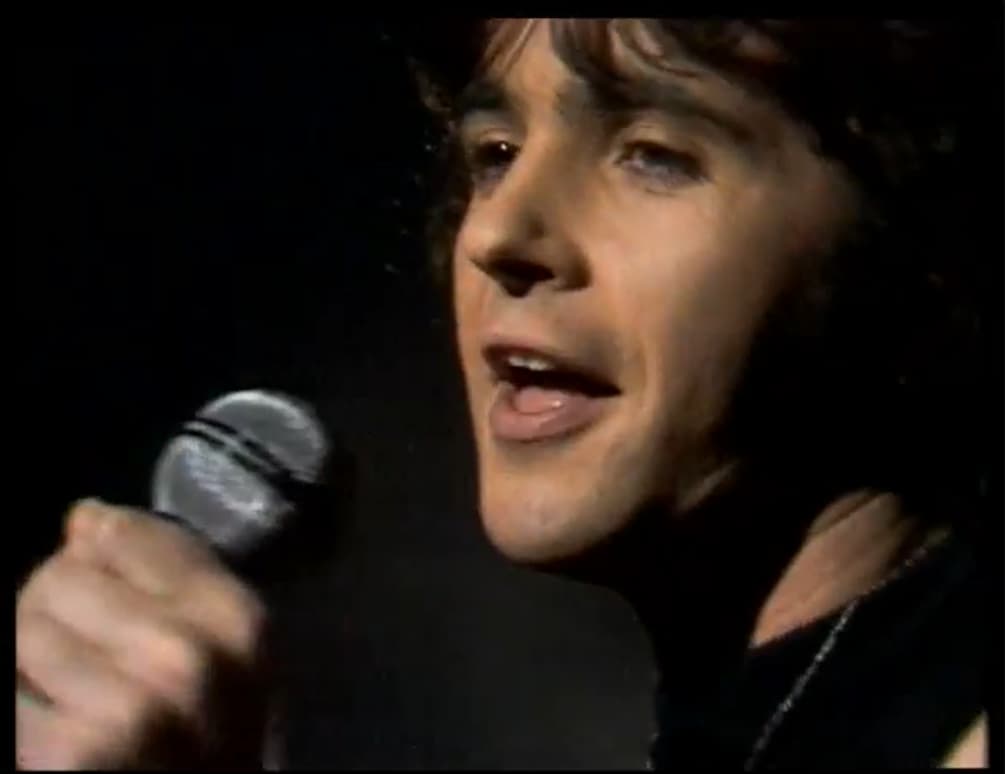
Watching David Essex deliver the song on an old UK television program, one is struck by the absence of excess. There are no elaborate stage effects, no grand gestures. Instead, there is a quiet intensity, a sense that the performer is entirely absorbed in the world of the song. His voice, soft and slightly detached, carries a subtle urgency—never demanding attention, yet impossible to ignore. It is a performance style that feels almost out of time, even by the standards of its own decade.
The origins of “Rock On” add another layer to its mystique. Essex has often spoken about how the song was written almost accidentally, shaped by experimentation rather than intention. The distinctive drum sound, for instance, was achieved through unconventional recording techniques, giving the track its haunting, hollow rhythm. These choices were not guided by commercial expectations; they were the result of curiosity, of a willingness to explore sound without knowing exactly where it might lead.
Lyrically, the song reads like a series of fragmented images—references to James Dean, cultural shifts, and a sense of youthful disillusionment. It does not tell a linear story, nor does it offer clear answers. Instead, it creates a mood, a feeling of standing at the edge of something uncertain yet inevitable. There is a quiet rebellion in its tone, not the loud defiance of protest songs, but a more introspective questioning of identity and direction.
What makes the live television performance particularly compelling is how it reveals the essence of the song without distraction. Stripped of studio layering, the core elements remain: the rhythm, the voice, and the atmosphere. It becomes clear that “Rock On” does not rely on production to sustain itself. Its strength lies in its simplicity, in the space it leaves for the listener to reflect.
By the time the song reached its peak in the United States, David Essex had already established himself as a significant presence in British music. Yet “Rock On” elevated him to an international stage, introducing a wider audience to his distinctive style. Unlike many hits of the period, it did not fade quickly. Instead, it continued to resonate, its influence subtly echoing in later works by artists who sought to capture a similar sense of understated cool.
There is something deeply evocative about revisiting this performance today. Perhaps it is the reminder of a time when music could be both experimental and accessible, when a song did not need to shout to be heard. Or perhaps it is the recognition of a voice that chose nuance over volume, reflection over immediacy.
In the end, “Rock On” remains a testament to the power of restraint. Through a combination of unconventional production, poetic ambiguity, and a quietly compelling performance, David Essex created something that feels both rooted in its time and remarkably timeless. Watching him perform it live, one senses not just the success of a hit single, but the presence of an artist fully in command of his own language—speaking softly, yet leaving an echo that continues to resonate long after the final note has faded.