
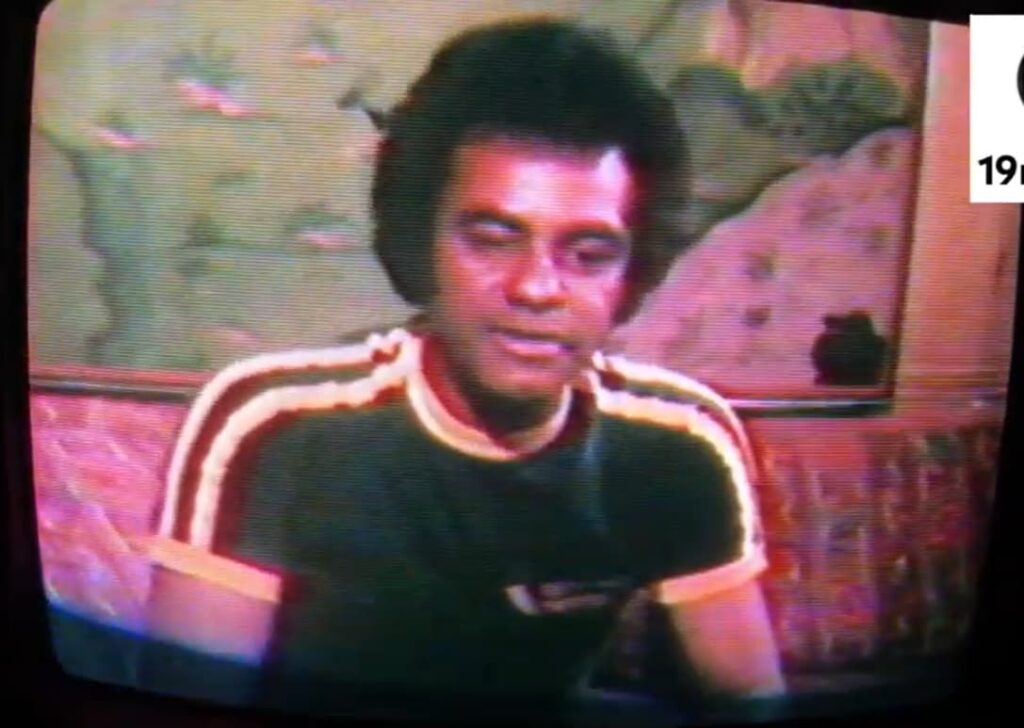
A quiet conversation at home reveals the soul behind one of the most enduring romantic voices in popular music.
In January of 1979, inside the calm and intimate setting of his Hollywood home, Johnny Mathis sat down for a remarkably personal interview with Bill Russell, a longtime friend whose presence seemed to dissolve the usual distance between artist and interviewer. Broadcast by ABC’s Channel 7 in Los Angeles, this was not a promotional appearance, nor a performance staged for applause. It was something far more revealing: a portrait of an artist in mid-career reflection, at a moment when his legacy was already firmly established, yet still unfolding.
By 1979, Johnny Mathis had long been recognized as one of the defining voices of romantic pop. His career began with extraordinary force in the late 1950s, when “Chances Are” (1957) reached No. 1 on the Billboard Most Played by Jockeys chart, followed closely by “It’s Not for Me to Say”, which became a Top 5 hit the same year. These early successes were not fleeting triumphs; they set the foundation for a style that would remain remarkably consistent—one rooted in warmth, control, and emotional sincerity.
Two decades later, Mathis experienced a remarkable resurgence with “Too Much, Too Little, Too Late” (1978), a duet with Deniece Williams that climbed to No. 1 on the Billboard Hot 100. It was a rare achievement—proof that his voice, though shaped by time, had lost none of its appeal. If anything, it had gained a deeper resonance, carrying with it the weight of experience and quiet understanding.
It is precisely this sense of continuity that defines the 1979 interview. Seated comfortably, speaking not as a distant star but as a reflective individual, Johnny Mathis reveals the inner landscape behind the music. There is no urgency in his voice, no need to impress. Instead, there is a calm, measured cadence—a way of speaking that mirrors the very qualities that made his recordings so enduring.
The conversation with Bill Russell carries a unique intimacy, shaped by mutual respect and shared history. Russell, known primarily for his legendary basketball career, approaches the interview not as a journalist seeking headlines, but as a friend seeking understanding. This dynamic allows Mathis to open up in ways rarely seen on traditional broadcasts. He speaks of discipline, of the importance of maintaining vocal integrity, and of the quiet dedication required to sustain a career across decades.
Though no single song dominates this moment, the presence of “Too Much, Too Little, Too Late” lingers in the background, both literally and symbolically. The song itself tells a story of love that has reached its natural conclusion—not with bitterness, but with acceptance. That same emotional maturity seems to permeate the interview. It is as though Mathis, like the narrator of the song, has come to terms with the passage of time, embracing it rather than resisting it.
There is also an understated elegance in the setting. The Hollywood home, far removed from the glare of stage lights, becomes a metaphor for the artist’s inner world—a place of quiet reflection, where music is no longer about performance, but about meaning. In this space, Johnny Mathis appears not as an icon, but as a custodian of a musical tradition that values melody, lyricism, and emotional truth above all else.
What emerges most clearly from this 1979 conversation is a sense of balance. Johnny Mathis stands at a point where past achievements and future possibilities coexist. He is neither looking back with regret nor forward with anxiety. Instead, he occupies the present with a rare sense of calm assurance.
For those familiar with his body of work—from the early innocence of “Chances Are” to the зрел, reflective tone of “Too Much, Too Little, Too Late”—this interview offers something invaluable: context. It reveals the man behind the voice, the discipline behind the ease, the thoughtfulness behind the simplicity.
And perhaps that is why this moment endures. Not because of spectacle or nostalgia alone, but because it captures something essential about Johnny Mathis—a quiet dedication to beauty, to consistency, and to the enduring power of a well-sung song. As the interview fades, one is left not with a sense of conclusion, but with a lingering note—soft, steady, and unmistakably sincere—echoing long after the conversation has ended.