
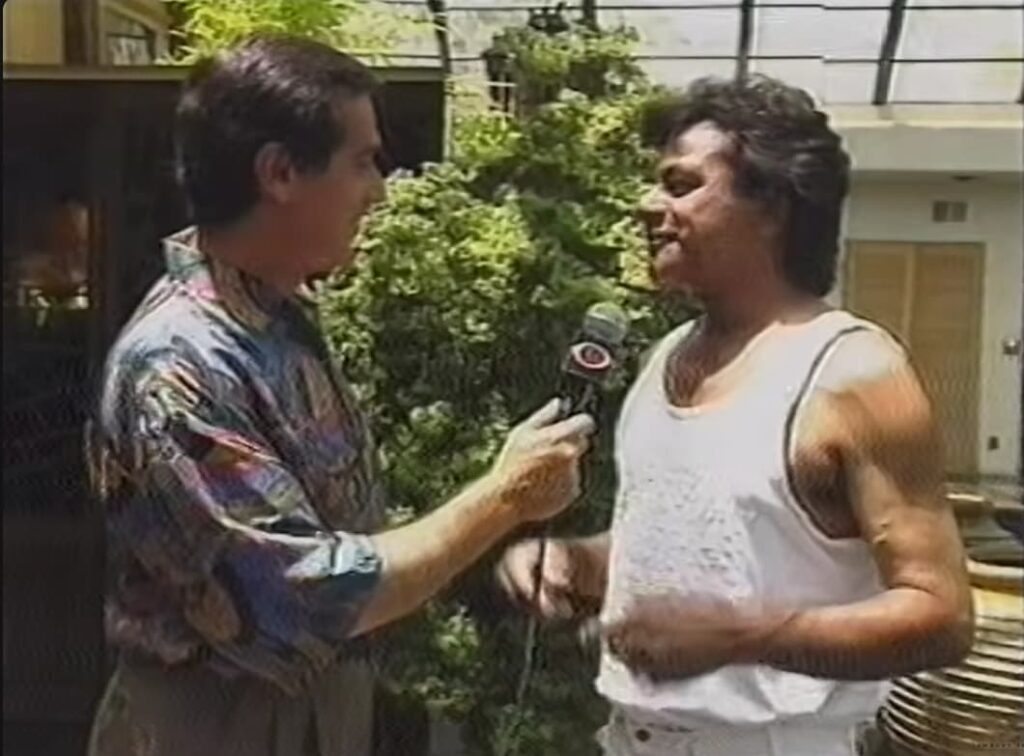
A quiet afternoon among melodies: when memory lingers in the voice of Johnny Mathis, where every note feels like a cherished conversation that never truly ends
There are moments in music history that are not defined by chart positions or awards, but by something far more intimate—an atmosphere, a voice in a room, a presence that transforms an ordinary visit into something quietly unforgettable. The story of Amaury’s visit to the home of Johnny Mathis in Hollywood belongs to that rare category. It is less about a single song, and more about a lifetime of songs distilled into one space, one voice, and one enduring legacy.
To understand the weight of such a moment, one must first consider who Johnny Mathis is—not merely as a singer, but as a living thread woven through decades of popular music. Emerging in the mid-1950s, Mathis quickly distinguished himself with a voice unlike any other: smooth, romantic, and almost impossibly controlled. His breakthrough came with “Chances Are” (1957), which reached No. 1 on the Billboard Most Played by Jockeys chart and No. 1 on the Best Sellers in Stores chart, cementing his place among the great vocalists of his era. That same year, his album “Johnny’s Greatest Hits” spent an astonishing 490 consecutive weeks on the Billboard 200—an achievement that speaks to the timeless appeal of his artistry.
By the time of Amaury’s visit, Mathis was no longer simply a chart-topping artist; he was an institution. His home in Hollywood, one can imagine, was filled not just with records and memorabilia, but with echoes—fragments of melodies that had once drifted across radios, dance halls, and quiet living rooms. Songs like “Misty” (1959), which became one of his signature recordings, carried with them a sense of longing so delicate that it felt almost weightless. Though it peaked at No. 12 on the Billboard Hot 100, its true success lay in its endurance, becoming a standard that transcended generations.What makes the image of that visit so compelling is the contrast between the grandeur of Mathis’s career and the intimacy of the setting. There is something profoundly moving about the idea of sitting in the presence of a voice that has accompanied so many private moments—first loves, quiet evenings, reflections that arrive unannounced. In such a setting, the music is no longer distant. It becomes immediate, almost tangible.
Although Amaury’s experience wasn’t widely documented in the traditional sense of industry data, charts, or awards, it represents something equally valuable: a personal connection with an artist whose work has shaped the emotional landscape of countless listeners. One can imagine the conversation unfolding naturally, perhaps interspersed with laughter, perhaps with silence—a silence that only exists when words are no longer necessary. And then, perhaps, a song. Not performed for an audience, not polished for a recording, but offered simply because it exists. In that moment, Johnny Mathis would not be the icon seen on album covers, but the man behind the voice—a voice that has always carried a sense of sincerity that cannot be manufactured.
There is a particular kind of nostalgia that emerges from such stories. It is not rooted in a desire to return to the past, but in an appreciation of what the past continues to offer. Mathis’s music has always been about connection—between singer and listener, between memory and emotion. In a world that often moves too quickly, his songs invite us to pause, to listen, to remember. The significance of this visit lies not in any specific details, but in the emotion it evokes. It reminds us that music is not something we hear; it is something we carry with us. And when we encounter the source of that music in such a personal way, it becomes more profound than ever.
Looking back, one might say that Amaury did not simply visit a home in Hollywood. He stepped into a living archive of emotion, where every note held a story, and every silence held meaning. And at the center of it all was Johnny Mathis, still singing—if not aloud, then through the countless memories his voice continues to inspire.In the end, that is the true legacy of an artist like Mathis. Not just the charts he topped or the records he sold, but the quiet, enduring presence he maintains in the lives of those who have listened. A presence that, much like that unforgettable visit, remains long after the moment itself has passed.