
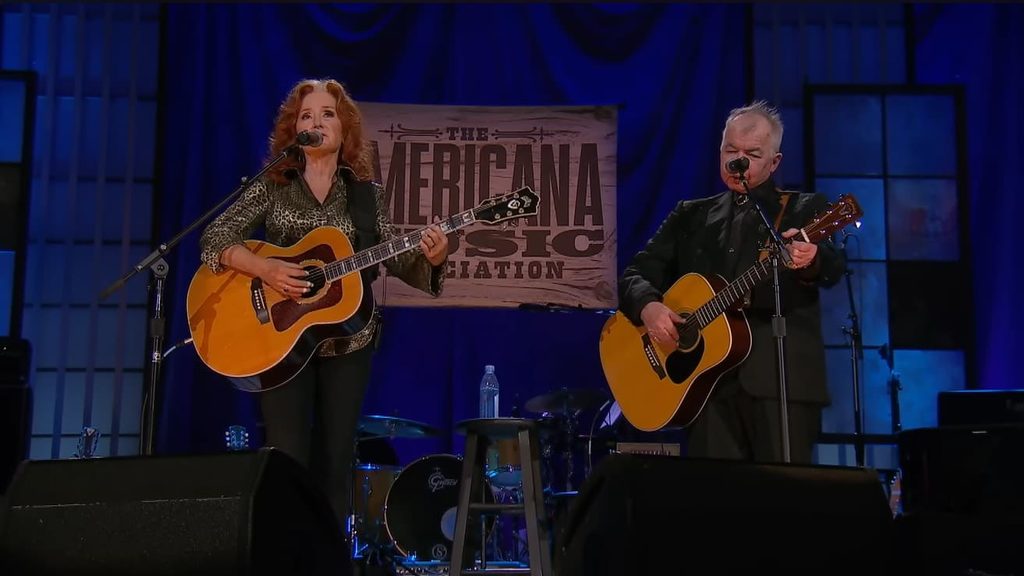
“Angel From Montgomery” became more than a song for Bonnie Raitt and John Prine, it became a musical friendship that lasted for nearly five decades
Some songs seem to belong to the person who wrote them. “Angel From Montgomery” became something larger. John Prine wrote it for his self-titled debut album in 1971, imagining the life of a middle-aged woman who feels trapped in an ordinary existence and longs for some kind of escape. Then, in the early 1970s, Bonnie Raitt heard it and immediately understood what she wanted to do with it. She recorded her version for Streetlights, released in 1974, and the song became one of the defining pieces of her repertoire. Raitt’s official discography lists Prine as the songwriter and places the recording among the ten tracks on the album, produced by Jerry Ragovoy and recorded at The Hit Factory in New York.
What makes their connection so beautiful is that Raitt did not simply discover a great song and turn it into a successful cover. She became one of the people who helped give Prine’s writing a much wider audience. She later recalled hearing his debut album and being astonished by the number of brilliant songs on it. Of “Angel From Montgomery,” she said she knew she wanted to record it the moment she heard it. She was particularly struck by the fact that such a young male songwriter could inhabit the perspective of a woman who felt old before her time and make her inner life feel so real.
Their friendship developed alongside their music. Raitt and Prine were contemporaries at the beginning of their careers and spent time touring together, including on the college circuit. Raitt remembered those years with extraordinary affection, describing Prine as someone whose humour, compassion and unusual way of observing people made him impossible not to admire. She also said she could hardly imagine her twenties without him. Their relationship was never simply about one famous song. They became close friends and fellow travellers in the roots music world, sharing stages, stories and years of touring while their individual careers continued to grow.
That history makes their later performances of “Angel From Montgomery” especially moving. In September 2019, Raitt and Prine performed the song together at the Ryman Auditorium in Nashville as part of the Americana Honors ceremony. The performance was later featured on Austin City Limits. This time, the song belonged to both of them. Raitt took the lead on the opening verse, while Prine supplied harmony, and then the arrangement reversed their roles. Prine sang the second verse from the perspective of the woman he had created almost half a century earlier, while Raitt joined him in harmony. It was an extraordinary exchange between songwriter and interpreter, each giving the other space.
There is something particularly poignant about watching that performance knowing what would happen only months later. John Prine died on April 7, 2020, after complications from COVID-19. Raitt had been with him in the final years of his career, including performances celebrating his achievements. In January 2020, shortly before his death, she performed “Angel From Montgomery” at the Grammy Awards as a tribute to Prine, who was present in the audience to receive the Lifetime Achievement Award. Afterward, Raitt called him her friend and told him that he had written songs that changed her life.
Perhaps that is why the song has always carried such a different emotional weight when Bonnie Raitt sings it. Prine gave her the story, but she lived with it for decades, carrying it through countless concerts and generations of listeners. Raitt has described “Angel From Montgomery” as a cornerstone of her sets since the early 1970s, and her official biography notes how strongly audiences continue to respond to it.
The 2019 performance therefore feels less like an ordinary duet and more like two old friends meeting inside a song they had shared for most of their adult lives. Prine’s writing gives the character her loneliness and yearning; Raitt’s voice gives those feelings another lifetime of experience. For nearly fifty years, they carried the song together in different ways. And when they finally stood beside each other at the Ryman, the distance between 1971 and 2019 seemed to disappear for a few precious minutes.
 Oldies Songs