
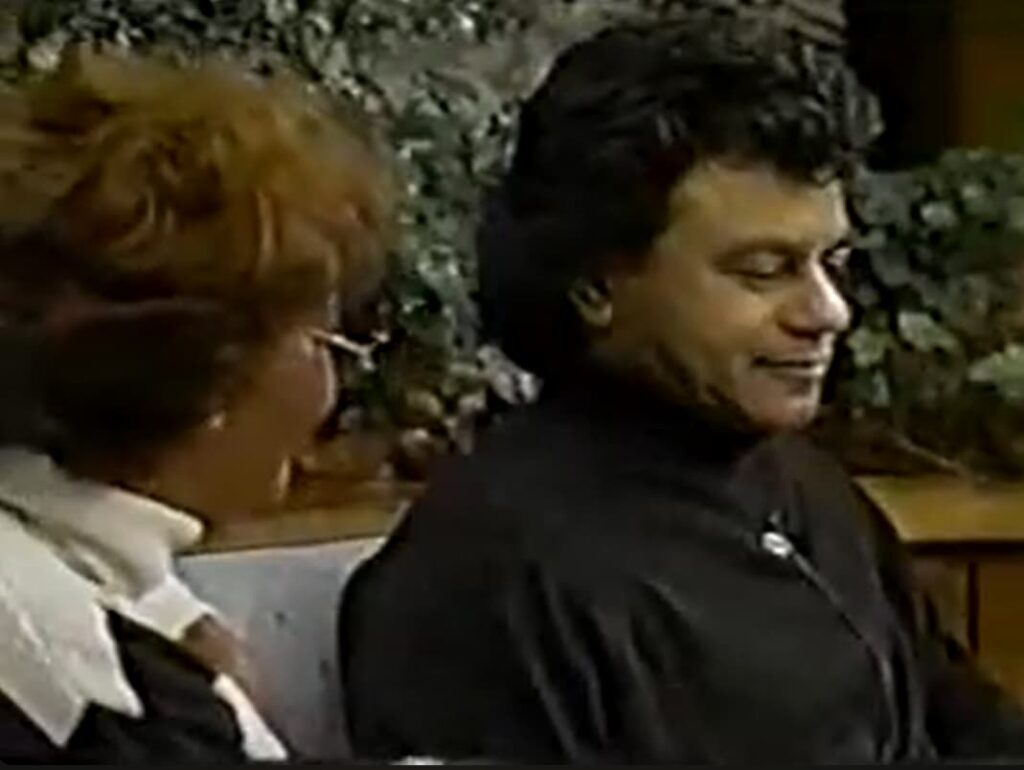
Two timeless voices revisiting a golden era, where elegance, romance, and musical mastery quietly outlive the passing years.
When Dionne Warwick and Johnny Mathis appeared together on WABC Eyewitness News in 1992, interviewed by Bryant Gumbel, the moment carried a quiet significance that extended far beyond the boundaries of a typical television segment. It was not merely an interview—it was a convergence of two of the most refined voices in American popular music, each representing a distinct yet harmonious chapter in the evolution of romantic songwriting.
By the early 1990s, both artists had already secured their places in musical history. Dionne Warwick, closely associated with the songwriting brilliance of Burt Bacharach and Hal David, had built a remarkable catalog of hits throughout the 1960s and 1970s. Songs like “Walk On By” (No. 6 on the Billboard Hot 100, 1964), “I Say a Little Prayer” (No. 4, 1967), and later “That’s What Friends Are For” (No. 1, 1986) revealed a voice capable of balancing technical precision with deep emotional subtlety. Her recordings often carried a sense of quiet sophistication—melodies that unfolded gently, yet lingered long after the final note.
Alongside her stood Johnny Mathis, whose career had begun even earlier, in the late 1950s. With his velvety tenor and impeccable phrasing, Mathis became synonymous with the art of the romantic ballad. His early successes included “Chances Are” (No. 1 on the Billboard Most Played by Jockeys chart, 1957) and “It’s Not for Me to Say” (Top 5, 1957), while his 1978 duet “Too Much, Too Little, Too Late” with Deniece Williams marked a triumphant return to the top, reaching No. 1 on the Billboard Hot 100. His music was never about urgency; it was about patience, about allowing emotion to breathe within the space of a melody.
What makes this 1992 interview so compelling is not the discussion of chart positions or career milestones—though those are impressive—but the atmosphere of reflection that surrounds it. Both Dionne Warwick and Johnny Mathis speak with the ease of artists who no longer need to prove anything. There is a shared understanding between them, an unspoken recognition of the era they helped define: a time when melody mattered, when lyrics were crafted with care, and when a song could unfold like a quiet conversation between two hearts.
There is also a subtle contrast in their artistic identities. Warwick’s voice, shaped by the intricate compositions of Bacharach, often dances along unconventional melodic lines—unexpected intervals, shifting rhythms—yet always lands with emotional clarity. Mathis, by contrast, embodies smoothness and continuity; his phrasing flows effortlessly, as though each note is simply the natural extension of the one before it. Together, they represent two complementary approaches to the same ideal: the pursuit of beauty in sound.
The “meaning” within this televised moment lies not in a single song, but in the legacy of an entire musical philosophy. It speaks of a period when recordings were built to endure, when the relationship between singer and listener was intimate rather than immediate. Listening to them reflect, one is reminded that their music was never tied to trends—it existed outside of time, anchored instead in universal emotions: love, longing, hope, and quiet resilience.
There is a certain poignancy in seeing these artists in 1992, looking back on decades that had already begun to feel distant. The industry had changed; new sounds dominated the airwaves. Yet nothing in their demeanor suggests regret. Instead, there is a calm assurance, a sense that what they created continues to live on, untouched by the shifting tides of fashion.
And perhaps that is the true legacy of Dionne Warwick and Johnny Mathis. Their songs do not demand attention—they invite it. They do not overwhelm—they resonate. In a world that often moves too quickly, their music remains a place of stillness, a reminder of what it means to truly listen.
As the interview fades into the closing moments of Eyewitness News, there is no grand finale, no dramatic conclusion. Only a lingering impression—like the final chord of a well-loved song—that something meaningful has quietly passed through the room. And long after the screen goes dark, their voices remain, echoing softly, carrying with them the enduring elegance of a time when music spoke not loudly, but deeply.