
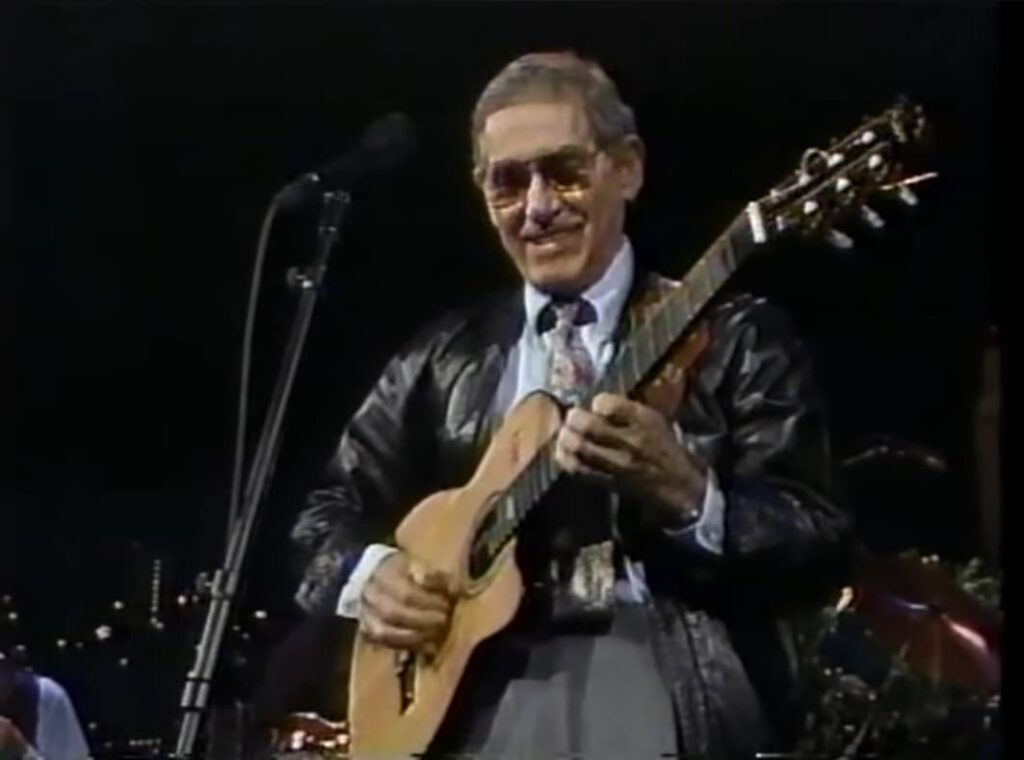
The gentle brilliance of Chet Atkins reminds us that true mastery speaks softly, yet lingers for a lifetime in every note.
When discussing the golden age of instrumental country and pop crossover, few names resonate with as much quiet authority as Chet Atkins, affectionately known as “Mr. Guitar.” His legacy is not tied to a single chart-topping hit, but rather to a body of work that redefined what the guitar could express—delicate, intricate, and profoundly human. Among his most cherished recordings, pieces such as “Yakety Axe,” “Mr. Sandman,” and “Windy and Warm” stand as enduring examples of his unmatched technique and musical sensitivity.
Unlike many artists driven by commercial chart success, Chet Atkins operated in a realm where artistry often outweighed chart positions. That said, his influence did reach measurable heights. His albums frequently appeared on the Billboard Country Albums chart throughout the 1950s and 1960s, and he won multiple Grammy Awards, including Best Country Instrumental Performance. “Yakety Axe,” released in 1965, became one of his most recognized recordings, reaching No. 4 on the Billboard Country chart—an impressive feat for an instrumental track in an era dominated by vocal hits.
But numbers alone cannot capture the essence of his work. What made Chet Atkins extraordinary was his ability to create the illusion of two guitarists playing at once. His fingerstyle technique—where the thumb maintains a steady bass rhythm while the fingers articulate melody and harmony—became his signature. Listening to “Windy and Warm,” one can almost feel the breeze he evokes, as if each note carries a memory of a quieter, slower time.
The story behind his rise is one of persistence and quiet determination. Born in rural Tennessee during the hardships of the Great Depression, Chet Atkins turned to the guitar not as a path to fame, but as a refuge. Influenced by artists like Merle Travis, he developed his own style through countless hours of practice, often playing late into the night. That dedication would eventually lead him to RCA Victor, where he not only recorded extensively but also shaped the careers of others as a producer, helping to craft what became known as the “Nashville Sound.”
His recording of “Mr. Sandman” in 1954 is particularly telling. Originally a pop standard, under Atkins’ hands it became something entirely different—playful, sophisticated, and technically dazzling. It bridged genres effortlessly, appealing to both country audiences and mainstream listeners. This ability to transcend musical boundaries became one of his defining traits.
Yet beyond technique and innovation, there is a deep emotional undercurrent in his music. His guitar does not demand attention; it invites reflection. Each phrase feels measured, thoughtful, almost conversational. In “Yakety Axe,” there is a lighthearted joy, a playful conversation between strings. In contrast, “Windy and Warm” carries a sense of introspection, as though recalling moments that have quietly slipped into the past.
By the time the music world began to change dramatically in the late 1960s and 1970s—with louder, more aggressive styles taking center stage—Chet Atkins remained steadfast. He did not chase trends. Instead, he refined his craft, continuing to produce music that felt timeless rather than timely. That consistency is perhaps why his work still resonates so deeply today.
Listening to these three masterpieces is like opening a well-worn photo album. There is no need for lyrics, no need for explanation. The guitar speaks in a language that feels both personal and universal. It tells stories of front porches, quiet evenings, long roads, and fleeting moments of peace.
In the end, Chet Atkins was never simply a guitarist. He was a storyteller without words, a craftsman whose legacy is etched not in grand gestures, but in the subtle beauty of perfectly placed notes. And in those notes, one finds something increasingly rare—a sense of calm, of grace, and of enduring musical truth.