
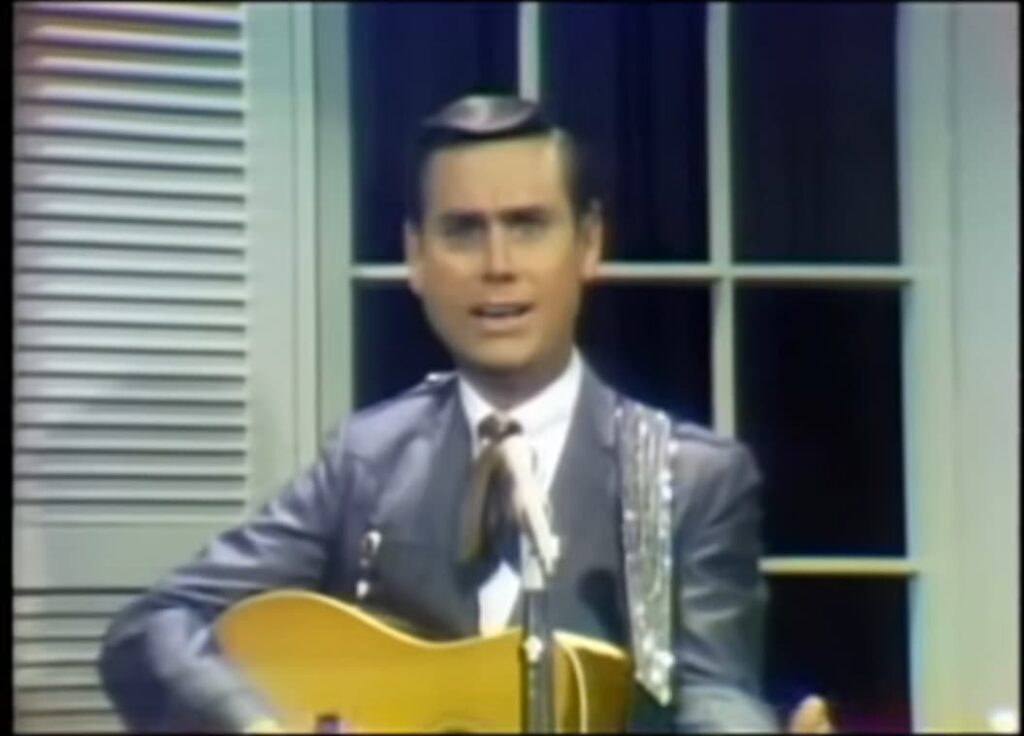
A quiet promise of forgetting that stretches beyond a lifetime—where heartbreak lingers longer than time itself
In 1970, George Jones delivered one of the most quietly devastating performances of his career with I’ll Be Over You (When the Grass Grows Over Me). Released as a single and later included on the album I Made It All the Way Down, the song climbed to No. 3 on the Billboard Hot Country Singles chart, reinforcing Jones’s place as one of the most emotionally authentic voices in country music. While it may not have reached the very top of the charts, its enduring power lies in something far deeper than commercial success—it lies in its unflinching honesty.
Written by Don Chapel, Red Lane, and Fuzzy Owen, the song presents a strikingly simple yet unforgettable premise: the narrator will only be over a lost love when he is gone—when “the grass grows over” him. It is a line that captures the permanence of certain emotions, the kind that do not fade with time but instead become part of one’s very being. In the hands of George Jones, this idea is not exaggerated or dramatized. It is delivered plainly, almost matter-of-factly, which only makes it more powerful.
By 1970, Jones had already lived a life marked by both musical triumph and personal turmoil. That lived experience seeps into every phrase of this recording. His voice does not simply convey sadness—it carries the weight of memory, of choices made and consequences endured. There is a steadiness in his delivery, but beneath it lies a quiet ache, as though each word has been carefully measured before being allowed to surface.
Musically, the arrangement reflects the Nashville Sound of the era—smooth, restrained, and subtly orchestrated. Gentle steel guitar lines weave through the melody, supported by soft backing vocals that add depth without distraction. The production is polished, yet it never overshadows the emotional core of the song. Instead, it creates a space in which Jones’s voice can resonate fully, drawing the listener into a world where time seems to move more slowly.
What makes “I’ll Be Over You (When the Grass Grows Over Me)” particularly compelling is its sense of inevitability. There is no attempt at resolution, no hint of moving on. The song accepts its own conclusion from the very beginning. In doing so, it reflects a truth that is often left unspoken—that some feelings do not diminish, no matter how much time passes. They settle quietly into the background of life, present but unchanging.
This perspective gives the song a timeless quality. It does not belong solely to the era in which it was recorded. Its message remains relevant, resonating across generations because it speaks to a universal experience: the persistence of memory, the way certain people and moments remain with us long after they are gone.
For those familiar with George Jones’s broader catalog, this song stands as a precursor to later masterpieces like “He Stopped Loving Her Today.” Both songs explore similar themes of enduring love and loss, but here, the approach is more understated. There is no dramatic climax, no narrative twist—just a quiet acknowledgment of a feeling that will not fade.
Listening to the song today, one is struck by its restraint. In an age where emotion is often amplified and exaggerated, this recording feels almost intimate, as though it were meant for a single listener rather than a wide audience. It invites reflection, encouraging the listener to consider their own experiences with time, memory, and the things that remain unresolved.
In the end, “I’ll Be Over You (When the Grass Grows Over Me)” is not a song about despair, but about permanence. It suggests that love, once truly felt, does not simply disappear. It changes, it quiets, but it remains—woven into the fabric of who we are.
And in that quiet, unwavering truth, George Jones offers something rare: a song that does not seek to comfort, but instead to understand. A song that lingers, like a memory that refuses to fade… even as the years pass, and the world moves on.