
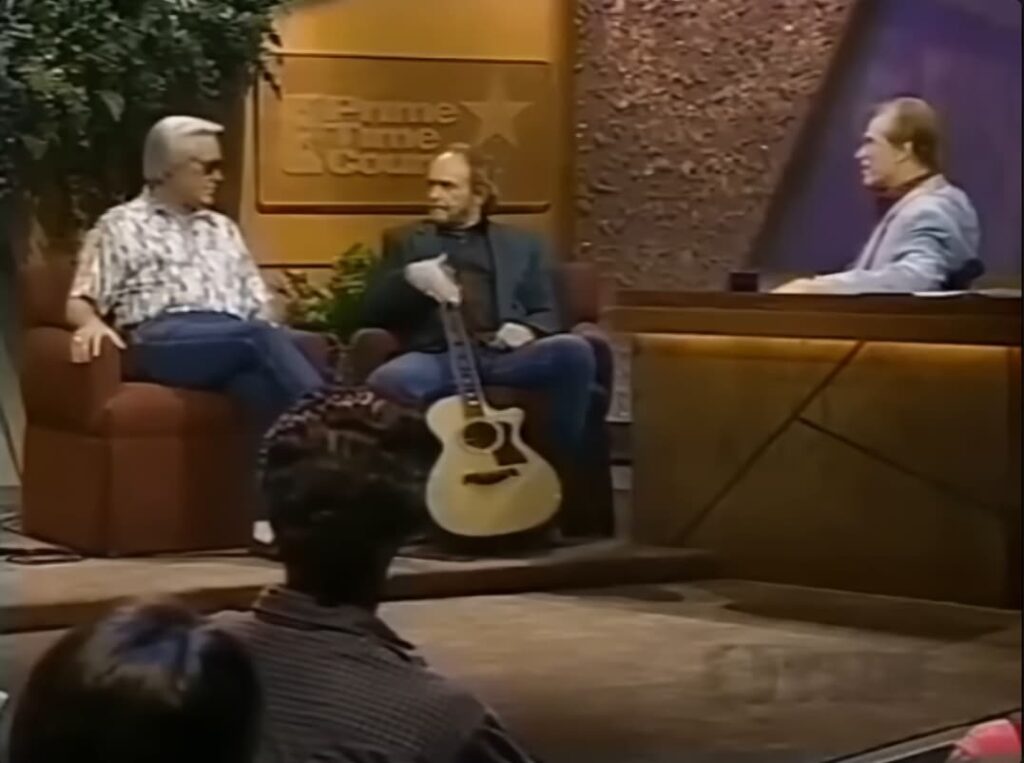
A fleeting moment where legends mirrored each other, revealing the soul behind the songs
There is something deeply human—almost disarming—about watching giants of country music step down from their pedestals and simply play. The 1996 appearance of Merle Haggard on Prime Time Country, hosted by Bob Eubanks, offered precisely that kind of moment. Broadcast on The Nashville Network, the segment has since become a cherished memory for those who understand that country music is not just about chart positions or radio play—it is about lineage, respect, and quiet conversation between artists across time.
By 1996, Merle Haggard was no longer merely a hitmaker; he was a living archive of American country music. His catalog had already secured him dozens of No. 1 hits on the Billboard Hot Country Songs chart, and songs like “Okie from Muskogee” and “Mama Tried” had long since entered the cultural bloodstream. Yet here, on this television stage, he chose not to lead with his own legacy. Instead, he reached backward—into memory, into influence—and brought to life the voices of those who shaped him.
When Haggard began imitating Marty Robbins, there was no sense of parody, no exaggeration meant for easy laughs. It was careful, studied, almost reverent. Robbins, whose 1959 classic “El Paso” topped both the country and pop charts, was known for his smooth phrasing and Western ballad storytelling. Haggard captured that essence with uncanny precision—not just the voice, but the pacing, the emotional restraint. It felt less like imitation and more like a conversation across decades.
Then came Johnny Cash—or rather, Haggard’s rendering of him. Cash, the “Man in Black,” had a voice that seemed carved out of stone, grounded in rhythm and conviction. Haggard’s interpretation was affectionate, almost playful, but again rooted in deep understanding. He didn’t merely mimic Cash’s baritone; he evoked the moral gravity that defined songs like “Folsom Prison Blues” and “I Walk the Line,” both of which were major hits on the country charts and beyond.
And then, as if the moment needed one more layer of meaning, George Jones himself appeared on stage.
Jones, often referred to as the greatest country singer of all time, carried with him a voice that could fracture even the most composed listener. His career had been marked by towering achievements—over 150 charted singles, including classics like “He Stopped Loving Her Today,” widely regarded as one of the finest country songs ever recorded. But in this setting, there was no grand performance, no attempt to reclaim the spotlight. Instead, there was camaraderie.
Watching Merle Haggard and George Jones share that stage was like witnessing two old friends exchanging stories without words. There was humor, certainly—Haggard’s impressions had already set a light tone—but beneath it lay something more profound: mutual recognition. These were men who had lived the songs they sang, who had carried the burdens and contradictions of life into their music.
What made this moment particularly poignant was its timing. By the mid-1990s, country music was undergoing a transformation, with a new generation of artists reshaping the sound for broader audiences. Yet here, on Prime Time Country, was a reminder of the genre’s roots—of a time when voices were unmistakable, when songs were built on lived experience rather than polished production.
There were no chart debuts tied to this performance, no commercial metrics to measure its impact. And perhaps that is precisely why it endures. It exists outside the machinery of success, preserved instead in memory and grainy recordings, passed from one admirer to another.
In the end, this brief television segment becomes something larger than itself. It is a testament to influence—how one artist absorbs another, reshapes it, and carries it forward. It is a portrait of humility, of legends who never forgot where they came from. And most of all, it is a quiet, unspoken acknowledgment that in country music, every voice is part of a longer song—one that never truly ends.