
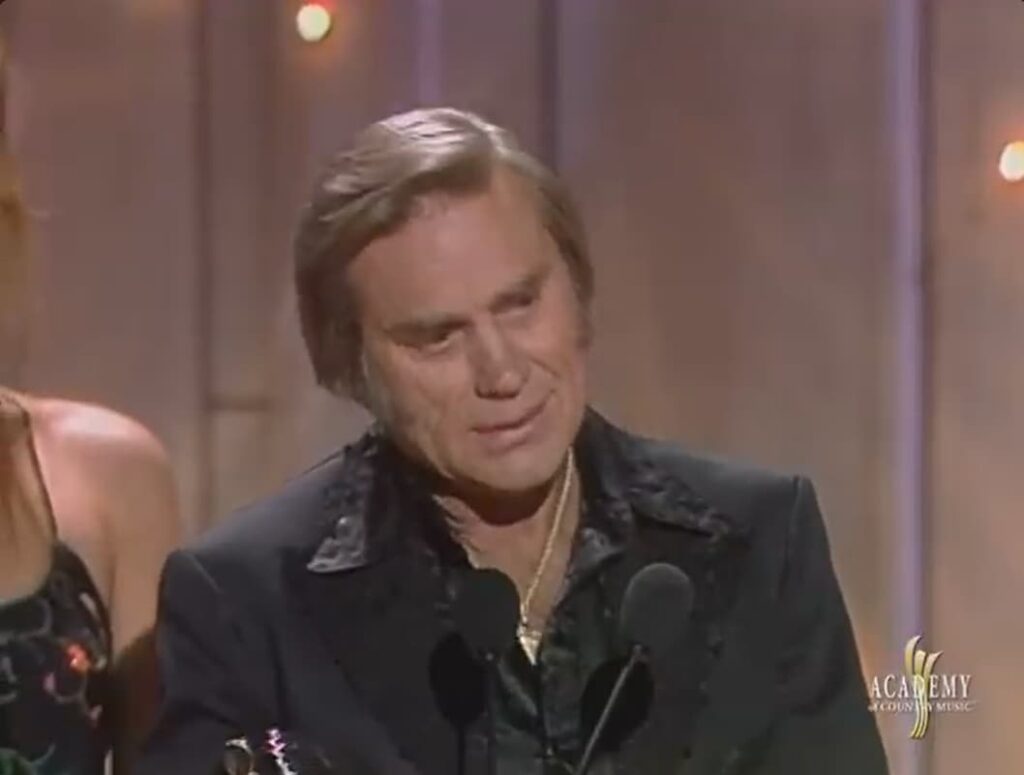
A night of reverence and remembrance—when a lifetime of heartbreak, truth, and song was finally reflected back to the man who lived it
When George Jones was honored at the Academy of Country Music Awards, it was more than a ceremonial gesture—it was a moment where an entire genre paused to acknowledge one of its most enduring and deeply human voices. By the time of this recognition, Jones had long since secured his place in history, with over 150 charted singles and numerous No. 1 hits on the Billboard Hot Country Songs chart, including the immortal “He Stopped Loving Her Today”—a song often cited as the greatest in country music history.
Yet awards, plaques, and standing ovations only tell part of the story. What unfolded on that stage was something far more intimate. It was not simply about celebrating success; it was about honoring a life lived through music—every misstep, every triumph, every note sung with a kind of honesty that could not be taught.
There was a quiet weight in the air during that tribute. As fellow artists gathered to perform his songs, each interpretation carried a sense of reverence, as though they were handling something fragile, something sacred. These were not just compositions—they were chapters of a life that had been laid bare for the world to hear. And at the center of it all sat George Jones, a man whose voice had, for decades, given shape to the complexities of love, loss, and redemption.
To understand the significance of this moment, one must look beyond the accolades and into the journey that led there. George Jones was never a polished figure in the conventional sense. His life was marked by turbulence—struggles with addiction, fractured relationships, and periods of absence that threatened to overshadow his immense talent. Yet it was precisely this vulnerability that made his music so profoundly affecting. When he sang, there was no distance between the man and the message. Every lyric felt lived, every note carried the weight of experience.
The tribute at the ACM Awards became, in many ways, a reflection of that truth. Songs like “The Grand Tour”, “She Thinks I Still Care”, and especially “He Stopped Loving Her Today” were performed not just as hits, but as emotional landmarks. Each one told a story—not only of heartbreak, but of endurance. And as they echoed through the venue, there was a shared understanding that these songs had shaped not just careers, but lives.
What made the moment particularly poignant was the presence of Jones himself. Time had softened his voice, but not its essence. There was a quiet dignity in the way he received the tribute—no grand gestures, no attempts to reclaim the spotlight. Instead, there was a sense of acceptance, as though he understood that the music had taken on a life of its own, belonging now as much to the audience as it ever did to him.
Musically, George Jones had always possessed a rare gift—the ability to inhabit a song completely. His phrasing, his timing, the subtle cracks in his voice at just the right moment—all of it contributed to a style that was unmistakably his own. It is no coincidence that so many artists cite him as a primary influence. To listen to Jones is to understand the very essence of country music: storytelling stripped of pretense, delivered with unflinching sincerity.
The ACM tribute served as a reminder of that legacy. In an era where the genre was evolving, blending with pop and expanding its reach, this moment brought the focus back to its roots. It highlighted the enduring power of a simple truth, sung well.
And perhaps that is what lingers most from that night—not the applause, not the accolades, but the quiet recognition of a life’s work. A body of songs that spoke when words alone were not enough. A voice that carried the weight of human experience with unmatched clarity.
In the end, honoring George Jones was never just about celebrating a career. It was about acknowledging a connection—between artist and listener, between past and present, between the pain we endure and the music that helps us understand it. And in that moment, under the soft glow of stage lights, it became clear that some voices do not fade. They remain, echoing gently, long after the final note has been sung.