
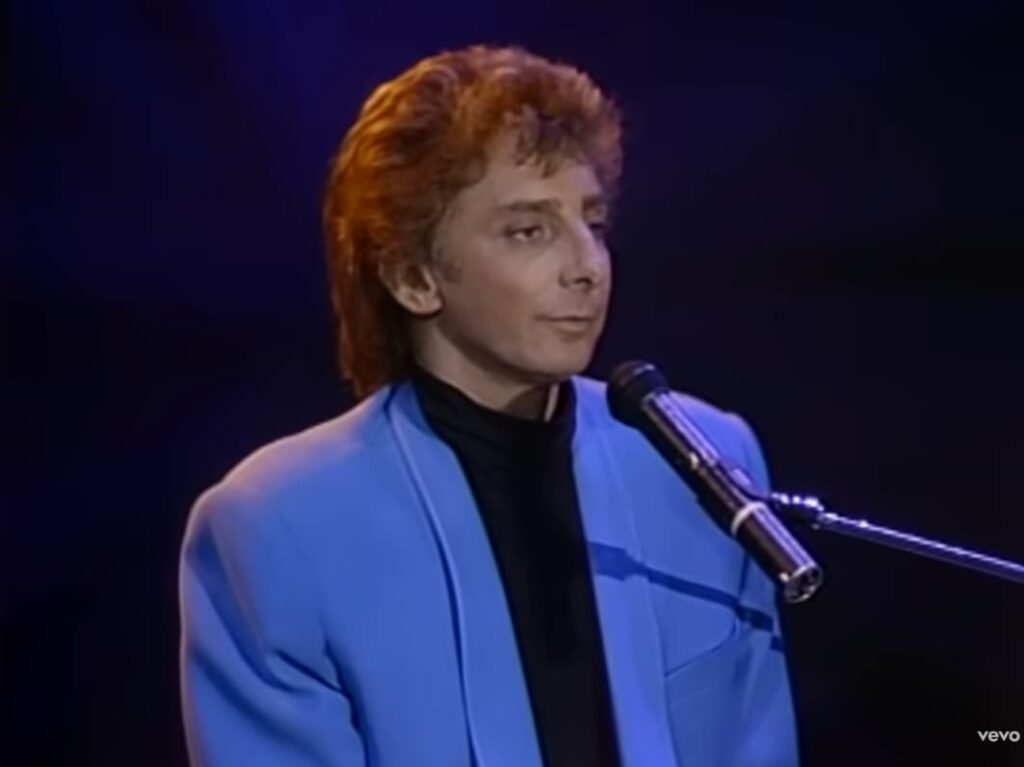
A fragile confession of love and regret—a voice reaching back through time to a woman who became both memory and salvatio
Few songs capture the aching tenderness of lost love quite like “Mandy” by Barry Manilow. First released in 1974 on the album “Barry Manilow II”, the song would go on to become his first No. 1 hit on the Billboard Hot 100 in January 1975, while also reaching No. 1 on the Adult Contemporary chart. It marked a turning point—not only in Manilow’s career, but in the emotional landscape of 1970s pop music, where vulnerability was beginning to find a stronger, more expressive voice.
Originally titled “Brandy,” the song was written by Scott English and Richard Kerr, but it was Barry Manilow who reshaped it into something timeless. Changing the title to avoid confusion with the already popular song “Brandy (You’re a Fine Girl)” by Looking Glass, Manilow infused “Mandy” with a deeply personal intensity. From the very first piano notes, there is a sense that this is not just a performance—it is a recollection, unfolding in real time.
The version from “Live on Broadway” adds yet another dimension to the song’s legacy. Performed years after its initial success, this live rendition reveals how the meaning of “Mandy” has matured alongside the artist himself. The audience, hushed and attentive, becomes part of the experience, as though collectively revisiting a memory that has never quite faded. There is a noticeable difference in tone here—less urgency, perhaps, but more depth. The voice carries the weight of time, and with it, a quiet understanding that only comes from having lived through the emotions the song describes.
Lyrically, “Mandy” is disarmingly direct. It tells the story of a man reflecting on a relationship he once took for granted, only to realize too late its true value. Lines like “Oh Mandy, well you came and you gave without taking” resonate not because they are complex, but because they are honest. There is no attempt to hide behind metaphor or abstraction. Instead, the song speaks plainly, allowing the listener to feel every ounce of regret and longing.
What elevates the song, however, is the way Barry Manilow delivers it. His vocal performance is carefully measured, building gradually from quiet introspection to emotional release. In the live Broadway setting, this progression feels even more pronounced. Each phrase is given room to breathe, each pause carrying its own significance. It is not just about hitting the right notes—it is about conveying the weight behind them.
Musically, “Mandy” is anchored by its iconic piano arrangement, supported by lush orchestration that swells at just the right moments. In the Live on Broadway version, the orchestral elements are enriched by the immediacy of the stage, creating a sound that feels both grand and intimate. The balance between these two qualities is what makes the performance so compelling—it fills the room, yet somehow speaks directly to the individual listener.
Behind the song lies a universal truth about human relationships: the tendency to recognize value only in hindsight. “Mandy” does not offer resolution or reconciliation. Instead, it lingers in that space between memory and realization, where emotions are most raw. It is a song about gratitude that arrives too late, about love that endures even in absence.
The enduring popularity of “Mandy” is no accident. It speaks to something deeply rooted in the human experience—the quiet moments of reflection when the past feels closer than the present. Over the decades, as musical trends have shifted and evolved, this song has remained untouched by time. Its simplicity, its sincerity, and its emotional clarity ensure that it continues to resonate long after its chart-topping days. In the end, the Live on Broadway rendition of “Mandy” is more than a revisiting of a classic. It is a conversation between past and present, between the man who first sang those words and the one who understands them more fully now. And in that conversation, there is a kind of beauty that cannot be manufactured—only lived. It reminds us, gently but unmistakably, that some songs are not just heard. They are remembered, felt, and carried quietly within us, long after the final note has faded into silence.
 Oldies Songs
  Oldies Songs