
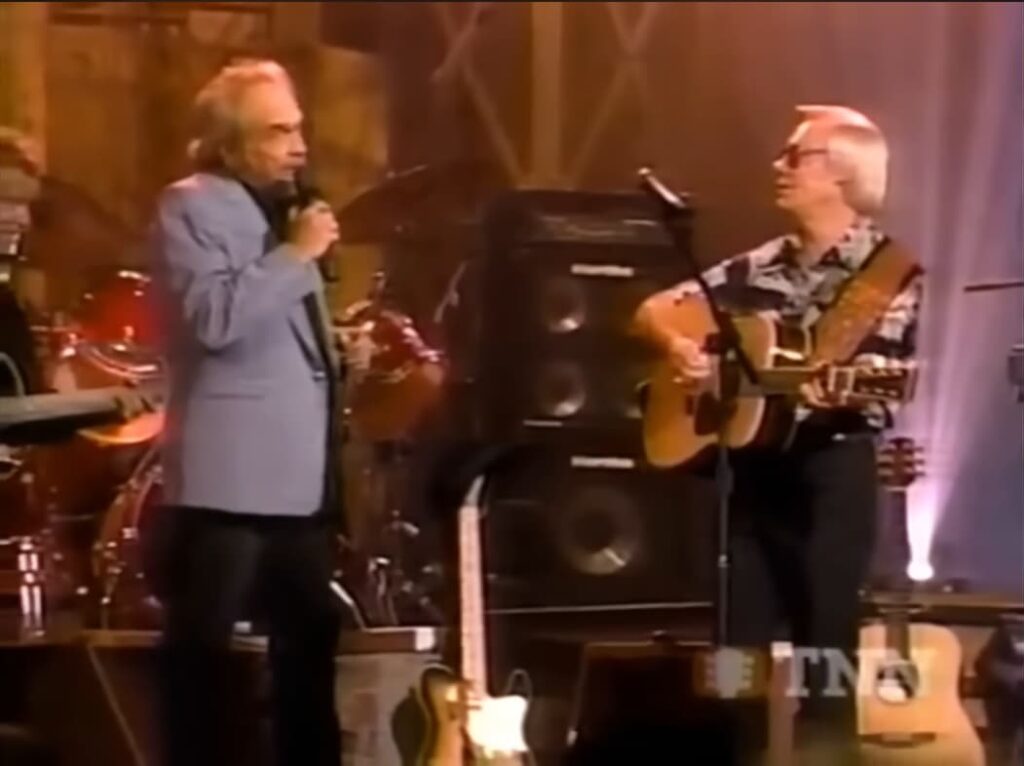
When two giants meet in quiet understanding: George Jones and Merle Haggard turn songs into lived confessions of time, regret, and identity
There are rare moments in country music when a performance feels less like entertainment and more like a gathering of truths—unspoken, weathered, and deeply understood. The live pairing of George Jones and Merle Haggard, performing “The Way I Am,” “Yesterday’s Wine,” and “I Must Have Done Something Bad,” belongs to that sacred category. These were not merely songs chosen at random; they were reflections—each piece echoing the lives these two men had lived, the mistakes they had survived, and the wisdom they had earned.
By the time these performances were captured, both Jones and Haggard had long secured their places among the most influential figures in country music. Merle Haggard’s “The Way I Am,” released in 1980, had climbed to No. 1 on the Billboard Hot Country Singles chart, affirming his voice as one of quiet defiance and self-acceptance. The song, drawn from the album of the same name, is deceptively simple—a man explaining himself, not asking for forgiveness, but for understanding. In Haggard’s delivery, there is no bitterness, only clarity. It is the sound of someone who has stopped pretending.
When performed alongside George Jones, the meaning deepens. Jones, whose own life was marked by turbulent highs and devastating lows, did not need to reinterpret the song—he embodied it. One could hear, in the subtle cracks of his voice, the weight of years spent chasing both love and escape. Together, they transform “The Way I Am” into something almost conversational: two old souls acknowledging that life rarely turns out as planned, yet somehow remains worth singing about.
Then comes “Yesterday’s Wine,” a composition originally written by Willie Nelson in 1971. Though Nelson’s version laid the philosophical groundwork, it was later popularized in duet form by Jones and Haggard themselves, reaching No. 1 on the country charts in 1982. The song is not about regret in the traditional sense—it is about perspective. It contemplates time, memory, and the strange comfort of looking back on a life that may not have been perfect, but was undeniably real.
In live performance, “Yesterday’s Wine” feels almost like a sermon whispered between friends. Haggard’s grounded, earthy tone meets Jones’ aching, tremulous phrasing, creating a balance that is both intimate and expansive. The lyrics speak of aging, of seeing life through a softer lens, and of understanding that yesterday’s struggles often become today’s quiet wisdom. There is no rush in their delivery—each line is allowed to breathe, as though time itself has slowed down to listen.
And then, perhaps most poignantly, “I Must Have Done Something Bad” enters the set—a song steeped in guilt, reflection, and the haunting question of consequence. Though less commercially prominent than the others, it carries a raw honesty that feels deeply personal. In the hands of lesser performers, it might sound like self-pity. But with George Jones and Merle Haggard, it becomes something else entirely: a confession without excuse.
One cannot ignore the shared history between these two men. Both had faced brushes with the law in their youth. Both had wrestled with addiction, fame, and the relentless demands of the road. And both had, in their own ways, found redemption—not in perfection, but in perseverance. That shared understanding is what makes their live collaboration so powerful. There is no need for theatricality; the truth in their voices is enough.
Listening to these performances today, one is struck not by technical perfection, but by emotional precision. Every note feels placed not by design, but by experience. These are not young men trying to prove something—they are seasoned artists who have nothing left to prove, and everything left to share.
In a world that often moves too quickly, these songs remind us to pause. To listen. To remember that behind every lyric lies a life, and behind every voice, a story still unfolding.
And in that quiet space between verse and silence, George Jones and Merle Haggard offer something timeless: not just music, but understanding.