
A voice shaped by hardship and heritage: how Johnny Rodriguez carried truth, culture, and quiet resilience into the heart of country music
When reflecting on the enduring legacy of Johnny Rodriguez, one must begin with the remarkable chart success that defined his early career—an achievement all the more striking given the personal struggles that shaped his artistry. By the mid-1970s, Rodriguez had already secured six No. 1 hits on the Billboard Hot Country Singles chart, including “You Always Come Back (To Hurting Me),” “Ridin’ My Thumb to Mexico,” and “That’s the Way Love Goes.” His 1973 debut album, “Introducing Johnny Rodriguez,” reached No. 1 on the Billboard Top Country Albums chart, making him one of the most successful new artists of that era. These were not merely commercial milestones—they were signals of a new voice entering Nashville, one that carried both cultural depth and emotional authenticity.
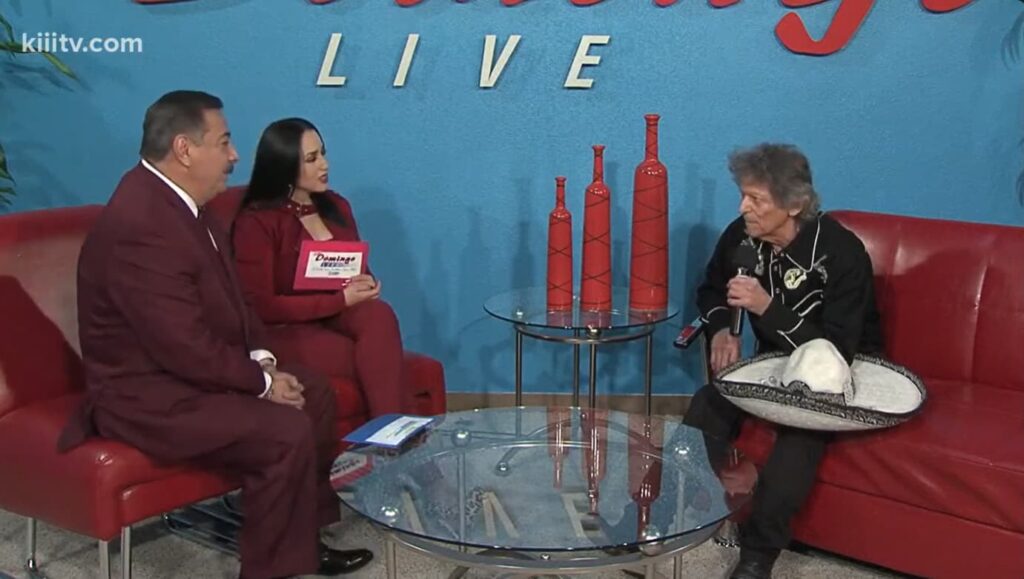
The interview setting on Domingo Live!, alongside figures like Rudy Trevino and Barbi Leo, offers something rare: a reflective window into a man whose life has been as compelling as his music. Unlike the polished narratives often presented on stage, these conversations reveal the quieter truths—the roads traveled, the mistakes endured, and the resilience required to return.
What makes Johnny Rodriguez such a compelling figure in country music history is not only his success but his significance. As one of the first Mexican-American artists to achieve major recognition in mainstream country, he brought bilingual phrasing and subtle Latin influences into a genre that had rarely embraced such diversity. Songs like “Ridin’ My Thumb to Mexico” did more than chart—they expanded the emotional and cultural vocabulary of country music. The track reached No. 1 in 1973, its gentle storytelling and melodic warmth capturing both longing and belonging in equal measure.
Yet behind these successes lies a story marked by hardship. Before Nashville came calling, Rodriguez endured a troubled youth, including time spent in jail—a moment that would unexpectedly alter the course of his life. Legend has it that his singing, heard while he was incarcerated, caught the attention of a Texas Ranger, eventually leading to connections in the music industry. Whether told in full detail or softened by time, the essence remains: music became his path forward, his means of transformation.
Listening to him speak in interviews like Domingo Live! carries a different kind of weight. There is a calmness in his tone, a reflective quality that only comes from years lived both in the spotlight and far from it. He does not speak as someone chasing relevance, but as someone who has already lived through the rise, the fall, and the quiet rebuilding that follows.
His hit “That’s the Way Love Goes,” which reached No. 1 in 1973, exemplifies his interpretive strength. Originally written by Lefty Frizzell and Sanger D. Shafer, Rodriguez’s version carries a tenderness that feels deeply personal. It is not simply sung—it is understood. That distinction is what separates a good vocalist from a truly great one.
But perhaps what lingers most in both his music and his spoken reflections is a sense of humility. Fame came quickly, and like many artists of his era, it did not come without its complications. The later years of his career saw fewer chart successes, yet his voice never lost its sincerity. In fact, time seemed to deepen it.
In revisiting these interviews, one is reminded that Johnny Rodriguez represents more than a collection of hits. He embodies a chapter of country music where storytelling mattered deeply, where voices carried lived experience, and where vulnerability was not hidden but honored. His journey—from small-town Texas to the вершины of Nashville charts—feels less like a fairy tale and more like a hard-earned truth.
And perhaps that is why his music continues to resonate. Because beneath every note, every lyric, and every quiet pause in conversation, there is something unmistakably real—a reminder that the most enduring voices are not the loudest, but the most honest.