
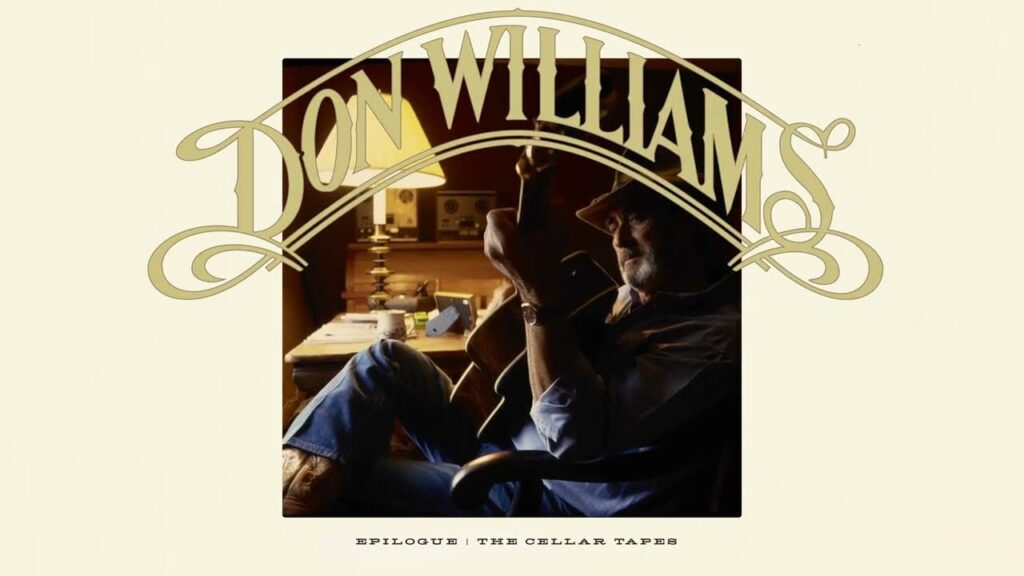
The Timeless Resonance of The Gentle Giant: A Deep Dive into Don Williams’ “Try Me Again” from Epilogue: The Cellar Tapes
In the ever-evolving landscape of American music, true authenticity is a currency that never depreciates. For decades, country music has been anchored by voices that do not just sing to the listener, but speak directly to the soul. Among these foundational pillars stands Don Williams, universally and affectionately known as the “Gentle Giant.” His recent posthumous project, Epilogue: The Cellar Tapes (2026), feels less like a collection of archival leftovers and more like a time capsule opened at the exact moment we needed it most. Among this treasure trove of unheard recordings from his golden 1979–1984 era, the track “Try Me Again” emerges as a profound masterclass in subtlety, emotional vulnerability, and traditional country craftsmanship.
To truly understand “Try Me Again,” we must dissect it not just as an audio file, but as a historical artifact, a lyrical confession, and, through its modern visualizer, a bridge spanning four decades of musical evolution.
The Context: Unearthing the Gold
To appreciate the gravity of “Try Me Again,” one must understand the era from which it was born. The years between 1979 and 1984 represented the absolute zenith of Don Williams’ career. During this time, he was dominating the Billboard Country charts with a signature sound that defied the era’s growing trend toward pop-country crossover. While others were adding synthesizers and swelling string sections, Williams remained steadfast in his commitment to a stripped-down, acoustic-driven, rhythm-heavy sound.
The fact that “Try Me Again” was recorded during this incredibly fertile period, yet remained securely locked away in multi-track tapes in a Tennessee cellar for over forty years, adds a layer of beautiful mystery to the song. It begs the question: why was it shelved? Was it too intimate? Did it simply not fit the sequencing of his albums at the time? Whatever the reason, its release now allows us to hear Williams at the absolute peak of his vocal prowess, untouched by the passage of time.
Lyrical Vulnerability: The Anatomy of a Second Chance
At its core, country music is the art of storytelling, and Don Williams was one of its most compelling narrators. “Try Me Again” is fundamentally a plea for redemption—a narrative of a man acknowledging his shortcomings and asking for the grace of a second chance.
However, what separates Williams from his contemporaries is his delivery. A lesser artist might have approached this lyric with theatrical desperation, employing soaring vocals to convey heartbreak. Williams, true to his moniker, does the exact opposite. His baritone delivery is incredibly restrained, almost conversational. He does not beg; he quietly and earnestly reasons with his listener. This stoic vulnerability is the hallmark of Williams’ appeal to his audience. It resonates deeply with a mature demographic—listeners who understand that real love is complicated, that mistakes are inevitable, and that the most profound apologies are often spoken in a whisper, not a shout. The lyrics navigate the delicate space between pride and regret, offering a remarkably mature perspective on romantic reconciliation.
The Sonic Landscape: A Masterclass in Restraint
Musically, “Try Me Again” serves as a textbook example of Don Williams’ signature production philosophy: less is always more. The newly restored tracks, meticulously handled by his son Tim Williams and longtime co-producer Garth Fundis, preserve the original integrity of the 1980s sessions while giving them a pristine, modern clarity.
The track is anchored by a slow, deliberate heartbeat of a rhythm section—likely the work of legendary session players like Kenny Malone on percussion and Joe Allen on bass. The acoustic guitar work is intricate yet completely unobtrusive, wrapping around Williams’ vocal like a warm, familiar blanket. There is a specific “pocket” that Don Williams’ music always sat in—a laid-back, unhurried groove that forces the listener to physically slow down and breathe. In “Try Me Again,” this tempo is utilized to maximum effect. The space between the notes is given as much respect as the notes themselves, allowing the listener to absorb the emotional weight of the lyrics. It is a stark contrast to the dense, overproduced tracks common in modern mainstream country, serving as a powerful reminder of the genre’s acoustic, front-porch roots.
The Visualizer: Bridging the Analog and Digital Worlds
The release of “Try Me Again” in the modern era comes accompanied by a “Visualizer”—a fascinating tool in contemporary music marketing that serves to enhance the auditory experience without the narrative distraction of a full-scale music video. For a legacy artist like Williams, the visualizer is a critical component of the song’s presentation.
Rather than attempting to retroactively create a storyline with actors, the visualizer for “Try Me Again” leans heavily into nostalgia and the tactile nature of analog recording. By utilizing imagery such as spinning reels of magnetic tape, warm sepia and golden-hour color grading, and perhaps rustic, slow-moving landscapes, the visualizer perfectly encapsulates the “Cellar Tapes” mythos.
This visual approach accomplishes two things. First, it honors the history of the recording, reminding the viewer that this music was created by human hands on physical tape long before the advent of digital perfection. It romanticizes the analog process. Second, the gentle, hypnotic loop of the visualizer forces the viewer to focus entirely on the audio. In an age of infinite scrolling and split-second attention spans, the visualizer acts as a digital anchor. It says to the viewer: Stop. Watch the tape spin. Listen to the story. It is a brilliant marriage of 1980s authenticity and 2020s consumption habits, perfectly tailored for platforms like YouTube where music fans congregate to share memories.
The Enduring Legacy of The Gentle Giant
“Try Me Again” is far more than a marketing gimmick to sell a posthumous album. It is a crucial puzzle piece in the enduring legacy of Don Williams. For older generations who lived through his peak, the track provides a visceral wave of nostalgia—a chance to hear an old friend speak again. For newer generations discovering his catalog, it serves as a pristine example of what pure, unadulterated country music sounds like.
In an era where the world feels increasingly chaotic, loud, and fast-paced, the sudden emergence of “Try Me Again” is a soothing balm. It reminds us of a time when music was crafted not for algorithms, but for the soul. Don Williams may have left this world in 2017, but through the remarkable preservation of Epilogue: The Cellar Tapes, his gentle giant persona continues to cast a long, comforting shadow over American music. He asked us to “try him again,” and without a doubt, the world of country music is more than happy to oblige.
 Oldies Songs