
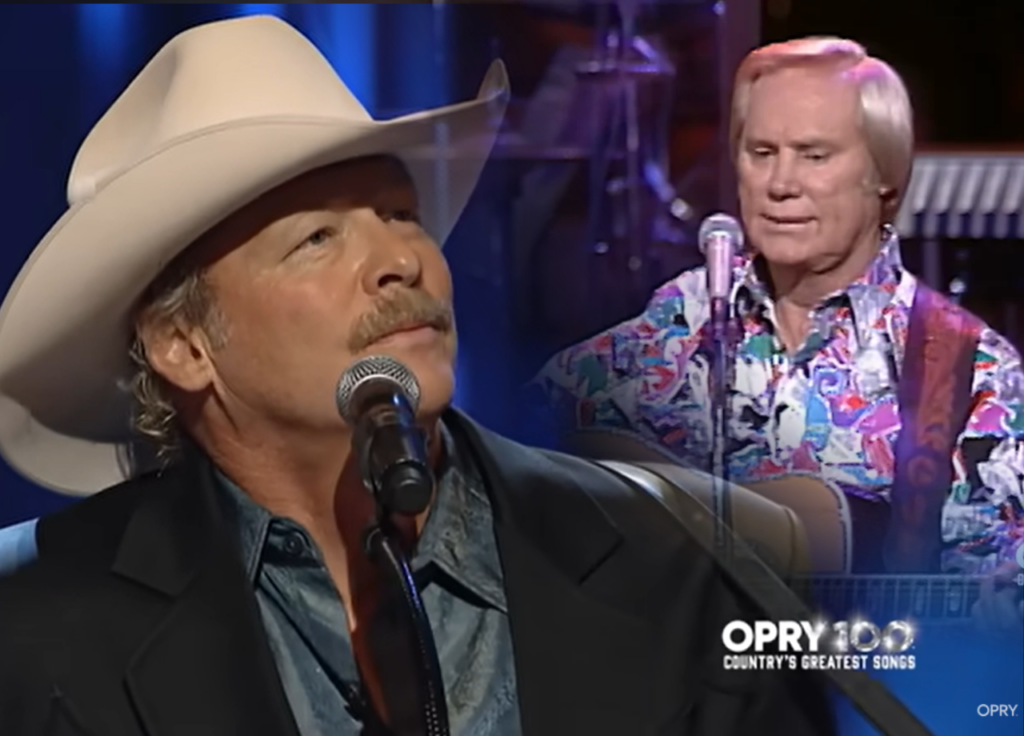
A farewell carved in melody: when “He Stopped Loving Her Today” becomes both a song of loss and a timeless circle of remembrance
Few songs in the history of country music carry the emotional gravity of “He Stopped Loving Her Today.” Recorded by George Jones and released in 1980 as part of the album “I Am What I Am,” the song did more than revive a struggling career—it redefined what heartbreak could sound like. It reached No. 1 on the Billboard Hot Country Singles chart, becoming Jones’ first chart-topper in six years, and went on to win Song of the Year at the Country Music Association Awards in both 1980 and 1981—an almost unheard-of achievement that reflects its monumental impact.
Written by Bobby Braddock and Curly Putman, the song tells a story so devastatingly simple that it feels almost sacred: a man who never stopped loving a woman… until the day he died. That final line—quiet, restrained, yet shattering—became one of the most powerful conclusions ever recorded in popular music. It is not merely a lyric; it is a truth that lingers long after the song fades.
By the time George Jones recorded it, he was a man weathered by life. Personal struggles, substance abuse, and years of inconsistency had nearly overshadowed his immense talent. And yet, when he stepped into the studio, something extraordinary happened. Producer Billy Sherrill famously had to persuade Jones to finish the recording, as he initially dismissed it as too morbid. But what emerged was not morbidity—it was immortality.
Decades later, that same song would take on an even deeper meaning during a moment that felt almost impossibly poetic. On May 2, 2013, following the passing of George Jones, his funeral was held at the Grand Ole Opry House—a place that had long been a spiritual home for him. There, standing on the very wooden circle where Jones had performed countless times, Alan Jackson delivered a heartfelt rendition of “He Stopped Loving Her Today.”
It was not simply a performance. It was a farewell.
Years later, through modern audio technology, those two voices—separated by time but united in spirit—were woven together into a single track for “Opry 100: Country’s Greatest Songs.” The result is something profoundly moving: a duet that transcends mortality, where George Jones’ original voice meets Alan Jackson’s tribute in a seamless, almost spiritual harmony. It feels less like a recording and more like a conversation across generations.
Alan Jackson, himself one of country music’s most sincere storytellers, approached the song with reverence. He did not attempt to reinterpret it or make it his own. Instead, he stood within it—honoring every pause, every breath, every fragile note that Jones had once delivered. In doing so, he reminded listeners that some songs are not meant to be changed; they are meant to be carried forward.
The significance of this “full-circle” moment cannot be overstated. In country music, tradition is not just respected—it is lived. And here, in this merging of past and present, we witness something rare: a continuity of emotion, a passing of the torch that feels both natural and deeply human.
Listening to this combined version, one cannot help but feel the weight of time. George Jones sings with the quiet authority of someone who has lived every word, while Alan Jackson responds with the tenderness of someone who understands what that voice meant—not only to him, but to the entire genre.
And perhaps that is the true meaning of “He Stopped Loving Her Today.” It is not just a song about unending love or inevitable loss. It is a reminder that music, at its very best, does not fade. It lingers, it evolves, and sometimes, it returns in ways we never expect—bringing with it the voices we thought we had lost.
In that sense, this performance is more than a tribute. It is a circle completed.
A voice remembered. A story retold. And a love that, even in silence, never truly ends.