
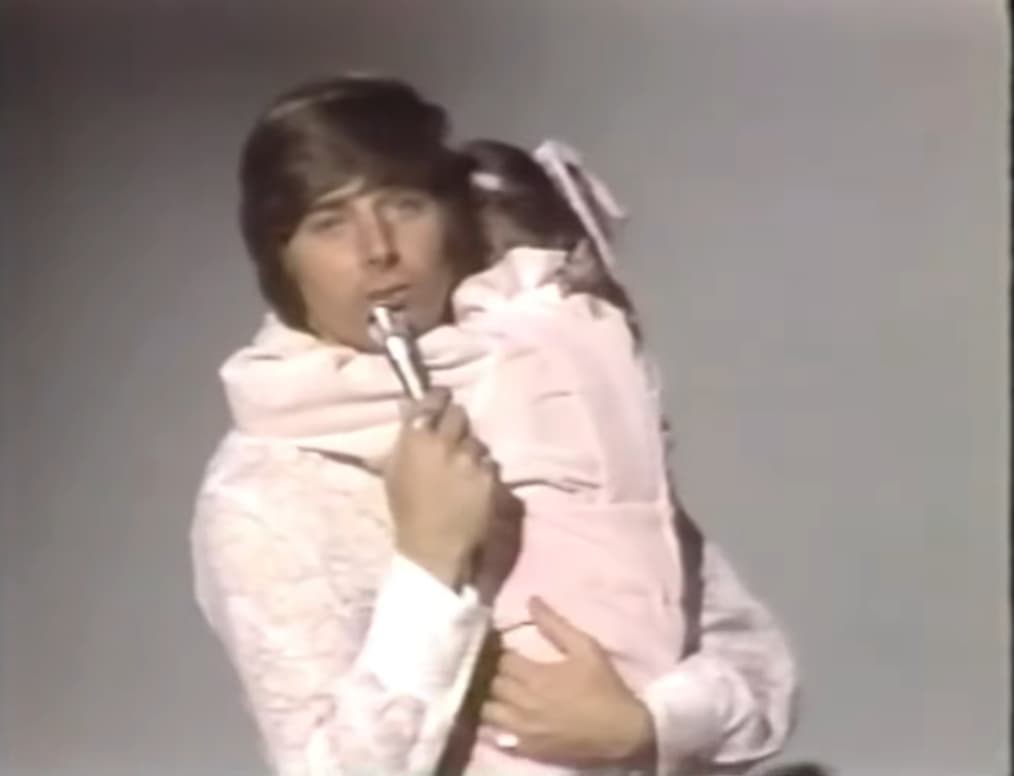
A fleeting moment of youthful light: Bobby Sherman’s 1971 TV Special captures the innocence of stardom, where music, charm, and sincerity briefly aligned in perfect harmony
There are certain evenings in television history that seem to glow a little softer in memory, as though time itself has chosen to preserve them with a gentler hand. The June 4, 1971 TV Special featuring Bobby Sherman is one such moment—an event that, while rooted firmly in its era, continues to echo with a quiet, enduring charm. It was not merely a broadcast; it was a reflection of a cultural moment when music and personality intertwined to create something both immediate and lasting. By 1971, Bobby Sherman had already reached the height of his popularity. Emerging from television fame on series like Here Come the Brides, he transitioned seamlessly into music, becoming one of the defining teen idols of the late 1960s and early 1970s. His chart success was undeniable. Songs such as “Little Woman” (1969) climbed to No. 3 on the Billboard Hot 100, while “Julie, Do Ya Love Me” (1970) reached No. 5. His albums, including “Bobby Sherman” (1969) and “Here Comes Bobby” (1970), consistently performed well, with the former achieving Gold certification and peaking within the Billboard 200’s Top 10.
The 1971 TV Special arrived at a moment when Sherman’s image was firmly established: approachable, earnest, and quietly charismatic. Unlike the more flamboyant figures of the era, he carried himself with a kind of understated sincerity. Watching the archival footage today, one is struck not by spectacle, but by warmth. The performances are intimate, the staging modest, allowing the focus to remain where it belongs—on the music and the man delivering it. There is a particular texture to Sherman’s voice that defined his appeal. It was not powerful in the traditional sense, nor was it technically extravagant. Instead, it possessed a clarity and gentleness that made each lyric feel personal. In the context of the TV special, this quality becomes even more apparent. Whether performing upbeat numbers or softer ballads, Bobby Sherman maintains a consistent emotional tone—one that feels genuine, unforced.
The significance of this broadcast lies not only in its performances but in what it represents. Television specials of that era served as a bridge between artist and audience, offering a glimpse beyond the confines of studio recordings. In Sherman’s case, it allowed viewers to see a fuller picture: not just the chart-topping singer, but the individual behind the songs. There is a quiet confidence in his presence, a sense that he is comfortable simply being himself. Behind the scenes, this period of Sherman’s career was both triumphant and transitional. The early 1970s marked the peak of his musical success, yet it also hinted at the shifting tides of popular music. The rise of more complex, genre-defying artists would soon reshape the landscape, making the straightforward pop sensibility of Sherman’s work feel like a snapshot of a particular moment in time. And perhaps that is precisely why it resonates so deeply today.
The emotional core of the 1971 TV Special is rooted in its simplicity. There are no elaborate narratives, no grand conceptual frameworks. Instead, there is a series of songs delivered with care, each one carrying its own quiet sentiment. It is music that does not demand attention, but gently invites it. And in that invitation, there is a sense of comfort—a reminder of a time when songs were often direct, their meanings clear, their intentions sincere. Looking back, one might say that this television special serves as a kind of time capsule. It captures not only the peak of Bobby Sherman’s career but also the atmosphere of an era when pop music was deeply intertwined with television culture. It was a time when an artist could step into living rooms across the country and, for an hour or so, become a familiar presence.
There is also an undeniable sense of nostalgia that accompanies these archival images. The lighting, the arrangements, even the pacing—all of it reflects a different rhythm of life. A slower, perhaps more attentive way of experiencing music. Watching Bobby Sherman perform in this setting, one cannot help but feel a quiet longing—not necessarily to return, but to remember. In the end, the June 4, 1971 TV Special is more than a collection of performances. It is a portrait of an artist at his most visible, yet also at his most unguarded. Through Bobby Sherman, it offers a glimpse into a moment when music was not just heard, but felt in a deeply personal way. And long after the final note fades, what remains is not just the memory of the songs, but the feeling they carried—soft, sincere, and gently enduring.