
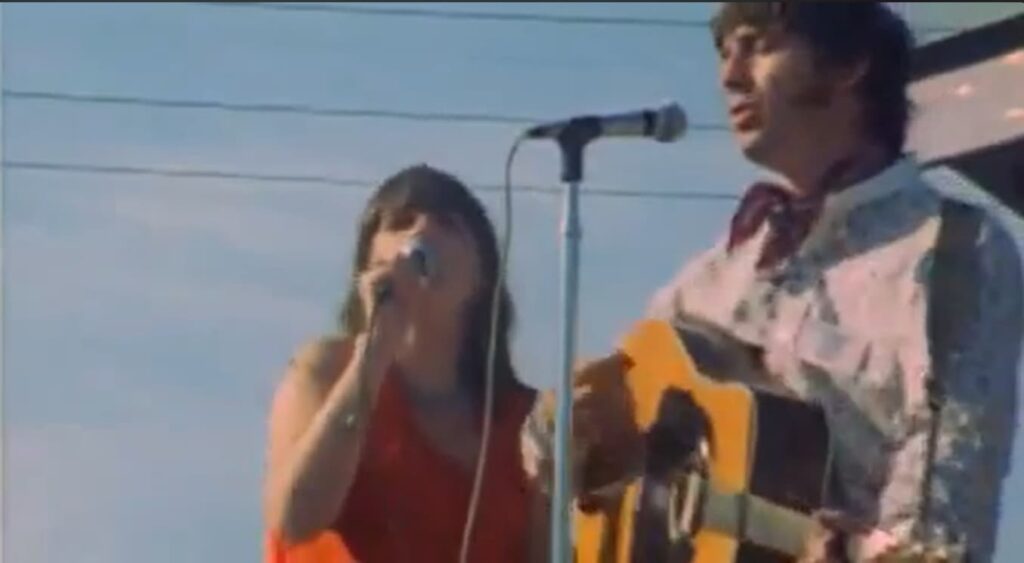
A lament of broken trust and quiet sorrow—where love, once given freely, returns as a question left unanswered
In 1970, amid a shifting musical landscape where folk began to merge with deeper introspection and social reflection, the duo Ian & Sylvia offered their own haunting interpretation of “Tears of Rage”, a song originally written by Bob Dylan and Richard Manuel. Their version appeared on the album Ian & Sylvia (1971 U.S. release, though recorded around 1970), during a period when both artists were gradually evolving beyond the boundaries of traditional folk into something more layered and emotionally complex. Unlike many chart-driven singles of its time, “Tears of Rage” was never a commercial hit for Ian & Sylvia. It did not climb the Billboard charts, nor did it seek the spotlight in the conventional sense. Yet its absence from the charts only deepens its quiet power—it was never meant to be a song measured by numbers, but rather by the emotional weight it carries.
The origins of “Tears of Rage” trace back to the legendary 1967 Basement Tapes sessions, where Bob Dylan and members of The Band crafted songs that felt both timeless and deeply rooted in human experience. When The Band officially released their version in 1968 on the seminal album Music from Big Pink, the song became a cornerstone of a new kind of storytelling—one that drew from biblical imagery, familial tension, and emotional ambiguity. By the time Ian & Sylvia approached the song, they brought with them a different sensibility—one shaped by years of harmony-driven folk music, but now tinged with a growing sense of maturity and reflection. Their rendition strips away some of the rawness found in earlier versions and replaces it with a gentler, almost resigned tone. It feels less like an accusation and more like a quiet reckoning.
At its core, “Tears of Rage” is a song about betrayal—though not the loud, explosive kind. Instead, it speaks of a deeper, more painful disillusionment: the kind that arises when love, trust, and sacrifice are met with indifference or misunderstanding. The lyrics, rich with metaphor, suggest a parental figure reflecting on a child who has turned away, raising questions that linger without resolution: “Why must you always want more?” In the hands of Ian & Sylvia, these questions are not delivered with anger, but with a kind of weary sadness. Their harmonies—once bright and clear in their earlier folk recordings—now carry a subtle gravity. There is space between the notes, a deliberate pacing that allows the listener to sit with each line, to feel its weight fully before moving on.
What makes this version particularly compelling is its sense of distance. It does not demand attention; it invites contemplation. The arrangement is understated, allowing the voices to remain at the forefront, supported by instrumentation that never intrudes. This restraint becomes its strength, emphasizing the emotional honesty at the heart of the song. There is also a broader context to consider. By 1970, the optimism of the early folk revival had begun to fade, replaced by a more introspective and, at times, uncertain mood. Songs like “Tears of Rage” reflect this shift—moving away from collective ideals and toward personal reflection, where the conflicts are internal as much as external.
Listening now, decades later, the song carries an even deeper resonance. It feels like a letter never sent, or perhaps one received too late. The themes it explores—love, expectation, disappointment—are timeless, yet they gain new meaning with the passage of years. What once may have sounded like a simple lament now reveals layers of understanding that only time can bring. In the quiet dignity of Ian & Sylvia’s performance, there is no attempt to resolve the song’s questions. And perhaps that is its greatest strength. Life, after all, rarely offers clear answers. Instead, it leaves us with moments—fragments of memory and emotion that we return to, again and again, searching not for resolution, but for recognition. “Tears of Rage”, in this interpretation, becomes one of those moments. Not loud, not triumphant, but enduring—like a memory that refuses to fade, quietly reminding us of what was given, what was lost, and what, perhaps, can never fully be understood.