
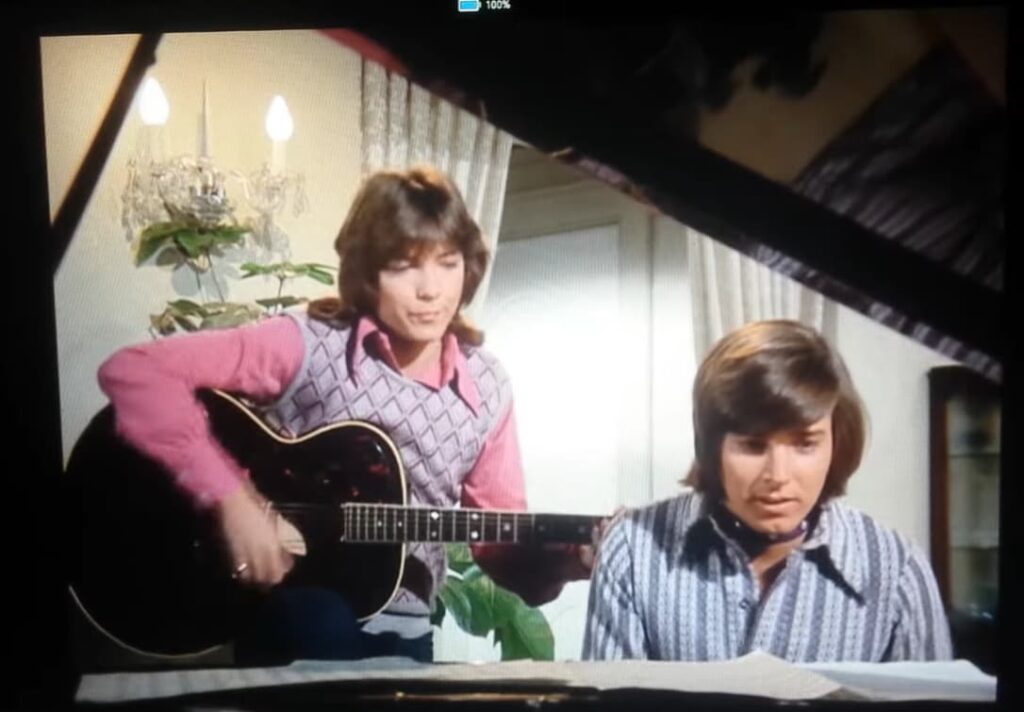
A tender promise wrapped in youthful innocence—where love is imagined as protection, devotion, and a quiet vow to always remain
There are songs that arrive not with thunder, but with a gentle, reassuring warmth—melodies that seem to belong to a simpler emotional landscape, where love is sincere, uncomplicated, and spoken with an open heart. “Knight in Shining Armor”, performed by Bobby Sherman in association with The Partridge Family, is one such piece. Released during the early 1970s, a period when television and pop music often intertwined seamlessly, the song became part of a broader cultural moment rather than a major chart-topping single in its own right. While it did not achieve significant standalone chart success on the Billboard Hot 100, its presence within the immensely popular world of The Partridge Family ensured that it reached a wide and devoted audience.
To understand “Knight in Shining Armor”, one must first step into the atmosphere of its time—a moment when television was not merely entertainment, but a shared experience, and when voices like Bobby Sherman’s carried a certain purity that resonated deeply. Known for his gentle vocal tone and approachable charm, Sherman had already established himself with hits like “Little Woman” (1969), which climbed to No. 3 on the Billboard Hot 100, and “Julie, Do Ya Love Me” (1970), reaching No. 5. These successes framed him as a figure of romantic idealism, and “Knight in Shining Armor” fits naturally within that image.
The song itself unfolds like a quiet confession. Its lyrics draw from a timeless metaphor—the idea of a protector, a devoted figure who stands steadfast against uncertainty and fear. Yet, unlike grand declarations often found in love songs, this promise feels intimate, almost fragile. There is no bravado here, no overwhelming display of strength. Instead, it is the sincerity that lingers—the sense that the singer is offering not perfection, but presence.
Within the context of The Partridge Family, the song takes on an additional layer of meaning. The show, centered around a musical family navigating both personal and professional life, often blurred the lines between fiction and reality. Music became a narrative tool, a way to express emotions that dialogue alone could not fully capture. In this setting, “Knight in Shining Armor” feels less like a performance and more like a moment suspended in time—a quiet reassurance offered in the midst of life’s gentle uncertainties.
There is also something undeniably nostalgic in the arrangement. The instrumentation, characteristic of early 1970s pop, is soft and unobtrusive, allowing the melody to breathe. Strings may swell subtly in the background, but they never overshadow the voice. This restraint creates a sense of closeness, as though the song is being sung not to a crowd, but to a single listener.
What gives the song its lasting emotional resonance is its simplicity. It does not attempt to explore the complexities of love in its darker forms. Instead, it holds onto a vision of love as something steady and dependable—an anchor rather than a storm. In a world that often grows more complicated with time, this kind of sentiment carries a quiet, enduring appeal.
Listening now, decades removed from its original context, “Knight in Shining Armor” feels like a letter from another era—one where emotions were expressed with clarity and without hesitation. It invites reflection, not through dramatic intensity, but through its gentle sincerity. The voice of Bobby Sherman, soft yet unwavering, becomes a vessel for that feeling, carrying it across time with remarkable ease.
And perhaps that is why the song remains meaningful, even without the validation of chart positions or widespread acclaim. It reminds us of a kind of emotional honesty that never truly fades. In its modest way, “Knight in Shining Armor” offers something rare: a moment of quiet reassurance, where love is not questioned, not complicated, but simply given—freely, and without condition.