
A stark portrait of forgotten lives, where progress arrives quietly and leaves silence in its wake
When Bob Dylan performed “North Country Blues” at the Newport Folk Festival in 1963, the moment did not announce itself with grandeur. It arrived plainly, almost austerely, much like the song itself. At that point, Dylan was still early in his recording career, having released “The Freewheelin’ Bob Dylan” earlier that same year, an album that reached No. 22 on the Billboard Pop Albums chart and would, in time, come to define an entire generation of folk songwriting. Yet “North Country Blues” was not part of that album. It would later appear on “The Times They Are A-Changin’” (1964), an album that climbed to No. 20 on the Billboard chart and carried some of his most socially conscious work. Even so, this particular song remained something apart, quieter, more intimate, and in many ways more devastating.
Unlike Dylan’s more widely recognized protest songs, “Blowin’ in the Wind” or “Masters of War,” “North Country Blues” does not speak in broad declarations. Instead, it narrows its focus to a single voice, a woman recounting the slow collapse of her mining town as the industry that sustained it disappears. The song is set in northern Minnesota, within the Mesabi Iron Range, a region that had once thrived but was beginning to feel the consequences of shifting economic forces. Foreign ore, cheaper and more accessible, had begun to replace local production, leaving entire communities without work, without purpose, and ultimately without a future.
What Dylan does here is something remarkably restrained. He does not argue. He does not accuse. He simply tells the story. The lyrics unfold with a quiet inevitability, each verse carrying the listener further into a world where options gradually disappear. Families leave, houses are abandoned, and those who remain are left to confront a reality that cannot be undone. By the final verse, there is no resolution, only acceptance, delivered in a tone that feels almost detached, as if even grief has been worn down by time.
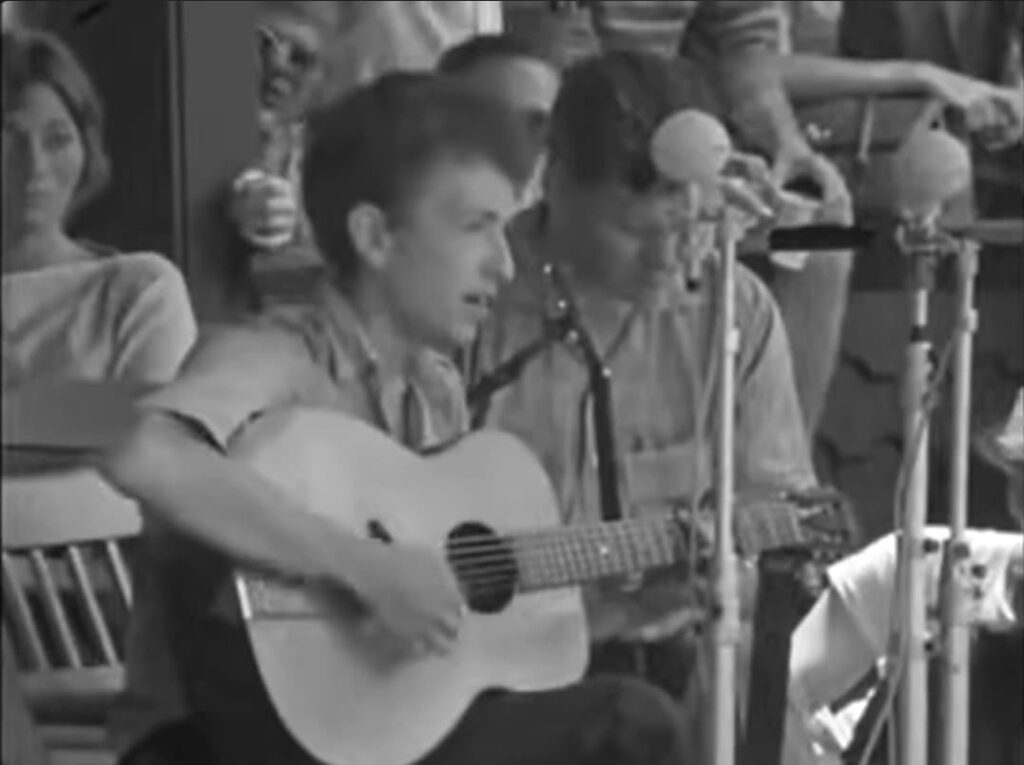
The performance at Newport in 1963 captures this essence with striking clarity. There is no embellishment, no attempt to heighten the emotion beyond what the song already contains. Dylan’s voice, still youthful but already marked by its distinctive roughness, carries the narrative with an understated gravity. The audience, accustomed perhaps to more overtly political material, is instead met with something quieter, something that requires listening rather than reaction.
There is a lineage to this kind of storytelling that reaches back into traditional folk music, where songs often served as records of lived experience rather than expressions of personal identity. In “North Country Blues,” Dylan steps into that tradition, adopting a voice that is not his own but feels entirely authentic. It is a reminder that the power of folk music has never relied on spectacle. It rests in its ability to preserve voices that might otherwise be forgotten.
What makes the song endure is its refusal to offer comfort. There is no sense that things will improve, no suggestion that the loss can be reclaimed. Instead, it presents a reality that feels uncomfortably permanent. And yet, within that permanence, there is a quiet dignity. The narrator does not collapse under the weight of her circumstances. She continues, because there is nothing else to do.
In the context of Dylan’s broader career, “North Country Blues” may not stand as prominently as his most celebrated compositions, but it reveals something essential about his approach to songwriting during this period. It shows a willingness to step aside, to allow the story to exist without interference, to trust that the truth, presented plainly, is enough.
Looking back at that performance in 1963, one senses not just the emergence of an artist, but the presence of a deeper understanding. That music, at its most enduring, does not always need to persuade. Sometimes, it simply needs to bear witness. And in doing so, it leaves behind something that lingers long after the final note has faded, a quiet reminder of lives once lived, and places that, though changed, are not entirely gone.
 Oldies Songs