
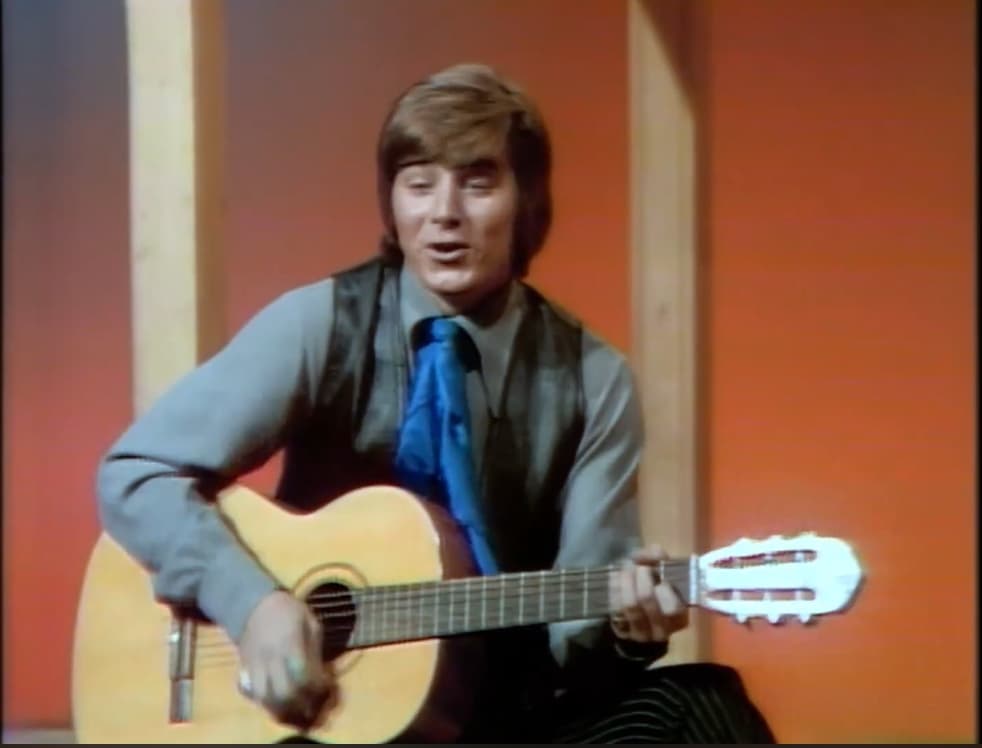
A fleeting promise of young love—softly spoken under stage lights, where hope lingers longer than certainty
In 1969, when Bobby Sherman appeared on the television program Music Scene, performing “I’ll Be Yours, Maybe Tonight,” he stood at the very height of a phenomenon that defined a generation of pop culture: the rise of the teen idol whose voice, image, and presence seemed to belong equally to the stage and to the private dreams of millions. At that moment, Sherman was not merely a singer—he was a symbol of youthful longing, of innocence poised delicately between fantasy and reality.
By the late 1960s, Bobby Sherman had already secured his place on the charts with remarkable consistency. His single “Little Woman” reached No. 3 on the Billboard Hot 100 in 1969, while “Julie, Do Ya Love Me” would soon follow, climbing to No. 5 in 1970. These chart positions were not accidental—they reflected a carefully cultivated sound that blended gentle pop melodies with a voice that carried both vulnerability and quiet assurance. Though “I’ll Be Yours, Maybe Tonight” was not among his major charting hits, it remains emblematic of the emotional landscape he inhabited: tender, hopeful, and tinged with uncertainty.
The performance on Music Scene captures something uniquely fragile. Unlike the polished grandeur of later television productions, there is an immediacy here—a sense that the moment is unfolding in real time, unguarded. Sherman’s delivery of “I’ll Be Yours, Maybe Tonight” is understated, almost conversational. He does not overpower the song; instead, he allows it to breathe, to linger gently in the air. The phrasing suggests a kind of emotional hesitation, perfectly aligned with the song’s central theme: a promise that is offered, but not fully claimed.
This sense of “maybe” is crucial. In an era often remembered for its bold cultural shifts and musical revolutions, there remained a quieter undercurrent—songs that spoke not of rebellion, but of intimate, personal emotions. “I’ll Be Yours, Maybe Tonight” belongs to that tradition. It is not a declaration of certainty, but a reflection of the delicate negotiations of young affection, where words are chosen carefully, and feelings are revealed in half-measures.
Behind the scenes, Bobby Sherman’s rise to fame was shaped as much by television as by music. His appearances on shows like Here Come the Brides had already introduced him to a wide audience, creating a connection that extended beyond the usual boundaries of pop stardom. By the time he stepped onto the Music Scene stage, that connection had deepened into something almost personal. Viewers did not simply watch him perform—they felt as though they knew him.
What makes this particular performance enduring is not its scale, but its sincerity. There is no elaborate staging, no overwhelming orchestration. Instead, there is a young artist, standing in the glow of studio lights, offering a song that feels as though it could have been written in a quiet moment of reflection. The simplicity becomes its strength.
Looking back, one cannot ignore the poignancy of that era. The late 1960s were a time of transition, when the optimism of earlier years began to encounter the complexities of a changing world. In that context, Bobby Sherman’s music provided a kind of refuge—a space where emotions remained uncomplicated, where love, even when uncertain, was still gentle and kind.
Today, revisiting “I’ll Be Yours, Maybe Tonight” is like opening a carefully preserved letter from the past. The words may be simple, the melody unassuming, but the feeling it carries is unmistakable. It speaks of a time when even the smallest promise held great significance, when “maybe” was not a weakness, but an honest acknowledgment of the heart’s uncertainty.
And perhaps that is why the performance continues to resonate. It reminds us that not all songs need to resolve their questions. Some are meant to linger, to echo softly in memory, much like the voice of Bobby Sherman on that distant stage—gentle, sincere, and forever suspended between hope and hesitation.