
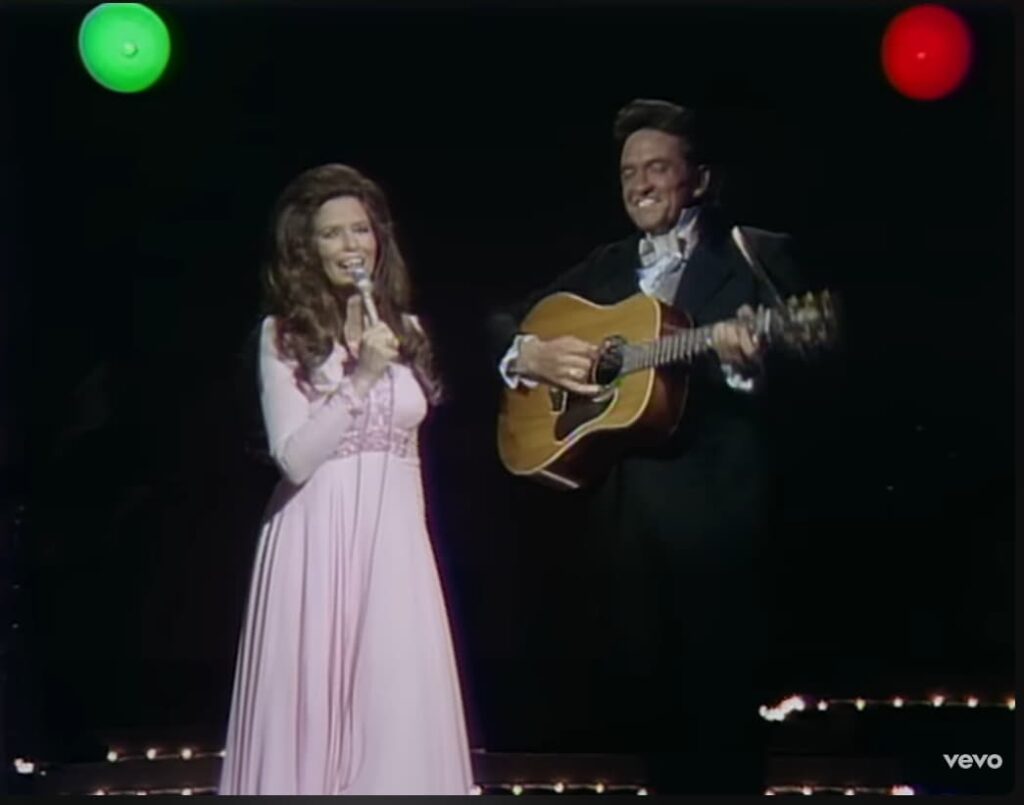
A playful duel of love and pride—where passion sparks through laughter, and two voices turn romance into a spirited conversation
When Johnny Cash and June Carter Cash performed “Jackson”—immortalized in recordings such as The Best Of The Johnny Cash TV Show—they were not simply singing a duet; they were enacting a living dialogue that blurred the line between performance and reality. Originally released in 1967, their studio version of “Jackson” became a defining moment in country music history, climbing to No. 2 on the Billboard Hot Country Singles chart and earning them a Grammy Award for Best Country & Western Performance, Duet, Trio or Group in 1968. It was a song that captured not just the sound of the era, but the very chemistry between two artists whose personal and musical lives were deeply intertwined.
Written by Billy Edd Wheeler and Jerry Leiber, “Jackson” had been recorded by other artists before, but it was the version by Johnny Cash and June Carter Cash that transformed it into something unforgettable. Their interpretation infused the song with wit, tension, and an unmistakable sense of authenticity. By the time they brought it to television audiences—particularly through The Johnny Cash TV Show (1969–1971)—the song had evolved beyond its original form. It became a signature piece, one that audiences anticipated not just for its melody, but for the dynamic exchange it promised.
At its core, “Jackson” is a conversation between two lovers standing at the edge of disillusionment. The lyrics tell of a couple whose relationship has lost its spark, each daring the other to seek excitement elsewhere—specifically in the lively, symbolic destination of Jackson. Yet beneath the playful teasing lies something deeper: a test of loyalty, a negotiation of pride, and perhaps an unspoken hope that the other will refuse to walk away.
What makes the performance so compelling is the way Johnny Cash and June Carter Cash inhabit these roles. Cash’s baritone carries a steady, almost stubborn confidence, while Carter’s delivery sparkles with humor and defiance. She does not merely respond—she challenges, teases, and ultimately matches him note for note. There is laughter in their voices, but also a subtle undercurrent of truth. This was not a fictional pairing; it was a reflection of a real relationship, with all its complexities, joys, and struggles.
The televised renditions, particularly those preserved in collections like The Best Of The Johnny Cash TV Show, add another layer to the song’s legacy. In these performances, one can see the glances, the timing, the effortless interplay that no studio recording can fully capture. The audience becomes part of the exchange, drawn into a moment that feels both spontaneous and timeless. It is here that the song transcends its structure, becoming something closer to theater—an intimate scene played out through music.
Musically, “Jackson” is deceptively simple. Its driving rhythm and straightforward arrangement provide the perfect foundation for the vocal interplay. There are no elaborate flourishes to distract from the central narrative. Instead, the focus remains firmly on the dialogue—the push and pull between two voices that know each other intimately.
Looking back, it is impossible to separate “Jackson” from the broader story of Johnny Cash and June Carter Cash. Their partnership, both personal and professional, was marked by resilience and mutual support. The song, with its blend of humor and tension, mirrors that journey. It acknowledges conflict, but it also celebrates connection—the kind that endures even when tested.
There is a certain warmth that emerges when revisiting these performances today. It is not just nostalgia for a particular era of country music, but for a way of storytelling that feels increasingly rare. Songs like “Jackson” remind us that music can be playful without losing depth, that a simple exchange can carry profound meaning, and that sometimes the most honest expressions of love are those that come wrapped in laughter.
In the end, “Jackson” endures because it feels alive. Each performance, especially those captured on The Johnny Cash TV Show, carries the sense that anything could happen—that the conversation might take a new turn, that the laughter might deepen, that the connection might reveal itself in a fleeting glance. And perhaps that is the true magic of Johnny Cash and June Carter Cash: they did not just sing songs—they lived them, right there on stage, for all to see and remember.
 Oldies Songs