
A confession wrapped in melody—where love falters, pride dissolves, and the heart quietly admits its own undoing
When Johnny Rodriguez released “Jealous Heart” in 1973, he was not simply adding another single to an already promising career—he was stepping into a lineage of country tradition that stretched back decades. The song itself was not new. Originally written by Jenny Lou Carson and popularized in 1945 by artists such as Al Morgan (whose version reached No. 1 on the Billboard charts of its time), “Jealous Heart” had long been a standard of sorrow, a lament shaped by insecurity and regret. Yet, in Rodriguez’s hands, the song found a renewed intimacy, one that resonated deeply with audiences of the early 1970s.
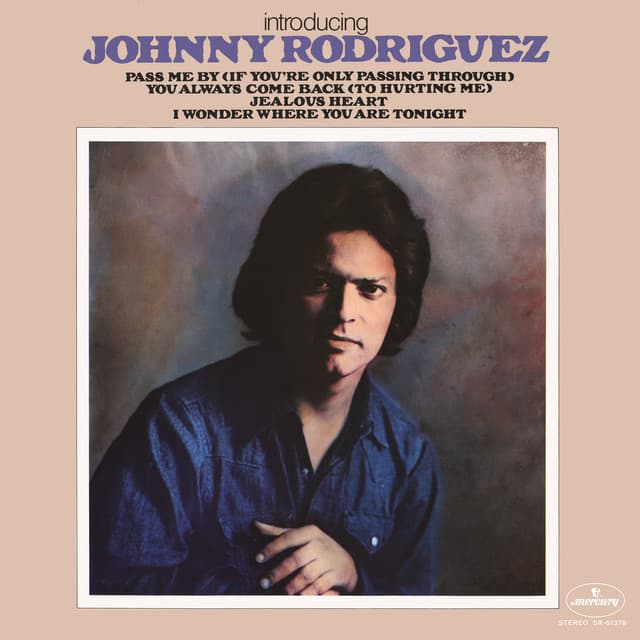
Released as part of his debut album Introducing Johnny Rodriguez, “Jealous Heart” climbed to No. 5 on the Billboard Hot Country Singles chart in 1973. This achievement was particularly significant given the remarkable momentum Rodriguez had already built with earlier hits like “Pass Me By (If You’re Only Passing Through)” and “Ridin’ My Thumb to Mexico,” both of which reached No. 1. At a time when country music was undergoing subtle transformation—balancing traditional roots with smoother, more contemporary production—Rodriguez emerged as a voice that could honor both worlds.
What makes “Jealous Heart” enduring is not its chart position alone, but the emotional clarity embedded within its lyrics. The song tells a story as old as love itself: a man undone not by betrayal, but by his own suspicion. “Jealous heart, oh jealous heart, stop beating,” the line pleads—not with anger, but with weary self-awareness. It is a moment of reckoning, where pride gives way to vulnerability, and the realization dawns that the damage inflicted may be irreversible.
Johnny Rodriguez’s interpretation is marked by a subtle restraint that elevates the song’s impact. His voice does not strain for drama; instead, it carries a quiet ache, a sense of lived experience that feels both personal and universal. There is a softness in his delivery, a careful pacing that allows each word to settle, as though he is not merely performing the song, but remembering it. This quality distinguished Rodriguez from many of his contemporaries—he understood that sometimes the most powerful expression lies in understatement.
Behind the recording lies a broader narrative about Rodriguez himself. As one of the first major Mexican-American stars in country music, his success carried cultural significance beyond the charts. Yet, he never allowed that identity to overshadow the music. Instead, he focused on storytelling—on delivering songs that spoke to shared human experiences. In “Jealous Heart,” that focus becomes evident. The song transcends background, era, and genre; it becomes a mirror in which listeners can see their own doubts and regrets reflected.
The arrangement of the track also deserves attention. Rooted in traditional country instrumentation, it avoids excess, allowing the melody and vocal to remain at the forefront. The gentle interplay of steel guitar and rhythm section creates a backdrop that feels both familiar and timeless. It is music designed not to distract, but to support—to hold the emotional weight of the story without overwhelming it.
Revisiting “Jealous Heart” today, one is struck by its enduring relevance. In a world that often encourages certainty and confidence, the song reminds us of a quieter truth: that love is often accompanied by fear, and that the greatest battles are sometimes fought within ourselves. It speaks to those moments when we recognize, perhaps too late, that our own insecurities have shaped the outcome we now regret.
There is, too, a sense of reflection that comes with time. Listening now, the song feels less like a lament and more like a confession—an acknowledgment of imperfection. And in that acknowledgment, there is a kind of grace. Johnny Rodriguez, with his measured voice and unassuming presence, does not offer solutions. He offers understanding.
In the end, “Jealous Heart” endures because it does not pretend. It does not resolve its tension neatly, nor does it seek to comfort with false reassurance. Instead, it lingers—like a thought that returns in quiet moments, like a memory that refuses to fade. And in that lingering, it finds its truth.