
A Playful Confession Across Time — When Old Standards Find New Life in a Gentle, Reflective Voice
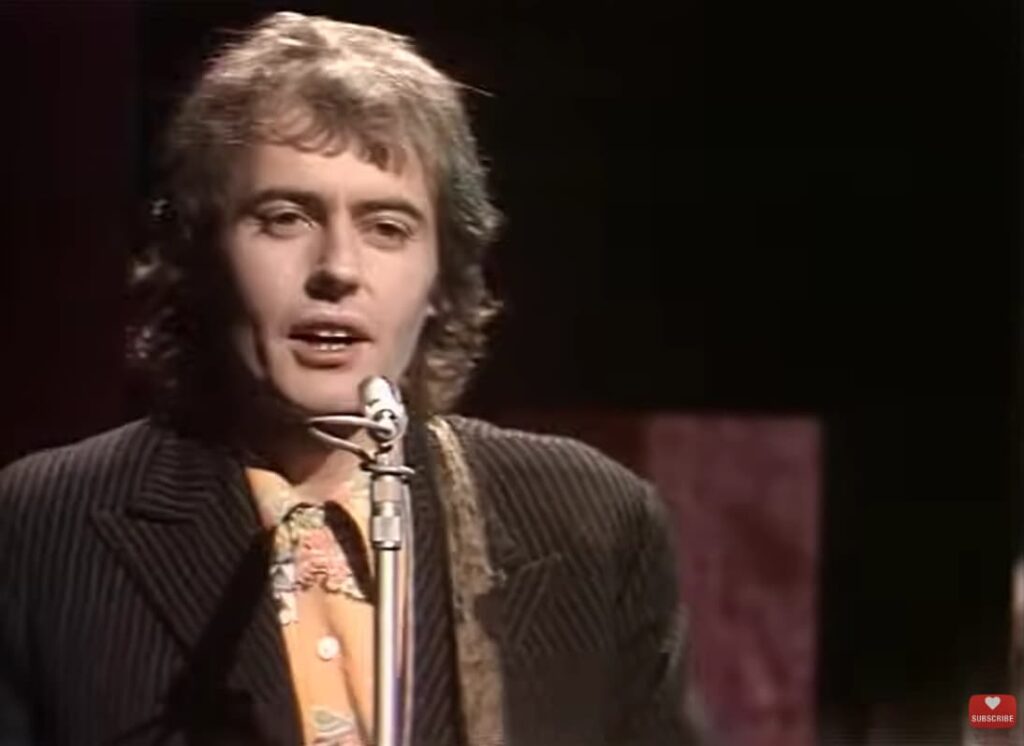
There is something quietly enchanting about hearing a familiar melody reborn in a different era, as if time itself had paused just long enough to let memory catch its breath. Such is the case with “I Get a Kick Out of You”, as interpreted by Gary Shearston during his appearance on TopPop. Though the song itself was first written in 1934 by the incomparable Cole Porter, Shearston’s rendition belongs to a later moment—one where nostalgia and reinterpretation meet in quiet harmony.
By the early 1970s, Gary Shearston had already made a name for himself as a thoughtful interpreter of folk traditions. His breakthrough came with “I Get a Kick Out of You” in 1972, a single that achieved notable chart success, reaching No. 6 on the UK Singles Chart and also performing strongly in Australia. This was no small feat, considering the song’s origins in the sophisticated world of 1930s Broadway. For Shearston to carry it into the contemporary charts of the 1970s speaks volumes about both the timelessness of the composition and the sincerity of his delivery.
Unlike the urbane, often theatrical interpretations by earlier artists such as Frank Sinatra, Shearston approaches the song with a kind of understated humility. His version strips away the polished glamour, replacing it with a folk sensibility that feels almost conversational. It is less about dazzling the listener and more about inviting them into a shared reflection. On TopPop, this quality becomes even more apparent. There is no grand spectacle—just a voice, a melody, and a quiet understanding of the song’s emotional core.
The lyrics of “I Get a Kick Out of You” have always carried a playful irony. Cole Porter, known for his wit and elegance, crafted a song that juxtaposes indulgence and restraint, excitement and simplicity. The “kick” in the song is not found in excess, but in the presence of someone deeply cherished. In Shearston’s hands, this irony softens into something more contemplative. The humor remains, but it is tinged with a sense of lived experience, as though the singer has come to understand the deeper truth behind those clever lines.
There is also a broader cultural context to consider. The early 1970s were marked by rapid change in popular music—rock was evolving, folk was transforming, and new genres were emerging. Amid this shifting landscape, Shearston’s choice to revisit a classic American standard feels almost like an act of quiet resistance. It suggests a belief that some songs do not belong to any one time, but rather exist as enduring companions to human emotion.
The performance on TopPop captures this sentiment beautifully. The setting, modest and unpretentious, allows the focus to remain entirely on the music. One can almost sense the audience listening not just with their ears, but with their memories. The familiar melody becomes a bridge between generations, connecting the elegance of the 1930s with the introspection of the 1970s.
Behind this rendition lies a subtle narrative about interpretation itself. Every artist who sings “I Get a Kick Out of You” brings something of themselves to it. For Shearston, that “something” is a quiet sincerity—a willingness to let the song breathe, to let its meaning unfold without embellishment. It is a reminder that great music does not need to be reinvented to remain relevant; it simply needs to be understood.
In the end, what lingers is not just the melody, but the feeling it leaves behind. A gentle warmth, a faint smile, perhaps even a moment of introspection. Gary Shearston does not attempt to outshine the song’s legacy. Instead, he walks alongside it, offering a version that feels both respectful and deeply personal.
And in doing so, he reminds us that sometimes, the simplest expressions of joy—the quiet “kick” of being near someone who matters—are the ones that endure the longest, echoing softly through the years.