
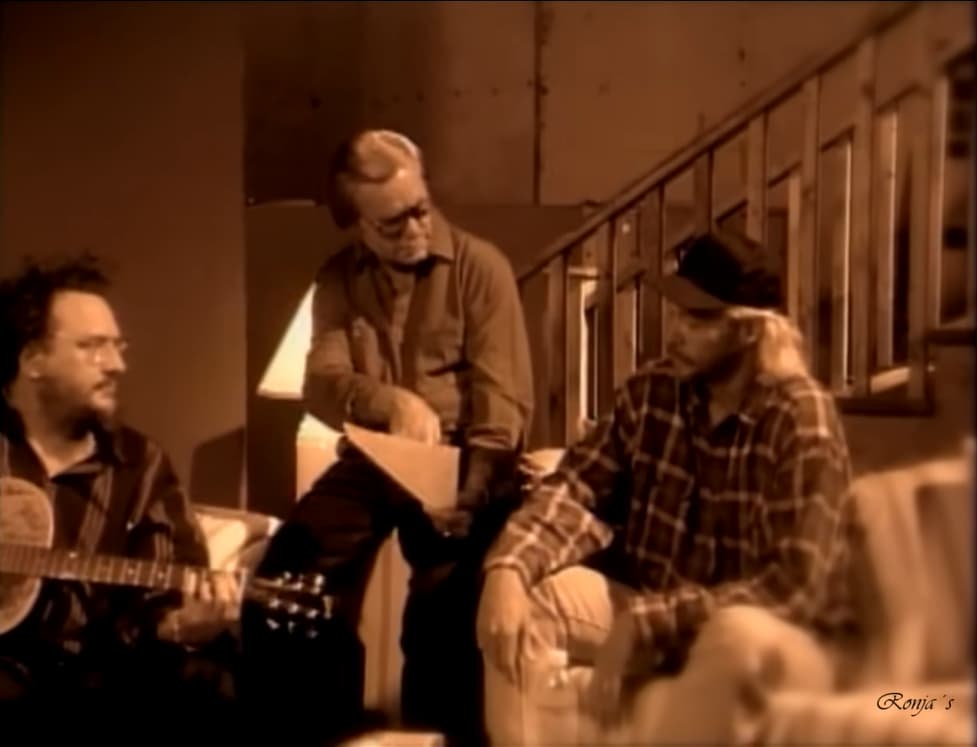
A quiet reckoning after love fades—where silence speaks louder than heartbreak, and memory lingers like dust in an empty room
When George Jones and Alan Jackson joined voices on A Good Year for the Roses, they did more than revisit a classic—they preserved a fragile emotional landscape that had already stood the test of time. Originally recorded by Jones in 1970 and released on his album George Jones with Love, the song climbed to No. 2 on the Billboard Hot Country Singles chart, becoming one of the most quietly devastating recordings of his career. Written by Jerry Chesnut, it remains a masterclass in restraint, where heartbreak is not shouted, but whispered through the cracks of ordinary life.
By the time this duet version with Alan Jackson emerged—most notably featured on Jones’ 1994 album The Bradley Barn Sessions—the song had already taken on the weight of legacy. Yet Jackson’s presence does not overshadow; instead, it deepens the narrative. His voice, steady and reflective, feels like a continuation of the same story told years later, as though time itself had added new layers of understanding to the original sorrow.
At its core, “A Good Year for the Roses” is not a song about dramatic endings. There are no slammed doors, no raised voices. Instead, it unfolds in the quiet aftermath of a love that has simply… slipped away. The narrator walks through a house filled with absence—her absence—taking note of the small, almost mundane details left behind. A few clothes in the closet. Some personal items forgotten. And outside, the roses bloom more beautifully than ever, indifferent to the human heartache unfolding within.
That contrast is where the song finds its deepest meaning. Life goes on, nature flourishes, and yet inside, something has ended. The line between the external world and internal emotion becomes painfully clear. The roses do not mourn; they thrive. And in that quiet irony, the listener is left to sit with a truth that feels both simple and profound: not all endings come with closure.
George Jones, often referred to as one of the greatest voices in country music, brings an unmatched authenticity to the song. His phrasing is deliberate, almost conversational, as if he is thinking aloud rather than performing. There is a weariness in his tone, a sense that the story he tells is not unfamiliar to him. It is this lived-in quality that makes the original recording so enduring.
When Alan Jackson joins in, there is a subtle shift—not in mood, but in perspective. Jackson has long been known for his deep respect for traditional country music, and here, he approaches the song with reverence rather than reinterpretation. His voice blends seamlessly with Jones’, creating a dialogue that feels less like a duet and more like two reflections of the same soul at different points in time.
Musically, the arrangement remains understated, allowing the storytelling to take precedence. The gentle steel guitar, the soft rhythm section—everything serves the narrative without drawing attention away from it. This simplicity is not accidental; it is essential. In a song where silence carries as much weight as sound, every note must be carefully placed.
Listening to this duet is like walking through a familiar room long after it has been emptied. The echoes remain, subtle but persistent. It invites reflection—not just on lost love, but on the quiet moments that define it. The things unsaid, the gestures unnoticed, the memories that linger in unexpected corners.
In the end, “A Good Year for the Roses” is not just a song—it is an experience. It reminds us that heartbreak does not always arrive with thunder. Sometimes, it settles in softly, like dust on a windowsill, unnoticed until the light hits it just right. And in that light, we see not only what was lost, but what once was—brief, beautiful, and gone too soon.