
A love story revisited in fragments, where every melody carries the echo of something once whole, now remembered in pieces
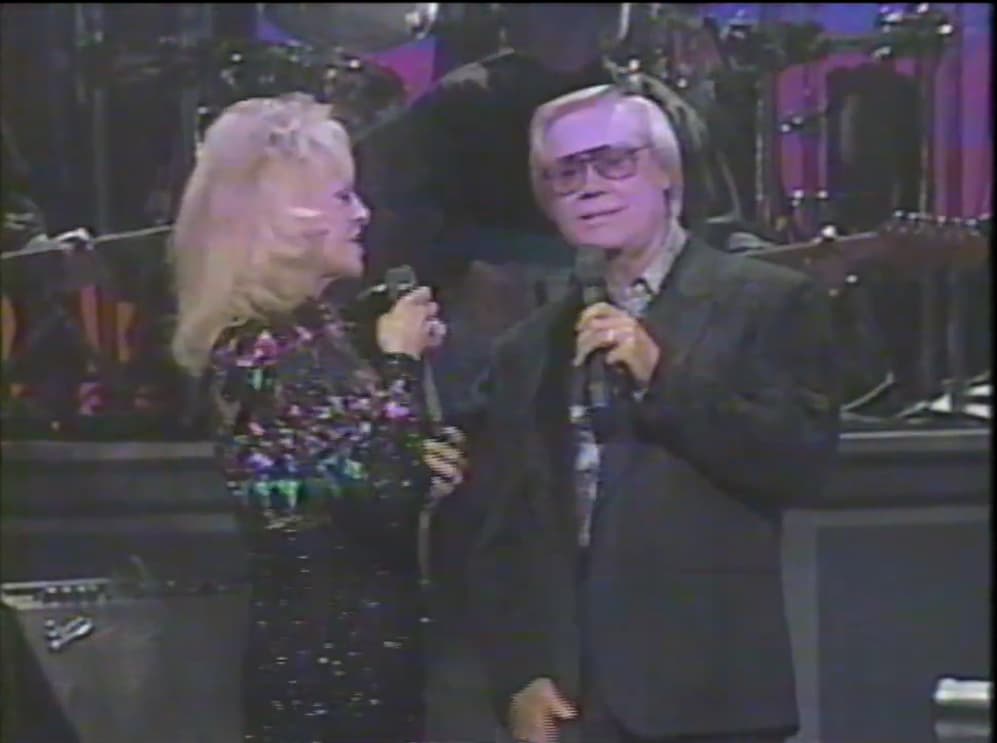
When George Jones and Tammy Wynette stepped onto the stage at the CMA Awards in 1995 to perform a medley of “Golden Ring,” “One,” and “They’re Playing Our Song,” it was not merely a performance. It was a quiet reckoning with a shared past that had long since moved beyond resolution. By then, both artists had already secured their places in country music history, their duet recordings from the 1970s having left an enduring mark on the genre. Among them, “Golden Ring”, released in 1976, had reached No. 1 on the Billboard Hot Country Singles chart, becoming one of their most recognized collaborations, while “Near You” and “We’re Gonna Hold On” had also topped the charts, reinforcing their status as one of country music’s most compelling duos.
But numbers, as significant as they are, only tell part of the story. What unfolded on that stage in 1995 carried something far more difficult to measure. The choice of songs itself felt deliberate. “Golden Ring” tells the story of a marriage that begins with promise and ends in quiet dissolution, its circular imagery reflecting the fragile nature of commitment. “One”, more subdued, speaks to the loneliness that can exist even in proximity, while “They’re Playing Our Song” brings forth the bittersweet recognition of a love that lingers long after it has ended. Together, these songs form a narrative that mirrors the real life relationship between George Jones and Tammy Wynette, a relationship marked by passion, turbulence, separation, and an enduring emotional connection that neither time nor distance seemed able to erase completely.
There is something striking in the way they delivered these songs that night. There was no attempt to dramatize what was already deeply understood. Their voices, older now, carried a different kind of weight. The youthful urgency that once defined their recordings had softened into something more reflective, more measured. Each line felt less like a performance and more like a recollection, as though the songs themselves had become a language through which they could revisit what could no longer be spoken directly.
The CMA Awards stage, typically a place of celebration and forward looking recognition, became in that moment a space of quiet reflection. The audience was not simply witnessing two legendary artists revisiting their catalog. They were witnessing a conversation that had been unfolding for decades, now distilled into a few carefully chosen songs. It is rare in popular music to see such a direct intersection between life and art, where the boundary between the two becomes almost invisible.
What makes this medley particularly powerful is its restraint. There are no grand gestures, no overt acknowledgments of the past. Instead, the meaning resides in the subtle exchanges, in the pauses between lines, in the way their voices meet and then move apart again. It is in these small details that the performance finds its emotional depth.
By 1995, country music itself was changing, moving toward a more polished and commercially expansive sound. Yet this moment stood apart from those shifts. It reached backward, not in resistance, but in recognition. It reminded listeners that the genre’s most enduring strength lies in its ability to tell the truth, even when that truth is complicated, unresolved, or quietly painful.
In the end, the medley performed by George Jones & Tammy Wynette at the CMA Awards 1995 becomes more than a revisiting of past hits. It becomes a reflection on time itself. On how certain stories never fully conclude, but instead remain present, evolving in meaning as years pass. And perhaps that is why it continues to resonate. Because it does not offer closure. It offers something far more honest, the understanding that some connections, no matter how changed, never truly disappear. They simply find new ways to be remembered.