
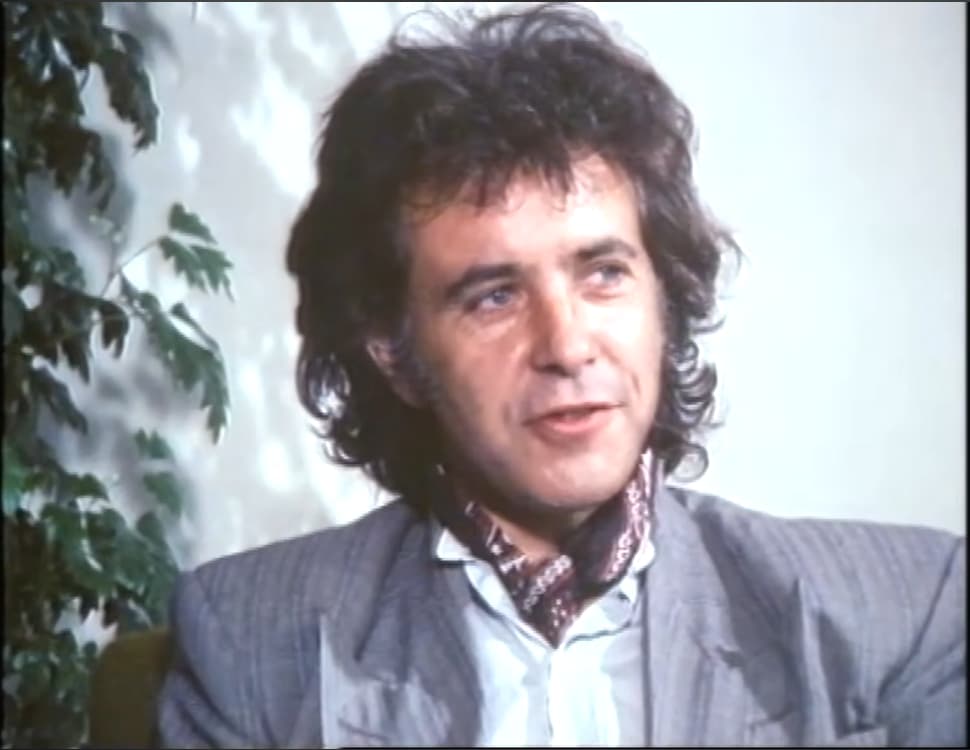
In Ireland in 1985, David Essex looked back on the extraordinary road that had taken him from a young drummer to one of Britain’s most recognisable stars, while revealing why he never wanted to be confined to just one kind of career.
The 1985 Irish television interview with David Essex offers something far more revealing than a simple conversation with a pop star promoting his latest work. Broadcast on RTÉ’s Video File on August 9, 1985, the interview found Essex speaking with presenter Marty Whelan while visiting Ireland for concerts in Dublin and Belfast. By that point, David Essex had already spent more than a decade at the centre of British popular culture. He was known not only for hit records but also for his work in theatre, film and television. What makes the interview so fascinating today is the relaxed way he discusses that journey, almost as if he is still slightly surprised by the many directions his life had taken.
By 1985, David Essex was already a familiar face to millions. His breakthrough had come through the stage musical Godspell, where his performance helped turn him into a major star before he became a chart sensation with “Rock On” in 1973. The song became a defining moment in his career, reaching No. 3 in the UK and later becoming an even bigger success in America, reaching No. 5 on the Billboard Hot 100. Then came “Gonna Make You a Star,” which reached No. 1 in the UK in 1974, followed by another No. 1, “Hold Me Close,” in 1975. Yet listening to Essex speak in the Irish interview, fame does not seem to be the centre of his story. Instead, he talks about the pleasure of variety, the ability to move between different forms of creative work and never remain trapped in one role.
One of the most revealing parts of the conversation concerns his beginnings. Before becoming a singer, Essex had played drums in show bands, an experience he credited with teaching him about rhythm and timing. He later spent time in Italy before returning to England and stepping out from behind the drum kit to become a frontman. It was a journey with no obvious map, and perhaps that uncertainty became one of the most important parts of his character as an artist. Essex never appeared entirely comfortable with being labelled simply as a pop singer. Theatre gave him his first major breakthrough, music made him a household name, and film offered him yet another creative world.
During the interview, Essex also reflects on Stardust, the 1974 film in which he played the troubled rock star Jim MacLaine. The role had a particularly deep effect on him because the character’s rise and fall mirrored the darker side of fame itself. Jim achieves everything he believes he wants, only to discover how quickly success can become destructive. For an artist who had experienced the sudden hysteria surrounding his own rise to fame, the role must have felt uncomfortably close to reality. Essex describes the character as painful to play, and that honesty gives the interview an unexpected depth.
There is also something wonderfully human about watching David Essex in 1985. The glamorous young star of the early 1970s was still unmistakably handsome and charismatic, but there was already a greater calmness in the way he spoke. He had lived through the madness of pop stardom, seen hit records come and go, and discovered that a long career required more than chasing the next chart position. He speaks about travelling, performing and exploring different creative opportunities with the curiosity of someone who still enjoys the journey.
The interview remains a beautiful snapshot of David Essex at a crucial point in his career. He was no longer simply the young man singing “Rock On” with wild ambition, yet he had not become a figure looking only backward at his greatest years. In 1985, he was still moving, still performing, still searching for the next interesting place to take his talent. That may be the most striking thing about the conversation. Behind the famous face and the hit records was an artist who seemed to understand that success was not a destination. It was simply one part of a much longer road.