
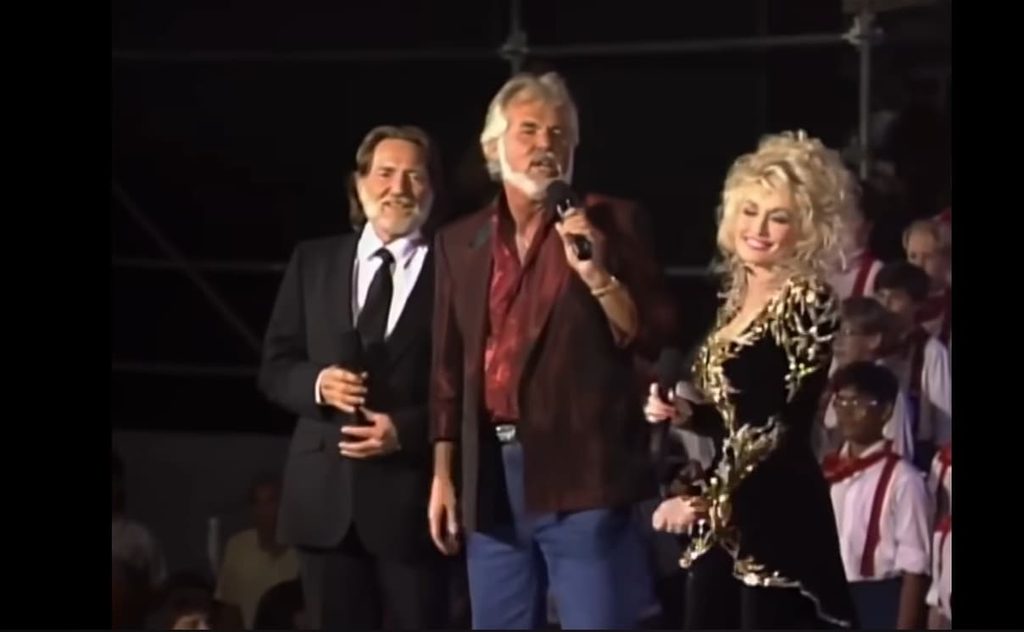
When Dolly Parton, Kenny Rogers, and Willie Nelson sang “Something Inside So Strong,” three of country music’s most distinctive voices came together to give a song of resistance, courage, and hope an entirely new emotional life.
In 1989, Dolly Parton, Kenny Rogers, and Willie Nelson joined forces for one of the most memorable moments in the television special Kenny, Dolly and Willie: Something Inside So Strong. The Emmy winning NBC special was filmed at the Johnson Space Center in Houston, Texas, before an audience of NASA employees and their families, and was broadcast in the United States on May 20, 1989. The setting itself added something remarkable to the evening. Against the history of the American space programme, three artists whose careers had already carried them to extraordinary heights stood together and performed music that spoke about reaching beyond barriers and refusing to surrender. The special featured many familiar songs, including “The Gambler,” “9 to 5,” “Coat of Many Colors,” “On the Road Again,” “Islands in the Stream,” and “Real Love,” but the title song brought all three stars together for a powerful performance of “Something Inside So Strong.”
The song itself had already become internationally known before Kenny Rogers made it the title of his 1989 album Something Inside So Strong. It was written by British singer and songwriter Labi Siffre, who released the original recording in 1987. Siffre wrote the song as a statement against oppression, drawing inspiration from the struggle against apartheid in South Africa and the wider experience of people who had been denied their rights. The lyrics speak directly to those who attempt to build barriers around others, deny them dignity, or silence them through fear. Yet the song refuses to answer oppression with despair. Its central message is one of inner strength: no matter how powerful the forces standing against you may seem, there can remain something inside that refuses to be broken.
For Kenny Rogers, the song represented an interesting choice at a time when his career was moving into a new chapter. His album Something Inside So Strong was released on May 2, 1989, and was produced by Jim Ed Norman and Steve Dorff. By then, Kenny had already become one of the biggest crossover stars in popular music, with classics such as “Lucille,” “The Gambler,” “Lady,” and “Islands in the Stream” behind him. The album featured several major collaborations, including duets with Gladys Knight, Anne Murray, Holly Dunn, and Ronald Isley, while its singles included “When You Put Your Heart in It,” “Planet Texas,” “The Vows Go Unbroken,” and “Maybe.” Yet the title song carried a different kind of weight. It was not built around romance or nostalgia. It was a declaration of endurance, and that message became even more powerful when Kenny invited Dolly and Willie to share it with him.
What makes the performance so fascinating is the extraordinary contrast between the three voices. Dolly Parton brings brightness and emotional clarity, her voice rising above the arrangement with the unmistakable purity that had carried songs such as “Jolene,” “I Will Always Love You,” and “Coat of Many Colors” into the hearts of millions. Kenny Rogers provides the steady centre, his warm and weathered voice giving the words a sense of experience. Then there is Willie Nelson, whose unmistakable phrasing makes every line sound as though it has travelled a long road before arriving at the microphone. Individually, their voices could not be more different. Together, they create something richer because the song does not demand perfection. It demands belief.
There is also something deeply symbolic about seeing these three artists standing together in 1989. Each had travelled a different road through country music. Dolly had moved from the Smoky Mountains to international superstardom without ever losing the storytelling spirit of her roots. Kenny had travelled through jazz, rock, folk, pop, and country before becoming one of the defining voices of the crossover era. Willie had spent decades refusing to fit comfortably inside the boundaries of the Nashville establishment, eventually becoming the great symbol of country music independence. When they sang “Something Inside So Strong,” the words seemed to gather new meaning simply because of who was singing them.
The song was never about chart success for this particular trio performance, and that distinction matters. Kenny Rogers’ version belonged to his 1989 album and television project, while the performance by Dolly, Kenny, and Willie was a special live collaboration rather than a separately released chart single. Its importance lies in the moment itself: three legendary artists taking a song born from resistance and turning it into something warm, human, and unexpectedly intimate. There were no complicated vocal tricks and no need for a grand spectacle. The power came from three recognisable voices joining together around a message that was already larger than any one of them.
Looking back now, the performance feels even more moving because of the history surrounding the three singers. They had shared stages, songs, television specials, friendships, and decades of musical history. Kenny Rogers and Dolly Parton had already created one of the most successful partnerships in popular music, while Willie Nelson had become a friend and fellow traveller in the world of country music. The 1989 special allowed audiences to see them not as isolated stars performing their own greatest hits, but as musicians enjoying one another’s company and sharing the songs that had shaped their lives.
“Something Inside So Strong” remains one of those performances that grows in meaning with time. The song speaks about barriers, injustice, and the refusal to surrender, but when sung by Dolly Parton, Kenny Rogers, and Willie Nelson, it also becomes something quieter. It becomes a reminder that strength does not always arrive with noise. Sometimes it is simply the voice that remains when everything else has changed, the courage to keep standing, and the faith that somewhere deep within us there is still something that refuses to let go.