
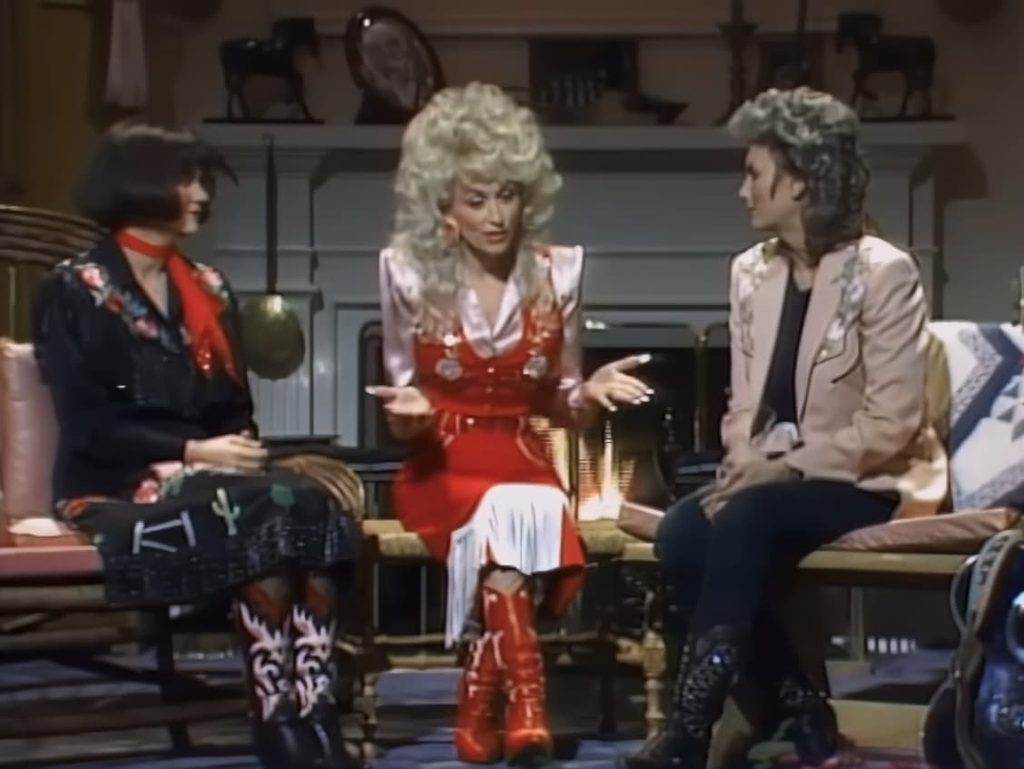
“My Dear Companion” brought Dolly Parton, Emmylou Harris, and Linda Ronstadt together around a song of heartbreaking loss, proving that three extraordinary voices could make an old Appalachian sorrow feel painfully alive again.
On October 11, 1987, Dolly Parton, Emmylou Harris, and Linda Ronstadt appeared together on Dolly’s ABC television series Dolly to perform songs from their celebrated collaborative album Trio. The album had been released earlier that year, on March 2, 1987, after nearly a decade of hopes, abandoned sessions, and repeated attempts to bring the three friends into the studio together. Their appearance on the third episode of the series gave television audiences a rare opportunity to see the three women perform side by side, not as competing stars but as three voices woven into one musical fabric. Among the songs they performed was the haunting “My Dear Companion,” written by the great Appalachian folk singer Jean Ritchie. It was not released as a charting single, so it had no individual chart position, but Trio itself became a major success, reaching No. 1 on Billboard’s Top Country Albums chart and climbing to No. 6 on the Billboard 200. The album also earned enormous critical recognition and went on to sell millions of copies, proving that traditional acoustic music could still find a wide audience in the late 1980s.
The story of “My Dear Companion” reaches much further back than the bright television lights of 1987. Jean Ritchie, often remembered as one of the most important voices in the preservation of Appalachian folk music, wrote the song in the tradition of the old mountain ballads she had grown up hearing in Kentucky. The song is built around the voice of a woman searching for the person she loves after learning that he has gone away to a distant place and may no longer care for her. There is no anger in the song, only loneliness. The narrator wishes she could fly away like a bird and search for him, while the world around her seems to have turned cold and distant. The imagery is simple, but that simplicity is precisely where the song finds its power. It speaks of separation in the old folk tradition, where mountains, birds, darkness, water, and silence often carry emotions too painful to explain directly. On Trio, Emmylou Harris took the lead vocal, while Dolly Parton and Linda Ronstadt surrounded her with harmonies that gave the song an almost ghostly beauty. The recording was supported by acoustic musicians including Albert Lee on mandolin, David Lindley on autoharp, Kenny Edwards on bass, and Mark O’Connor, creating an arrangement that remained faithful to the song’s mountain roots.
What makes the 1987 television performance so unforgettable is the contrast between the three singers and the remarkable way those differences disappear when they begin to sing together. Dolly Parton brought the unmistakable sound of East Tennessee and the Appalachian traditions that had shaped her earliest musical life. Emmylou Harris possessed a voice capable of carrying loneliness with almost no effort, while Linda Ronstadt, who had travelled effortlessly through rock, country, Mexican music, and American standards, brought a clarity that made every harmony shine. Their friendship had existed for years before Trio finally became a reality. They had first attempted to record together in 1978, but the sessions were abandoned because the project had not yet found the right musical direction. Almost ten years later, they returned to the idea with producer George Massenburg, and this time everything seemed to fall into place. The three women deliberately moved toward acoustic instruments, traditional songs, and close harmony singing, creating an album that sounded less like a commercial supergroup project and more like three old friends sitting together and singing the music they loved most.
Watching “My Dear Companion” today, there is something deeply moving about the absence of excess. No elaborate stage production is needed. No singer tries to overpower the others. The beauty lies in the restraint. Emmylou Harris carries the sadness at the centre of the song, while Dolly and Linda answer her with harmonies that seem to rise from somewhere beyond the stage itself. For a few minutes, the performance feels almost timeless. The song could belong to 1987, to the Kentucky mountains of Jean Ritchie’s childhood, or to any earlier generation that understood what it meant to lose someone without ever truly understanding why they had gone.
Perhaps that is the lasting beauty of “My Dear Companion.” Dolly Parton, Emmylou Harris, and Linda Ronstadt were three of the most successful women in American popular music, yet they chose to stand together and sing a quiet song about loneliness and loss. They did not need a No. 1 single to make the moment important. Their voices carried the song where chart statistics could not. In the harmony of those three women, an old Appalachian lament became something more than a song from the past. It became a memory of love, a search for someone who is no longer there, and a reminder of how deeply a simple melody can stay with us long after the final note has disappeared.